
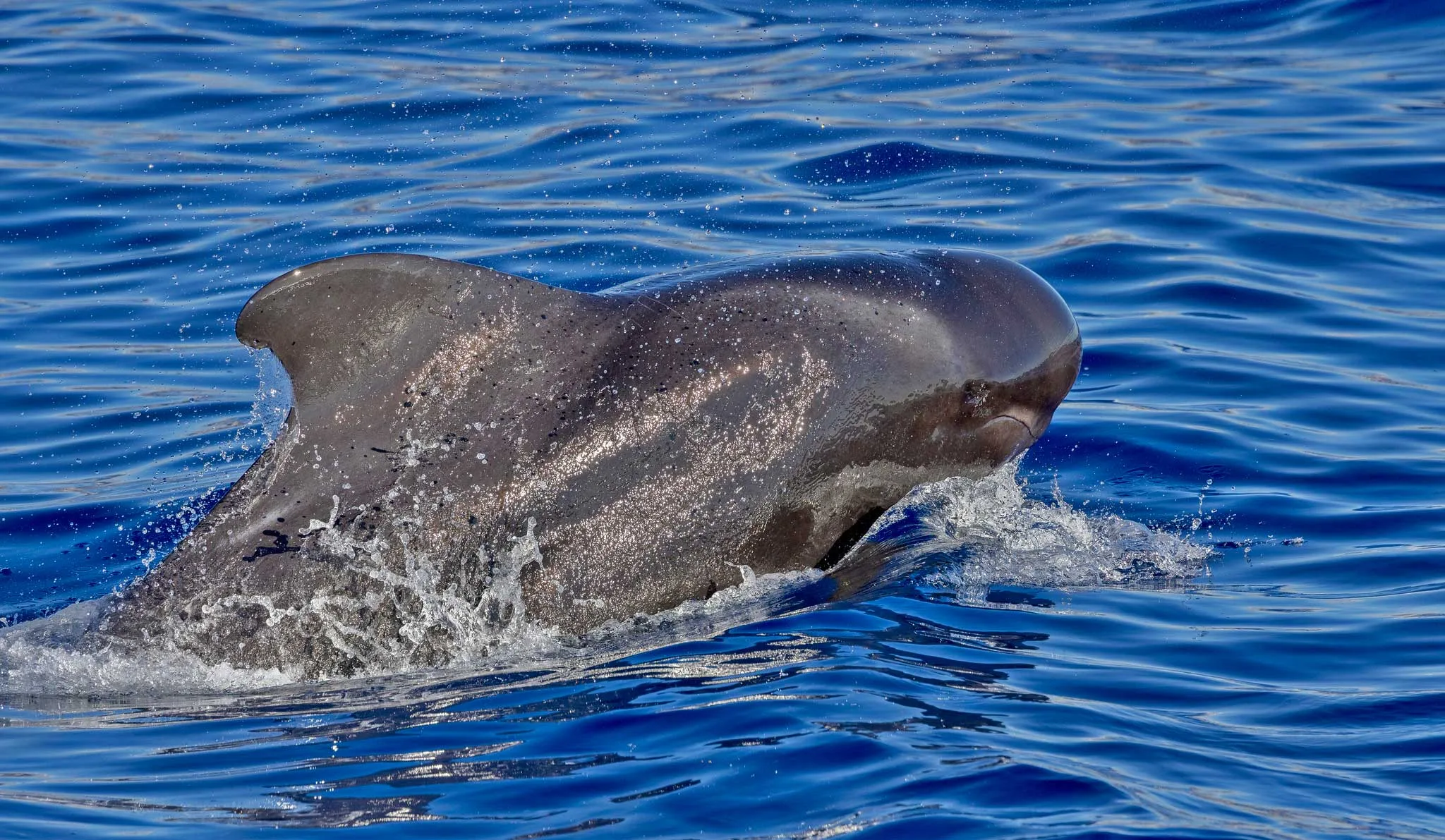
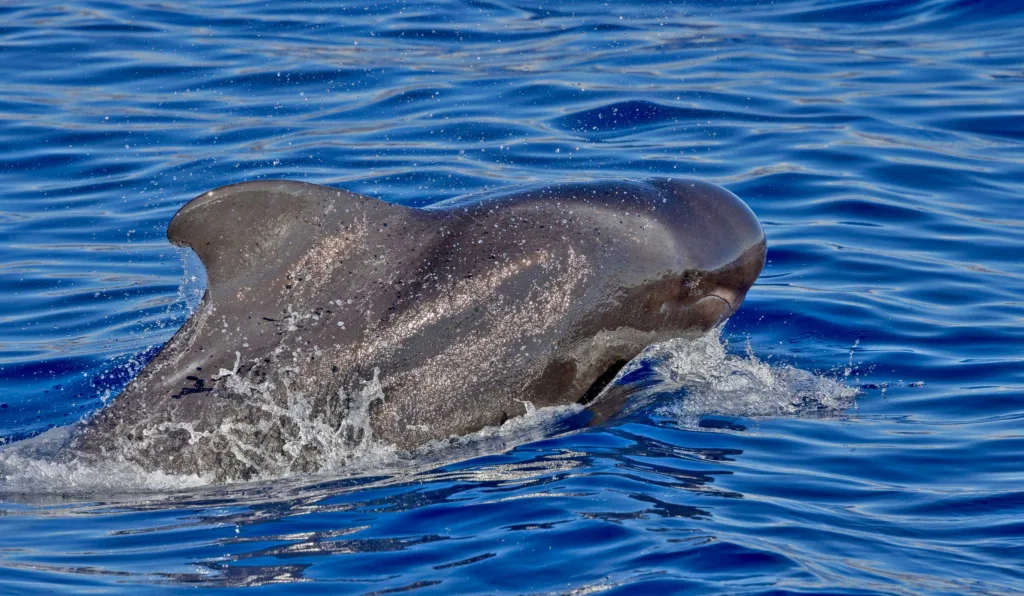
In the sapphire depths beyond the sun-drenched atolls of the Maldives, a silent migration unfolds every spring. While the world celebrates the archipelago for its shallow lagoons, a mysterious drama plays out along the steep, vertical walls of the outer reef slopes. Here, the short-finned pilot whale (Globicephala macrorhynchus)—known as the “cheetah of the deep sea”—reigns supreme.
The Great Spring Arrival
For decades, researchers have noted a rhythmic pulse in the Maldivian cetacean population. Every year, as the calendar turns to late March, pilot whales make a “sudden arrival” in the central atolls near Malé. Historical data from a 12-year study reveals that sightings surge from 0.12 per day in early March to 1.19 per day by early April.
Recent findings from the Maldives Dolphin ID Project (2024–2025) reinforce this ancient pattern, documenting pods migrating northward along the eastern boundaries of the atolls during the first months of the year. These modern records have even identified individual whales—nicknamed “Grinch,” “Frank,” and “Nunis”—who have been spotted together over the course of six years, suggesting incredibly precise and stable migration routes along our shores.
Masters of the Abyss
Why do these giants—males can reach nearly 7.2 meters in length—hug the treacherous outer slopes of our islands? The answer lies in the darkness below. Pilot whales are specialized teuthivores (squid-eaters).
They earned their “cheetah” nickname through high-speed, energetic sprints at the end of deep dives to capture fast-moving prey. While they typically forage at depths of 300 to 600 meters, some GPS-tracked individuals in recent years have been recorded reaching depths of over 1,100 meters. The Maldives’ steep reef slopes act as a concentrated pantry for the cephalopods they depend on.
A Social Tapestry: The “Granny” Effect
Pilot whales are defined by their loyalty, living in stable, matrilineal groups where females often stay in their birth pods for their entire lives.
- The Pod Structure: Average schools in the Maldives consist of about 18 individuals, though “mega-pods” can occasionally reach 100 or more.
- The Wisdom of Grandmothers: They are one of the few non-human species—alongside orcas and humans—to go through menopause. Post-reproductive “grandmother” whales play a critical role in the pod’s survival, using their long-term memory to lead the family to food when resources are scarce.
- Acoustic Dialects: Recent research has discovered that different pilot whale families use distinct vocal dialects, much like human languages, to maintain pod cohesion.
The Interspecies Dance
The Maldivian slopes are a crowded theater. Pilot whales are frequently seen in the company of bottlenose dolphins and Fraser’s dolphins. In a display of interspecies cooperation, Fraser’s dolphins—which are naturally faster—have been observed “loitering” specifically to allow the slower-moving pilot whales to catch up.
However, life on the slope isn’t always harmonious. Risso’s dolphins, who compete for the same squid, have been documented behaving aggressively toward pilot whales, using tail-slapping and breaching to displace them from choice feeding grounds.
Conservation: A Silent Watch
As of 2026, the short-finned pilot whale is classified globally as Least Concern by the IUCN, but they face mounting modern threats. In the Maldives, they are sensitive to ocean noise from shipping and seismic surveys, which can disrupt their delicate echolocation and lead to tragic mass strandings. Their intense social bonds mean that if a leader becomes disoriented or ill, the entire loyal pod may follow them into shallow waters.