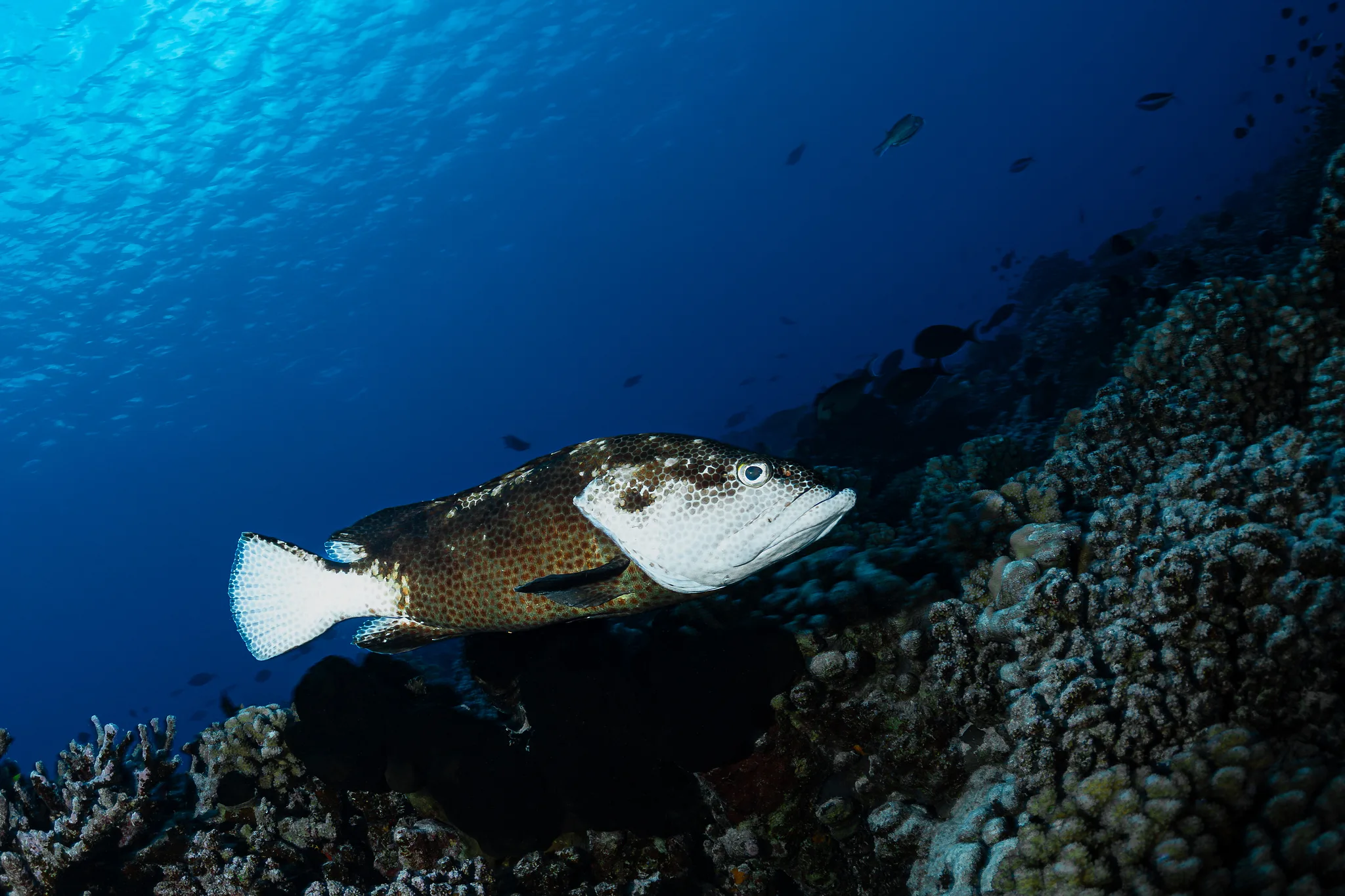
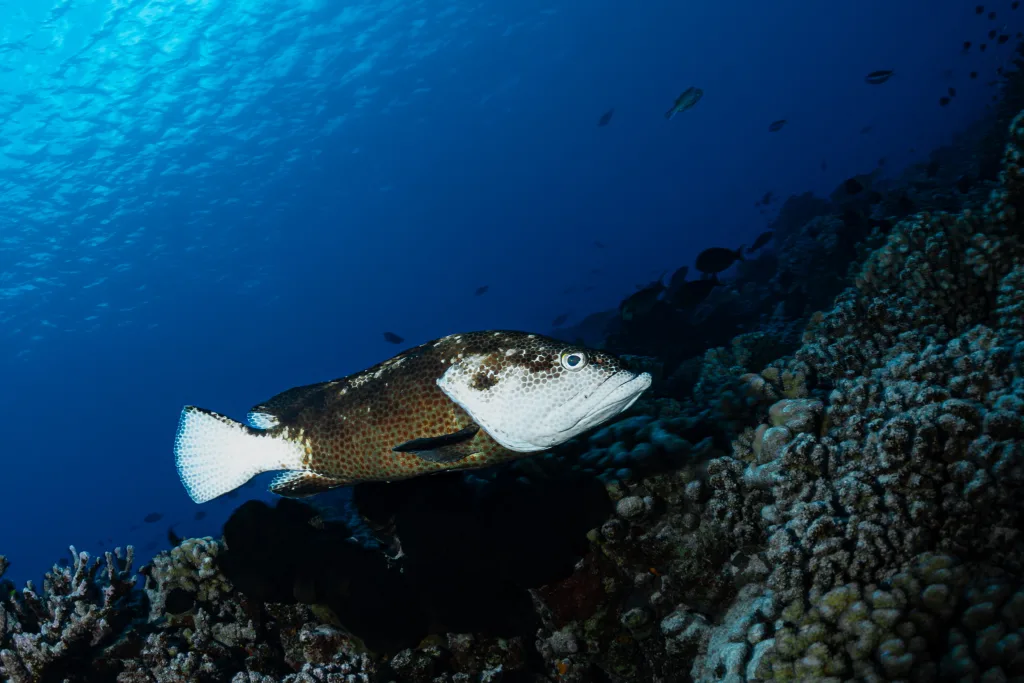
Deep within the intricate coral architecture of the Indo-Pacific resides a predator defined not by its ubiquity, but by its sheer biological endurance. While the Greasy Grouper (londhi faana) remains a rare sight in Maldivian waters, its reputation as a culinary prize and a marvel of aquaculture has made it a titan of the regional blue economy.
a ghost on the reef
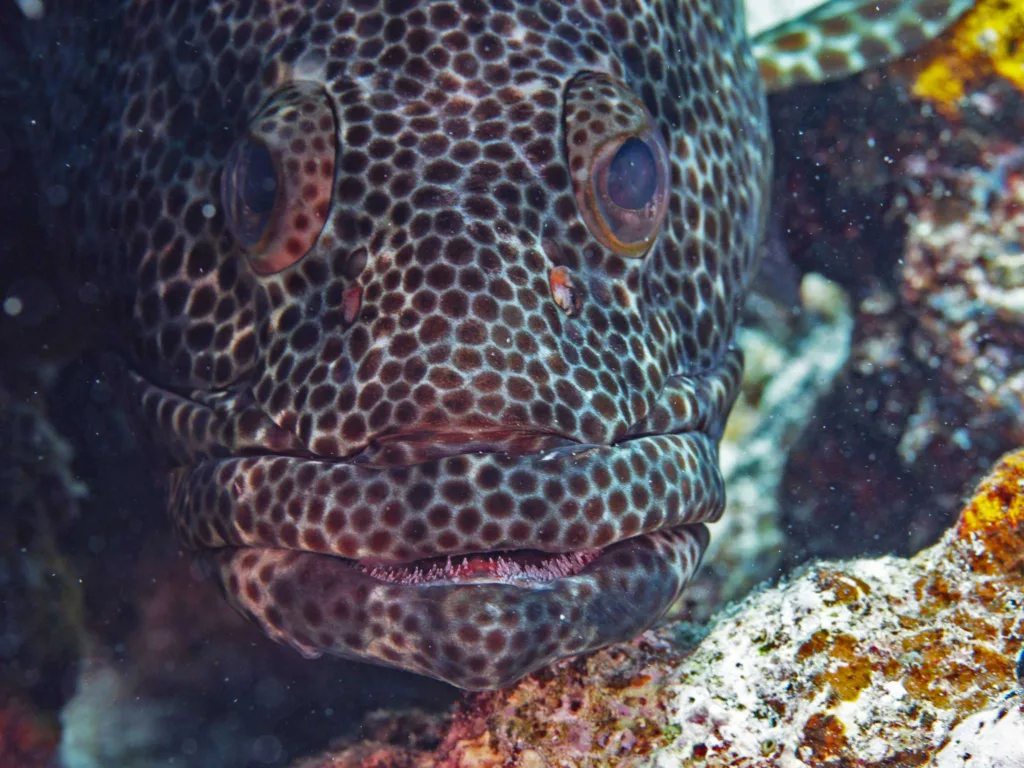
In the Maldives, the species is known locally as Londhi faana. It is a creature of shadows and structure, a powerful serranid that haunts depths ranging from sun-drenched reef flats to the dim, high-pressure environments 50 meters below the surface.
For the Maldivian fisher, an encounter with Epinephelus tauvina is a noteworthy event. Though not as abundant as other groupers, it is prized for its firm, flavorful flesh. In a world where natural stocks are under increasing pressure, the Londhi faana has become a symbol of a shifting tide—where the wild reef meets the controlled environment of captivity.
the anatomy of a specialist
The Greasy Grouper is built for the ambush. Its compact, muscular frame—measured at 3.0 to 3.6 times its standard length—allows for explosive bursts of speed.
Marine Species
Greasy Grouper
| Scientific Name | Londhi faana Epinephelus tauvina |
| ID Marker | Brown-grey with orange-brown spots. Long maxilla extending past the eye; rounded caudal fin; cycloid scales with a small naked patch near the pectoral fin. |
| Habitat | Juveniles in reef flat tide pools; adults on coral slopes and deep reef structures down to 50m. |
| Biology | Resilient predator reaching 75 cm. Highly valued in aquaculture due to rapid growth and tolerance to confinement. |
Its appearance is a masterclass in camouflage. Draped in a palette of brown-grey, it is adorned with a galaxy of orange-brown spots that blur its silhouette against mottled coral and sand. Its most telling predatory feature is the maxilla; extending far beyond the eye, it allows for a massive gape, ensuring that once prey is targeted, escape is nearly impossible.
From the tide pools to the abyss
The life cycle of the Londhi faana is a journey of increasing depth.
- The Nursery: Juveniles are often found in the precarious environment of tide pools on reef flats. Here, they navigate fluctuations in temperature and oxygen, honing their survival instincts.
- The Hunting Grounds: As they mature, they migrate to coral slopes. As apex residents, they feed primarily on smaller fish, serving as a critical check and balance within the reef’s complex food web.
The Aquaculture Revolution
Perhaps the most fascinating chapter of the Greasy Grouper’s story is its resilience. Despite its somewhat unglamorous English name, its “greasy” texture is actually a sign of the healthy fats that make it a premium food source.
Because the Londhi faana is exceptionally hardy and tolerant of confinement, it has become a cornerstone of intensive cage culture. In nations where wild populations have dwindled, this fish thrives in captivity, growing rapidly and providing a sustainable alternative to reef harvesting.
The Londhi faana remains a testament to the reef’s hidden treasures—a rare, spotted sentinel that bridges the gap between ancient Maldivian tradition and the future of global food security.
Source: M.R.S. (1997) Fishes of the Maldives. Marine Research Section, Ministry of Fisheries and Agriculture, Republic of Maldives. 408 pp. ISBN: 99915-62-12-5