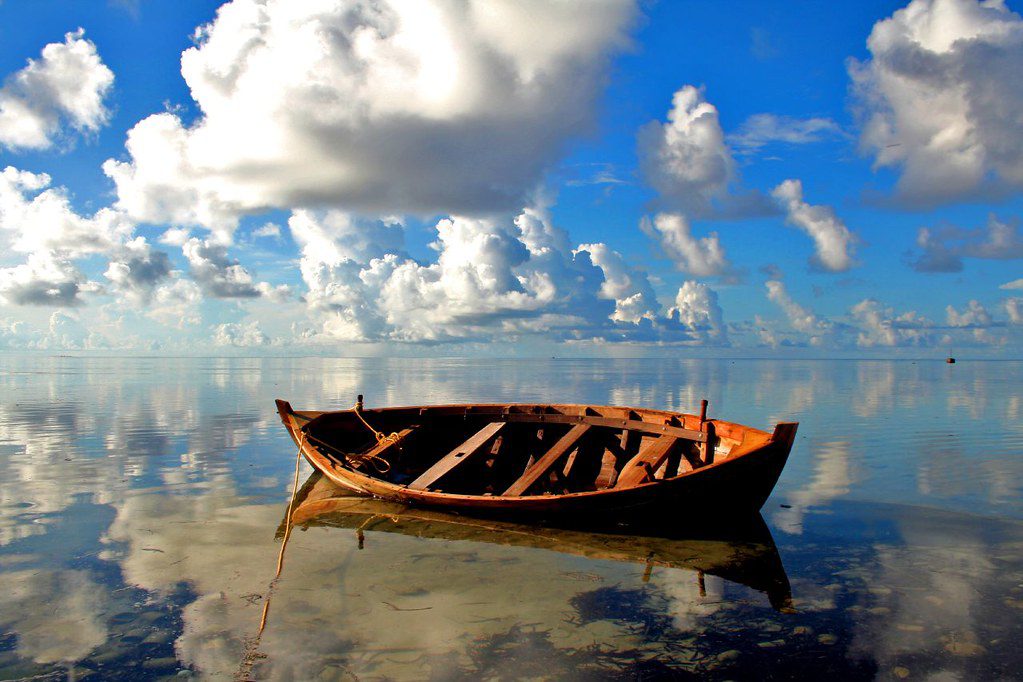
In the Maldives, even the smallest boats tell stories of the open ocean. Among them is the bokkuraa, the most modest of Maldivian traditional vessels—and one of the most essential. Light, narrow, and powered entirely by oars, the bokkuraa moves across the water with a quiet efficiency that reflects generations of intimate knowledge of sea and reef.
Each stroke of the oar sends the boat gliding forward in a steady rhythm. The motion never truly pauses. With practiced timing, a rower can maintain progress for hours, the boat responding smoothly to the balance between effort and resistance. It is a simple demonstration of physics—and of skill refined through daily life on the water.
Built for the Reef
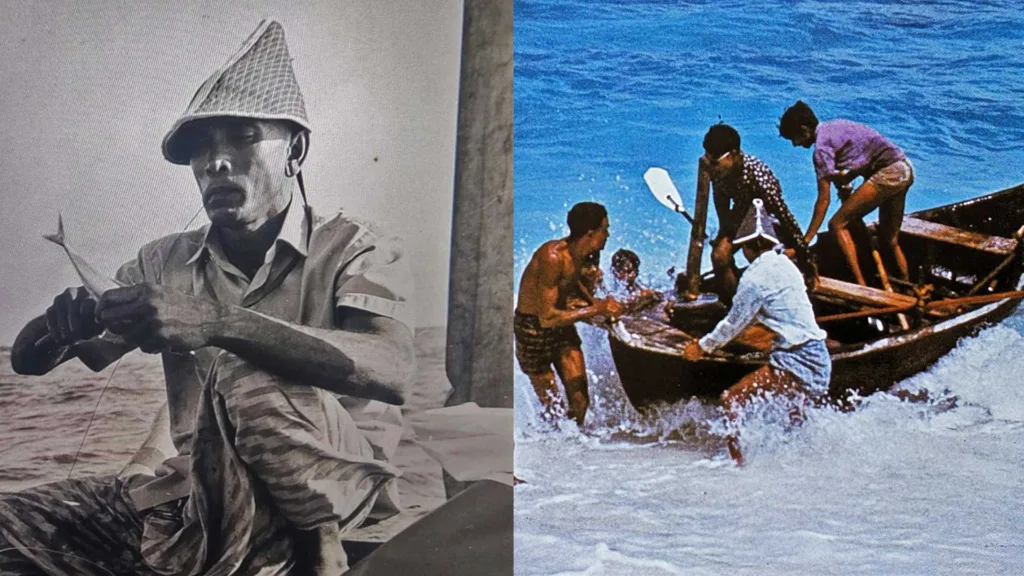
Small and responsive, the bokkuraa is ideally suited to reef environments. Most are powered by four oars, though smaller versions use only two. In shallow lagoons, long poles are often used to push the boat forward. Rarely does a bokkuraa carry more than six people. Its shallow draft allows it to slip easily over reef flats and sandy shallows where larger boats cannot safely approach.
The bokkuraa favors balance over speed, control over force. It is a boat shaped not by ambition, but by geography.
Daily Life on the Water
Historically, the bokkuraa was both the smallest and the most common of Maldivian traditional rowboats. It served many purposes: fishing close to shore, ferrying fishermen between land and anchored vessels, transporting gear, and supporting daily coastal life. When not in use, bokkuraas were anchored in lagoons or pulled onto the beach, ready for the next tide.
Fishing from a bokkuraa is a quiet, deliberate practice. Common catches include red snapper (raimas), trevally (handhi), barracuda (farutholhi), squirrelfish (ankera), and occasionally wahoo (kurumas). While trolling is sometimes practiced, pole-and-line fishing is not conducted from these boats. Fishermen often set out at dawn or at sunset, when the sea is calm and the light soft.
Beyond fishing, the bokkuraa played a crucial role in Maldivian seafaring life. It was never meant to cross vast distances alone, but instead functioned as a working companion to larger vessels—ferrying people, cargo, and supplies between shore and ship. When boats anchored offshore, unable to approach shallow lagoons, it was the bokkuraa that ensured connection to land.
A Quiet Legacy
Rowing through open water in a bokkuraa leaves a lasting impression. The slow journeys offer an intimate perspective on the Maldivian seascape—the changing color of the water, the sound of oars dipping and lifting, the steady breathing of the rower. It is a way of moving that invites observation rather than haste, revealing a deep and enduring relationship between people and ocean.
Today, the bokkuraa has largely faded from everyday use, replaced by fiberglass dinghies and motorized tenders. Yet its legacy remains. It represents a time when every vessel, no matter how small, was shaped by an understanding that the sea is never secondary in Maldivian life.
In the Maldives, the ocean did not belong only to great ships and long voyages. It also belonged to the bokkuraa—humble, dependable, and indispensable.