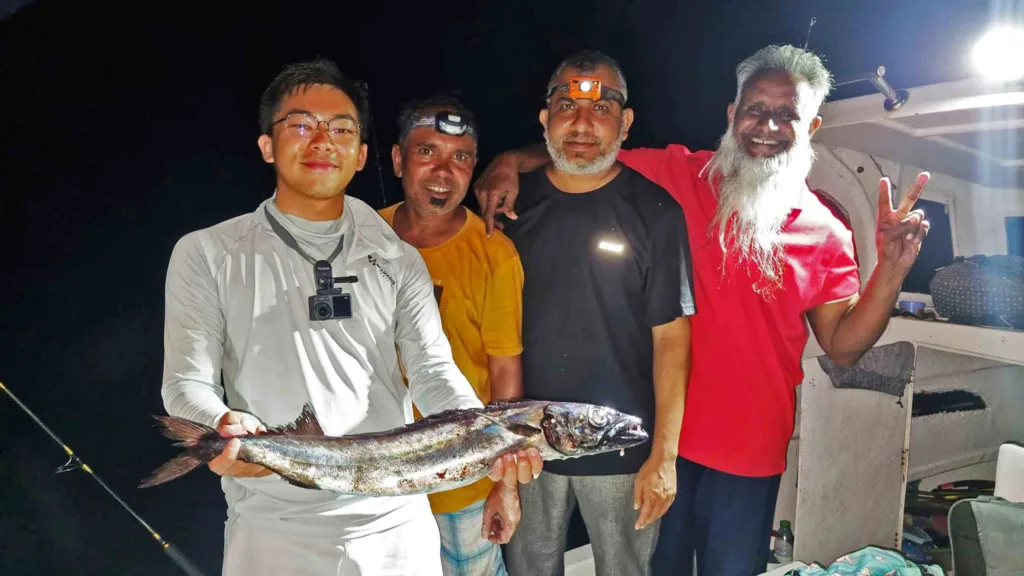

After dark on Fuvahmulah’s northern shore, traditional reef fishing for gini mas offers a window into island life, where patience, skill, and ecological balance are shaped by the sea.
Night Fishing at Thoondu
We used to go to Thoondu—the northern beach of Fuvahmulah—after dark, when the reef fell quiet and the shoreline belonged to fishermen and the tide. The reef flat here is short and uneven, a patchwork of sand and coral rather than a wide shelf. It is the kind of place where fish move cautiously, and where patience matters.
One of our most common catches was the humpback snapper, known locally as gini mas. We baited our lines with tuna belly and fish scraps, casting as far as we could into the black water beyond the break. A monofilament line—usually 30 to 60 pounds—was enough for these stealthy predators.
As the bait sank, you could feel it pulling gently through the line, touching bottom. The moment a snapper took it, the line tightened. We reacted instantly—tugging hard, pivoting toward shore, and sprinting up the beach to haul the fish clear of the surf before it could escape back into the reef.
Small stones served as improvised sinkers, keeping the bait from drifting sideways with the current. Everything about the method was simple, precise, and learned through repetition.
Instagram page embedding authorized by artist/architect mai.Jameel
The Shadow Keeper of the Reef
The humpback snapper is a majestic fish, but it is also a quiet regulator of reef life. It plays a crucial role in maintaining balance, preventing any single species from overwhelming the ecosystem. Territorial but not aggressive, it allows other fish to pass through its domain—until smaller fish linger too long or stray too close.
Its presence helps regulate herbivorous fish such as parrotfish, damselfish, rabbitfish, unicornfish, and surgeonfish. By keeping these populations in check, humpback snappers indirectly protect corals from overgrazing, preserving the health of the reef itself.
Beneath the Coral Ledges
Though often seen at shallow depths, humpback snappers are capable of living far deeper—down to around 150 meters. They inhabit coral reefs and seagrass beds, moving slowly through the reef or holding position near coral heads.
Their calm, watchful behavior makes them a familiar sight to snorkelers, hovering motionless before gliding away into shadow. It is this same stillness that makes them vulnerable to spearfishing, a method that has long targeted the species.
Memory, Method, and the Reef Today
Fishing for gini mas at Thoondu was never just about the catch. It was about reading water in the dark, understanding the reef’s rhythms, and knowing when to pull and when to wait. Those nights taught us how closely survival, skill, and ecology are tied together on an island shaped by the sea.
For travelers walking Thoondu’s pale sands today, the reef may seem calm and unchanging. But beneath the surface, the same balance endures—maintained by fish like the humpback snapper, silent custodians of a fragile world.