In the southern reaches of the Maldives, where the deep Indian Ocean meets the sudden rise of coral limestone, the word “wings” usually signals a season of frenzy and abundance. But a rare encounter this week in Huvadhoo Atoll has revealed a different kind of winged resident—one that prefers the silent, shifting shadows of the lagoon floor over the chaotic spray of the surface.
For those who have long chronicled the southern atolls and the raw energy of the Maldivian seas, this encounter offers a rare glimpse into a quieter mystery—one that lies hidden beneath the surface of the turquoise expanse.
The Butterfly of the Abyss
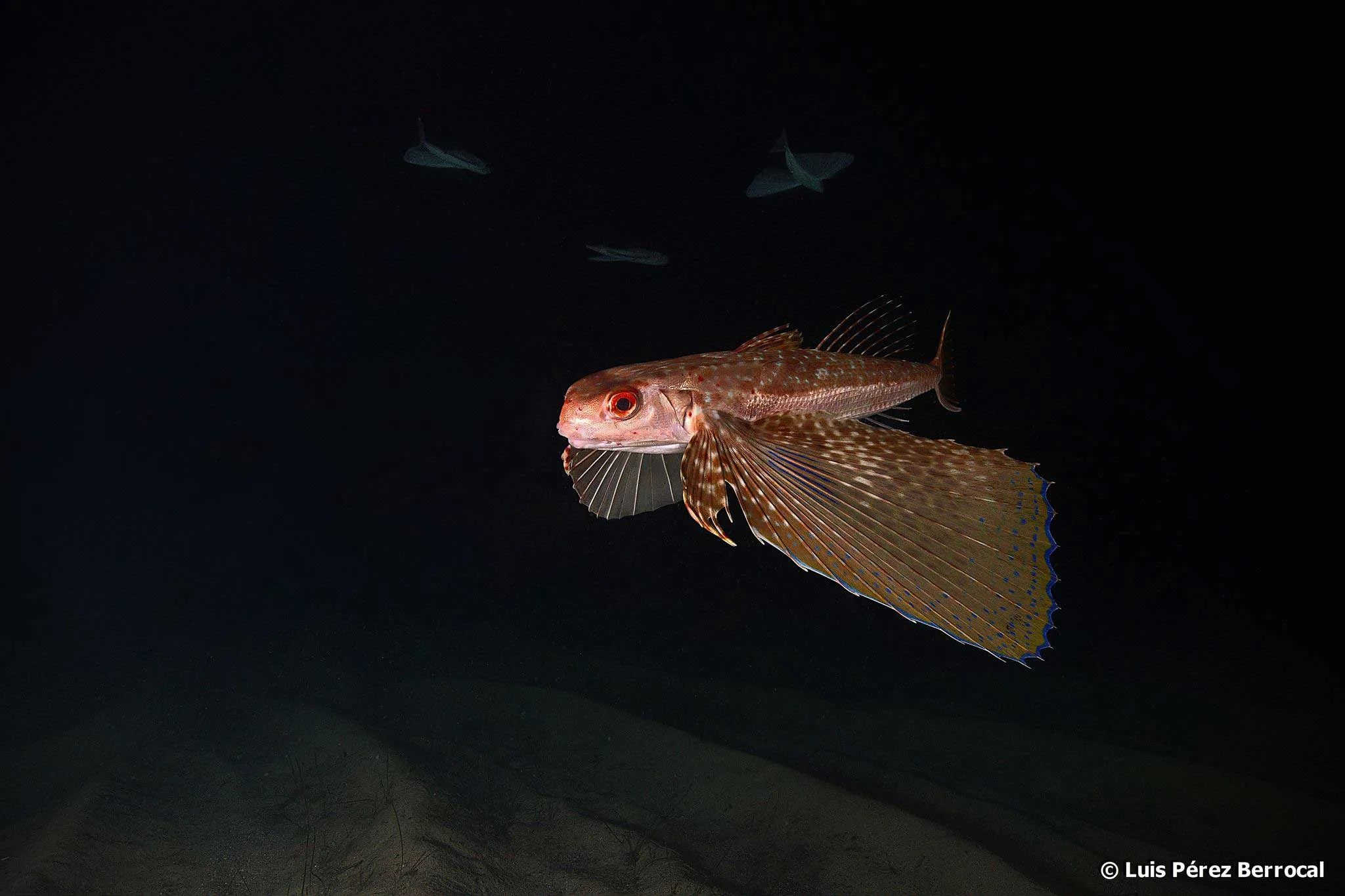
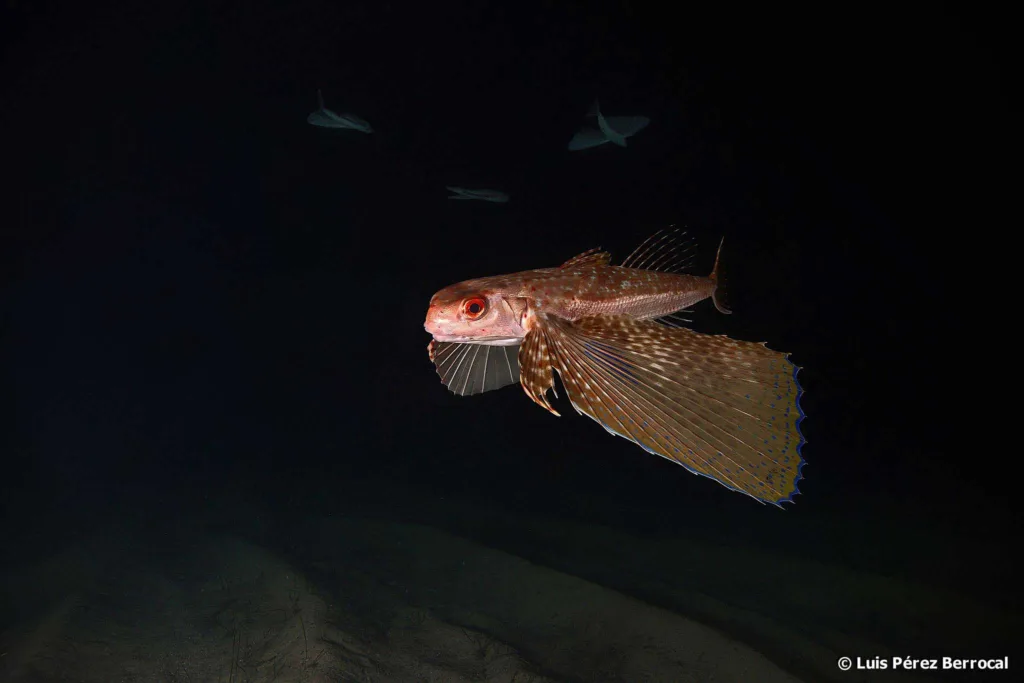
Deep within the turquoise expanse of Huvadhoo, the sea floor is a world of camouflage and armored patience. It was here that a local fisherman recently pulled a strange, spectacular specimen from the water. To the untrained eye, the creature appeared to be a mottled phantom of the sand—bony, heavy-headed, and unremarkable. But as it was handled, the fish performed a transformation that has captivated the local community. Seeking clarity on the discovery, I reached out to Aquaculturist Hussain Ahmed. After reviewing the photos of the catch, he noted that the specimen appears to be a juvenile Flying Gurnard. He explained that these fish are masters of disguise, often mistaken for stones or debris until they unfurl their oversized, wing-like pectoral fins—a dramatic defense mechanism used to startle potential threats. This rare visual confirmation from an expert has added a layer of scientific wonder to an already extraordinary find.
The Flying Gurnard (Dactylopterus volitans) is a biological contradiction. While its name suggests a life in the sky, it is a dedicated bottom-dweller. When threatened, it unfurls a pair of massive, fan-like pectoral fins that flare with an electric, neon-cobalt radiance. These are not tools for flight, but a magnificent bluff—a visual scream designed to startle predators while the fish “walks” across the seabed on specialized pelvic rays that resemble delicate fingers.
The Pelagic Mirror: The Fulhangi Frenzy
This rare Gurnard sighting provides a striking contrast to the most famous “flyer” of the southern atolls. In Huvadhoo and Fuvahmulah, the arrival of the Southwest Monsoon (Hulhangu Moosum) transforms the ocean’s surface into a theater of high-speed survival. The Tropical Two-Wing Flying Fish (Exocoetus volitans), known locally as the Fulhangi, is a master of the boundary between worlds.
Unlike the Gurnard, which stands its ground on the sand, the Fulhangi lives a life of constant motion. Driven upward by the explosive charge of the Dorado (Mahi-Mahi)—a predator that tracks its prey from the blue depths like a heat-seeking missile—the flying fish breaks the surface at 60 kilometers per hour. Using its rigid, wing-like fins, it glides for hundreds of meters in a desperate bid to outrun its pursuers.
The Pirates of the Monsoon Skies
However, as the fisherman’s catch reminds us, the Maldives is a vertical kingdom where every layer is patrolled. As the Fulhangi breaches the water to escape the Dorado, it enters the domain of the Great Frigatebird (Huraa). These “Masters of the Skies” are the aerial pirates of the monsoon. Because their feathers lack the oils necessary to sit on the water, they must hunt entirely in the air.
Circling thousands of feet above Huvadhoo, the Frigatebirds watch for the silver glint of a flying fish. In a display of superior aerial maneuvering, they plunge like blades to intercept the fish mid-glide. This creates a terrifying gauntlet: the fish flees a predator below only to be snatched by a predator above. In Fuvahmulah, this pressure is so intense that schools of fish often make a fatal error, landing directly on the island’s vegetation and beaches in a phenomenon locals call the Hulhanmaha Ralho.
Two Strategies, One Ecosystem
The discovery of the Flying Gurnard by a Huvadhoo fisherman adds a missing chapter to the narrative of our southern waters. One species is a stationary sentinel, relying on heavy armor and a stunning visual defense to thrive in the sanctuary of the lagoon. The other is a nomadic glider, whose existence is defined by a high-stakes chase across the open ocean.
Marine Species Profile
The Huvadhoo Discovery
| Category | |
|---|---|
| Quick Fact | Despite the name, it cannot fly. It uses its wings to startle predators. |
| Primary Habitat | Sandy lagoon floors and deep reef slopes. |
| Defense Logic | Unfurls vibrant neon-cobalt fins as a bluff display. |
| Locomotion | Uses specialized pelvic rays to “walk” across the seabed. |
| Visual Trait | Heavy, armored head with large, expressive eyes. |
While the Fulhangi represents the raw energy and seasonal rhythms of Maldivian fishing traditions, the Gurnard represents the hidden, resilient mysteries of our reef floors. Whether they are walking through the sand or gliding through the spray, these winged residents prove that Huvadhoo Atoll remains one of the most complex and vibrant ecological crown jewels of the Indian Ocean. Ultimately, the presence of the Flying Gurnard is a profound testament to the unique and multi-layered biodiversity of the Maldives.