A fixture of the Maldivian “Kandus,” the Grey reef shark is a high-speed guardian of the outer reef, existing at the intersection of extreme grace and predatory precision.
A fixture of the Maldivian “kandus,” the grey reef shark is a high-speed guardian of the outer reef, existing at the intersection of extreme grace and predatory precision.
If you descend into the deep channels of the Maldives, where the current pulls toward the open blue, you will likely meet the steady, unblinking gaze of the grey reef shark (Carcharhinus amblyrhynchos). Known locally as the Vahboa miyaru, this species is the quintessential reef shark—a moderate-sized, muscular sentinel that patrols the vertical walls and outer slopes of the atolls.
To divers, they are a familiar and welcome sight, often found in large aggregations at the famous “shark corners” across the archipelago. Yet, behind their calm, cruising demeanor lies a complex social structure and a biological mystery that has intrigued scientists for decades.
The Silver Silhouette
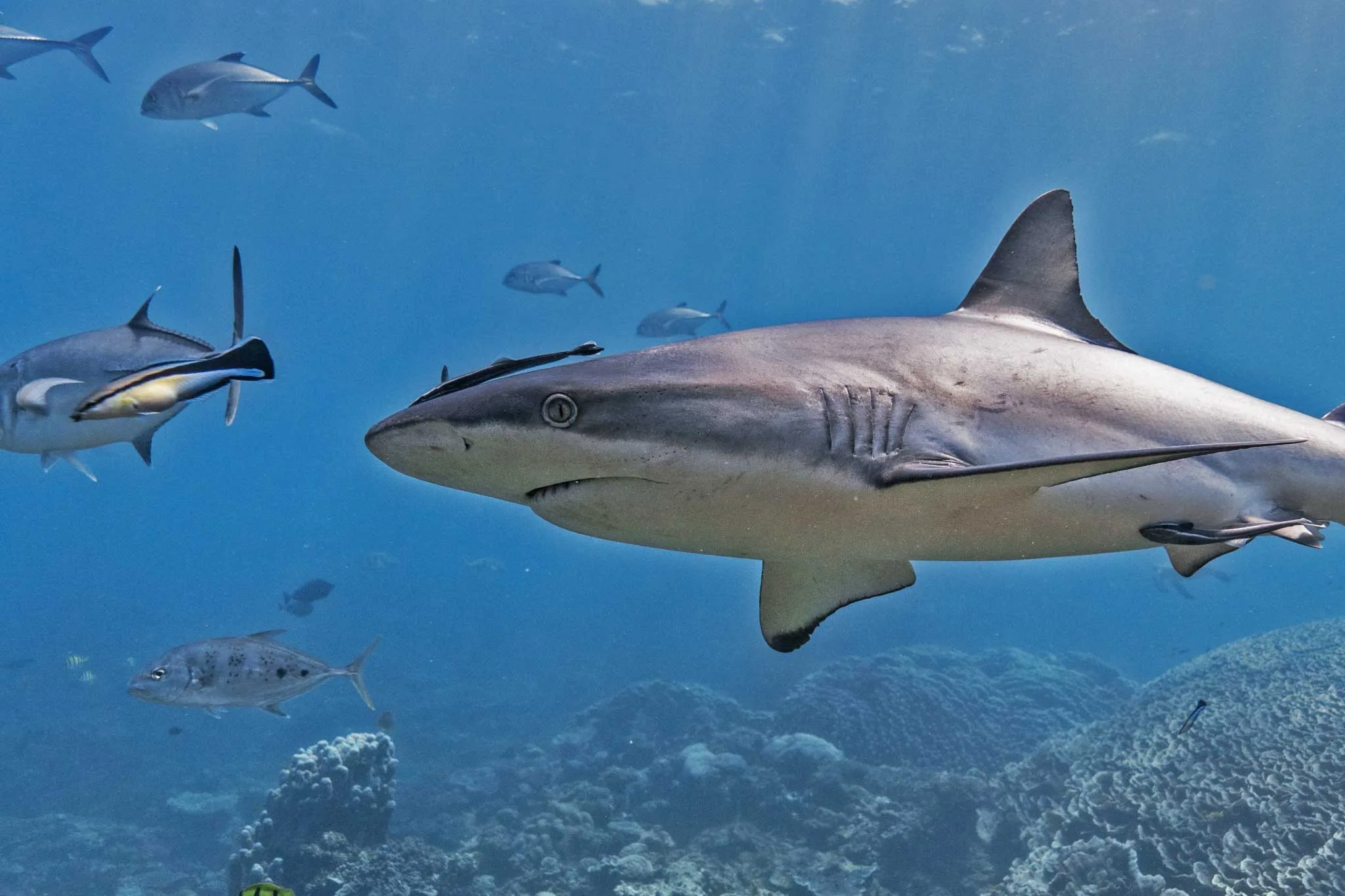
The grey reef shark is a masterpiece of hydrodynamic efficiency. Reaching a common length of about 1.6 meters, it possesses a stocky body and a broadly rounded snout. Its coloration is a classic oceanic gradient: a cool bronze-grey on the back that fades into a pale, clean white on the belly.
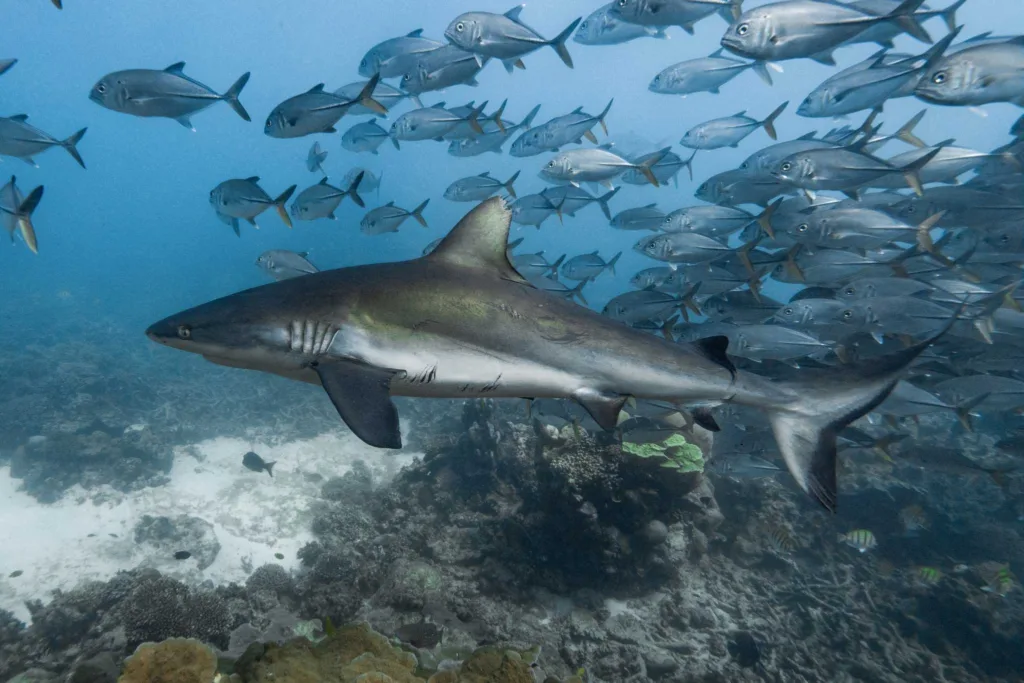
However, its most diagnostic features are found on its fins. The trailing edge of its caudal (tail) fin is marked by a broad, distinct black band. In a curious regional twist, individuals in the Indian Ocean often display a narrow white edge on the trailing part of the first dorsal fin—a trait frequently absent in their Pacific counterparts. This subtle difference, alongside a notably less aggressive temperament, has led some marine biologists to hypothesize that the Indian Ocean population may eventually be classified as a distinct species.
The Social Predator
Unlike many solitary sharks, the Vahboa miyaru is deeply social. During the day, they congregate in groups near reef drop-offs and passes, often using strong tidal currents to rest without swimming. By moving against the incoming tide, they allow oxygenated water to flow over their gills—a behavior that enables them to remain alert while conserving vital energy.
When the sun sets, the social schools disperse. The grey reef shark becomes a solitary, high-speed hunter of the night, utilizing its narrowly triangular, serrated upper teeth to seize bony fishes and cephalopods caught in the reef’s cracks.
A fragile life cycle
The survival of the grey reef shark is a delicate balance. They are viviparous, with females nourishing their young via a yolk-sac placenta. With a small litter of only 1 to 6 pups and a long gestation period, their population growth is slow.
Marine Species
Grey Reef Shark
| Scientific Name | Vahboa miyaru Carcharhinus amblyrhynchos |
| ID Marker | Broad black band on caudal fin; grey body with pale underside; Indian Ocean individuals often show a white-edged dorsal fin. |
| Habitat | Outer reef slopes, passes, and channels; commonly associated with strong currents. |
| Biology | Viviparous (1–6 pups). Social by day; nocturnal hunter of fishes and cephalopods. |
Because they exhibit high site fidelity—often remaining within the same atoll for years—they are the face of the Maldives’ successful shark-based ecotourism. They are the backbone of the reef ecosystem, the regulators of the food chain, and a reminder of the wild, untamed beauty that defines the Maldivian deep.
References
- Marine Research Centre (Maldives): Records on specimen identification and local abundance.
- Anderson, R.C. (1993): Reef Fish Resources Survey in the Maldives.
- FishBase: Biological data and distribution for Carcharhinus amblyrhynchos.
- IUCN Red List: Conservation status and threat assessment.