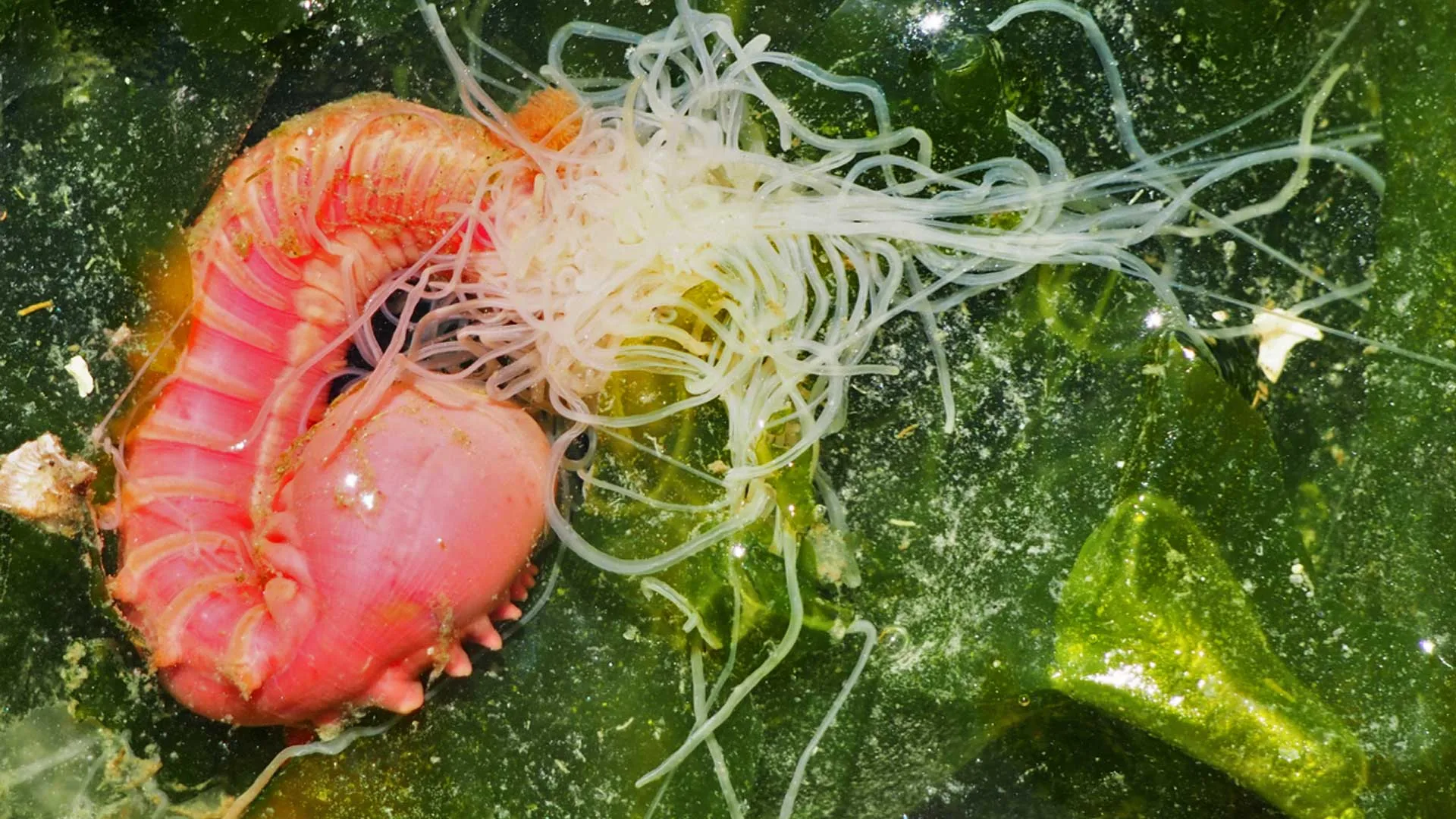
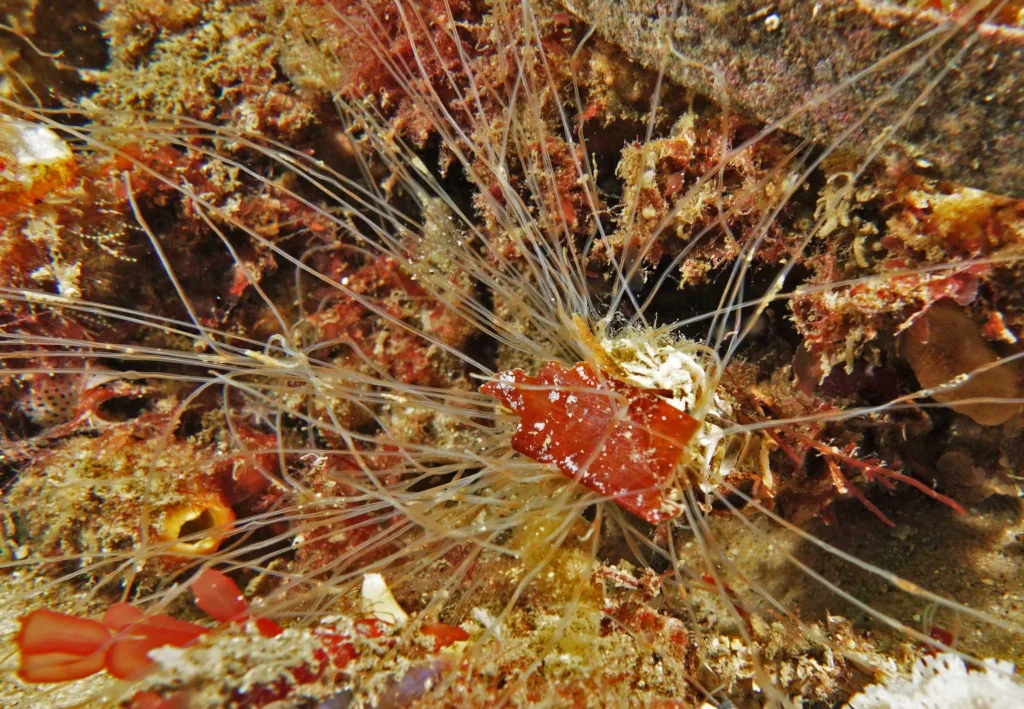
At first, it looks like a mistake. A spill. A pale tangle of noodles strewn across the sand at the edge of a coral head. Then it moves—slowly, deliberately—and the reef reveals one of its quietest architects. In the shallow lagoons and reef slopes of the Maldives, the Giant Spaghetti Worm goes about its work almost entirely unseen, maintaining the delicate balance of life beneath the surface.
A Worm You Almost Never See
The creature most divers refer to as a “spaghetti worm” is not a single species, but a group of marine polychaete worms belonging to the family Terebellidae. In Maldivian waters, sightings most commonly involve species from the genus Loimia, such as Loimia medusa, or Retetrebella, including Retetrebella queenslandica.
What catches the eye is not the worm itself, but its extraordinary feeding tentacles. The long, threadlike strands draped across sand and rubble are not limbs in the usual sense, but highly elastic, whisper-thin extensions designed for foraging. The worm’s body—modest in size, rarely exceeding a few centimeters—remains hidden deep within a protective tube or crevice. From this concealed refuge, the tentacles can spread outward for nearly a meter, forming a living net that blends seamlessly into the reef.
A Life Anchored to the Reef
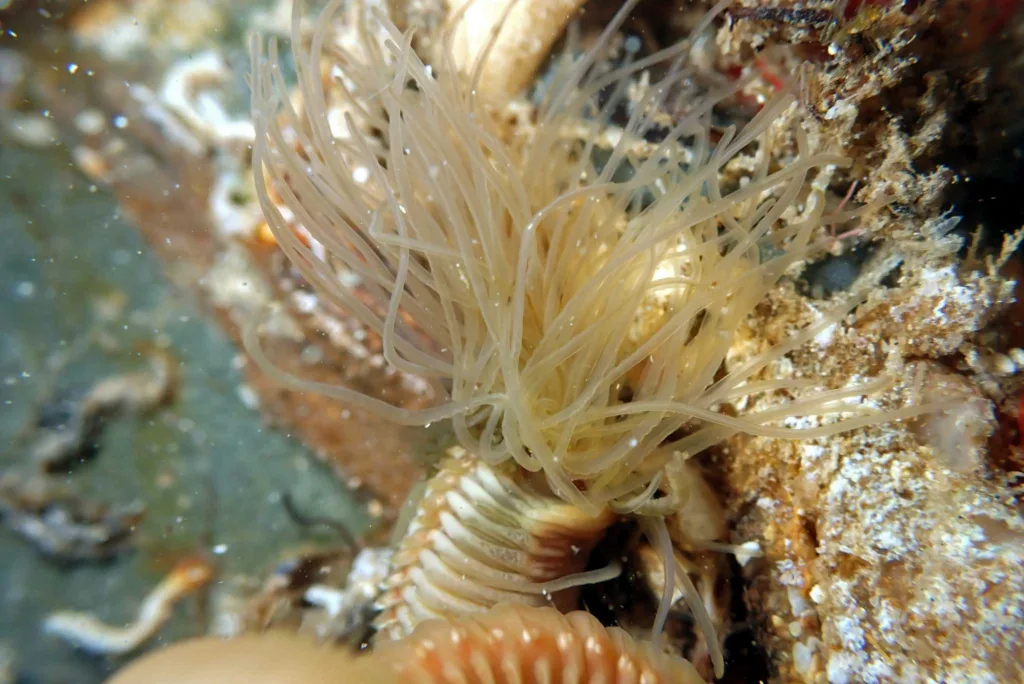
Once established, a Giant Spaghetti Worm rarely moves again. It constructs a permanent home by binding sand grains, shell fragments, and bits of coral with a specialized mucus, anchoring its tube in sheltered patches of reef where organic debris naturally accumulates. These sites—often sandy hollows at the base of coral colonies or beneath coral boulders—offer both protection and a reliable food supply.
Feeding is a slow, continuous process. Each tentacle creeps across the seafloor, probing and curling as it encounters microscopic organisms and decaying organic matter. A thin coating of mucus traps these particles, while thousands of tiny cilia transport the food along grooves in the tentacle toward the worm’s mouth, hidden safely inside its tube. The system functions like a conveyor belt, allowing the animal to feed efficiently without ever exposing its body.
Life at the surface is not without risk. Fish occasionally nip at the tentacles, but the loss is temporary. Giant Spaghetti Worms can regenerate damaged tentacles—an essential adaptation for a creature that leaves its feeding tools scattered openly across the reef.
The Reef’s Quiet Custodian
Marine Species
Giant Spaghetti Worm
| Scientific Name | Terebellid Worm Retetrebella queenslandica |
| ID Marker | Long, elastic, white feeding tentacles extending from a tube; tentacles can reach up to one meter in length. |
| Habitat | Sandy hollows at the base of coral colonies or beneath boulders in shallow lagoons and reef slopes. |
| Biology | Sedentary detritivore; uses mucus-coated tentacles to transport organic debris and microbes to its mouth. |
Though easily overlooked, Giant Spaghetti Worms perform a vital ecological service. By consuming dead organic material and constantly reworking the sediment, they prevent waste from accumulating and reduce the growth of harmful bacteria. In doing so, they recycle nutrients back into the reef ecosystem, supporting the health of corals and the countless organisms that depend on them.
This role is so effective that similar worms are often welcomed in marine aquariums, where they quietly improve water quality without drawing attention to themselves.
For humans, these worms are entirely harmless. They do not sting or bite, and their only defense is retreat. A single touch sends the tentacles streaming back into the tube, interrupting feeding and leaving nothing behind but smooth sand—and a lingering sense of mystery.
The Giant Spaghetti Worm may never be the star of a dive, but it doesn’t need to be. In the Maldives, its value lies in its invisibility—proof that some of the reef’s most important work is carried out by creatures content to remain hidden, patiently tending the foundations of the underwater world.
Where to Look: Insights from the Experts
Unlike reef icons tied to specific landmarks, the Giant Spaghetti Worm is a master of the Maldivian sandy seascape. According to Maldivian dive instructor and underwater videographer Abdulla Sivad, there is no single “hotspot” for these worms. Instead, they can appear anywhere a sandy bottom meets coral structure. Their presence is shaped more by environment than by geography.
This observation is echoed by Tim Godfrey in Dive Maldives: A Guide to the Maldives Archipelago, where he notes that Retetrebella species live in sand- and shell-lined tubes hidden beneath coral boulders or tucked into reef crevices. From these secure hideaways, the worms extend their white feeding tentacles—sometimes reaching up to a meter in length—across the seafloor to scavenge for food.
References & Further Reading
- Waikiki Aquarium — Species profiles and biological observations of Loimia medusa, including feeding behavior and tentacle morphology.
- World Register of Marine Species (WoRMS) — Taxonomic classification and distribution of Terebellidae polychaete worms.
- DivePoint Maldives — Field observations and photographic records of polychaete worms in Maldivian reef systems.
- Alamy Marine Archive — Verified photographic documentation of Retetrebella queenslandica in Indian Ocean reef habitats.