For centuries, the Indian Ocean shaped life in the Maldives. It provided food, trade, and passage between distant shores, while demanding endurance and courage from those who crossed it. Long before engines and modern navigation, Maldivian sailors journeyed across open seas aboard wooden sailing vessels known as vedi. Their voyages depended entirely on wind, monsoon currents, and faith. Many of these journeys were never written down. Some survive only through memory and oral history.
This account was recorded during an interview with Mueenbe of Dhadimagu Ward, Fuvahmulah, conducted at the request of my cousin, Ismail Rafeeq, for the Humans of Fuvahmulah project. As part of an ongoing effort to document the history and culture of the Maldives, I felt it important to preserve this story. It forms part of a wider chronicle of vedi voyages—experiences now rarely recorded, yet essential to understanding how island communities once lived, worked, and survived.
These stories reveal the sacrifices Maldivians made in pursuit of a livelihood. They speak of resilience, communal effort, and the profound relationship between islanders and the sea. What follows is Mueenbe’s recollection of one such voyage—an encounter that remained etched in his memory for the rest of his life.
Preparations had been underway to sail for Kolhonbo (Colombo) aboard the Finifenmaage vedi. Heavy rain and worsening weather had delayed departure, and many believed the journey would be postponed. That morning, Mueenbe had gone to the taro fields, assuming there would be no immediate call to sail.
Not long after, a young boy arrived in haste. The vedi was preparing to depart, he said, and he had been sent to fetch Mueenbe. Without delay, he made his way to Rasgefannu beach.
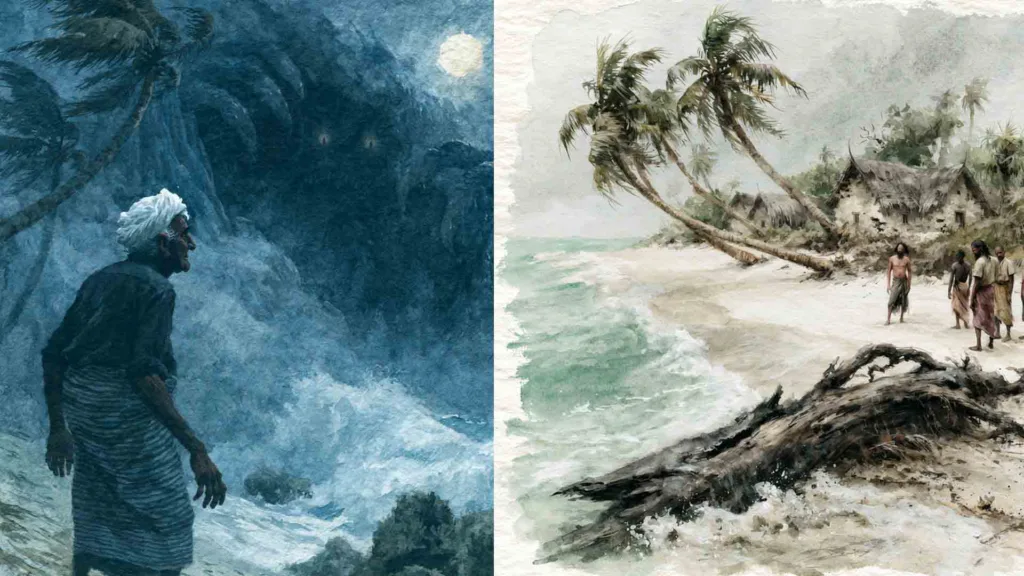
By the time he arrived, much of the island had gathered along the shore. The vedi rested close to the reef edge—faraha laafey—held back by strong winds blowing in from the open sea toward the island. Before the voyage could begin, the vessel first had to be pulled into deeper water. Assisted by two dhonis, the vedi was carefully hauled away from the reef—faro beyre kerun. Once it reached open sea, the sails were raised.
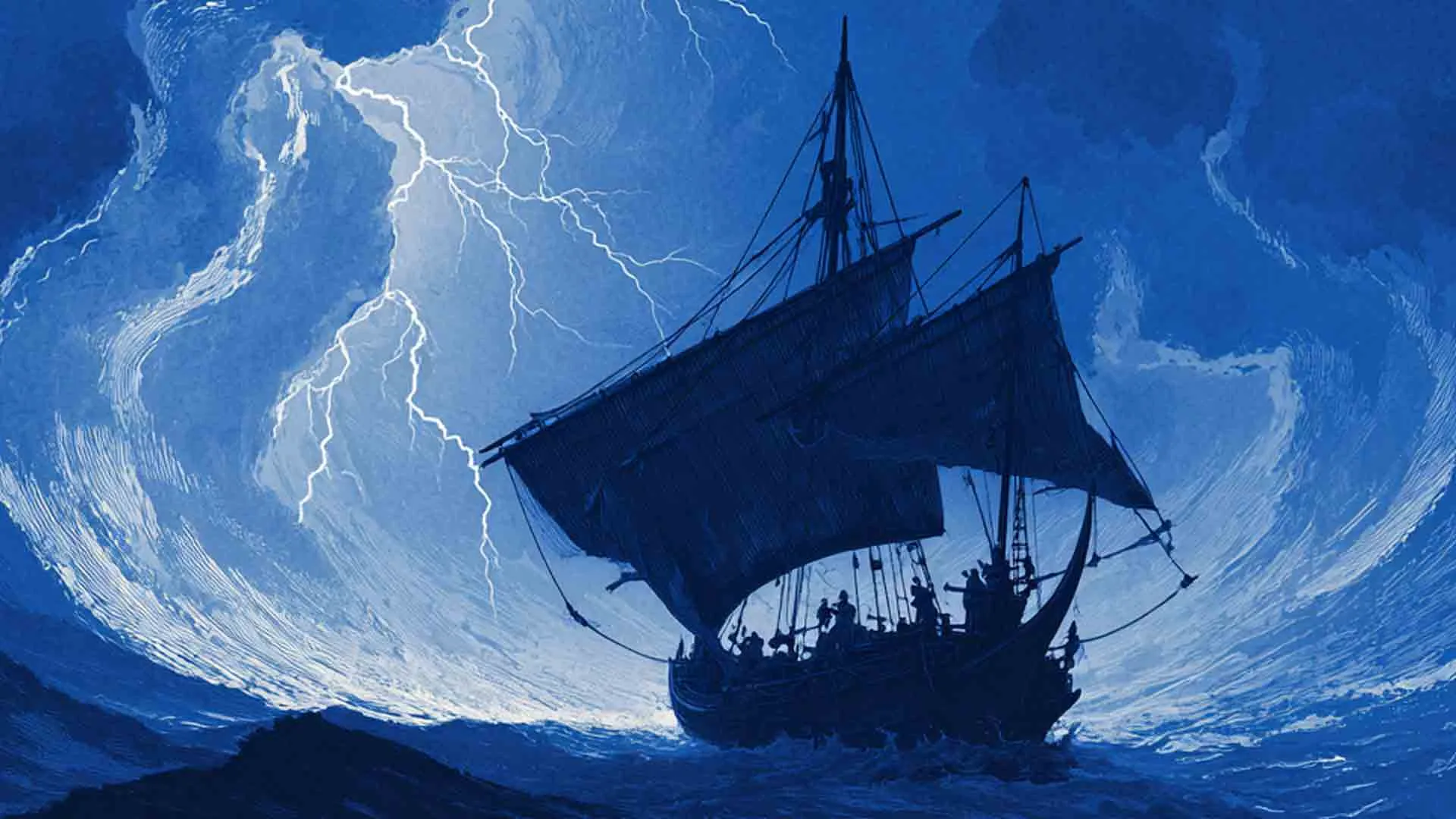
But the conditions remained unforgiving. Rain continued to fall heavily, and the sea grew increasingly rough. Those aboard stayed inside the small cabin of the vedi, unable to step onto the deck as waves crashed against the hull and the vessel strained against the wind. As the storm intensified, prayers filled the air. Thakbeer—the collective proclamation of “Allah Akbar” (“God is the Greatest”)—was recited alongside salavaafulhu, blessings upon the Prophet Muhammad offered in moments of danger as pleas for protection and divine mercy. Their voices rose together against the sound of wind and rain.
Then, without warning, a violent gust struck the sails.
The vedi lurched sharply to one side—hulhahasha jahaali—and lost its forward momentum. Water began rushing into the vessel.
Panic spread among those on board. Mueenbe later recalled seeing fear on every face. Together with Ibrehimfuthu, he began bailing water using buckets and dabiyaa, iron containers kept aboard for emergencies. Yet despite their efforts, water continued to pour in.
At that critical moment, Kenaari Beyya—the chief man of the vedi—acted decisively. Grabbing a large axe known as a kondo furey, he struck the dhanmaanu, the main rope securing the sail. The sail collapsed instantly, reducing the strain on the vessel. Gradually, the men managed to empty the water, and the immediate danger passed.
That same day, several other vedi had also attempted to depart. All were driven northward by the storm, pushed far beyond Maldivian waters by the force of the monsoon winds.
For three nights and two days, Mueenbe and the others drifted at sea.
Eventually, land appeared on the horizon.
They had reached Galle, on the southern coast of Sri Lanka.
Years later, Mueenbe would describe the voyage as one of the most terrifying experiences of his life. It was not only the violence of the storm that remained with him, but the knowledge of how close they had come to disaster.
Stories such as this illuminate a chapter of Maldivian history that risks fading from memory. The men who sailed aboard vedi vessels did so not in search of adventure, but out of necessity. With limited means, they faced immense danger guided only by experience, faith, and trust in one another.
By preserving these accounts, we preserve more than memory alone. We honor a way of life shaped by the sea—its generosity and its peril—and the courage of islanders who entrusted their lives to it. These chronicles remain quiet testimony to the resilience, sacrifice, and enduring beauty of Maldivian maritime culture.