A predator shaped by open water and depth
Beyond the sheltered lagoons of the Maldives, where reefs drop sharply into clear blue water, dark shapes patrol the slopes with quiet authority. Among them is the Black Trevally (Caranx lugubris), known locally as Kalha handhi—a powerful hunter whose presence signals the transition from reef to open ocean.
Growing to lengths of up to 85 centimeters, the Black Trevally is among the larger trevallies found in Maldivian waters. It is not a fish of shallow coral gardens or sandy flats; instead, it belongs to deeper, clearer environments, where space is vast and speed is the ultimate currency.
A body shaped for pursuit
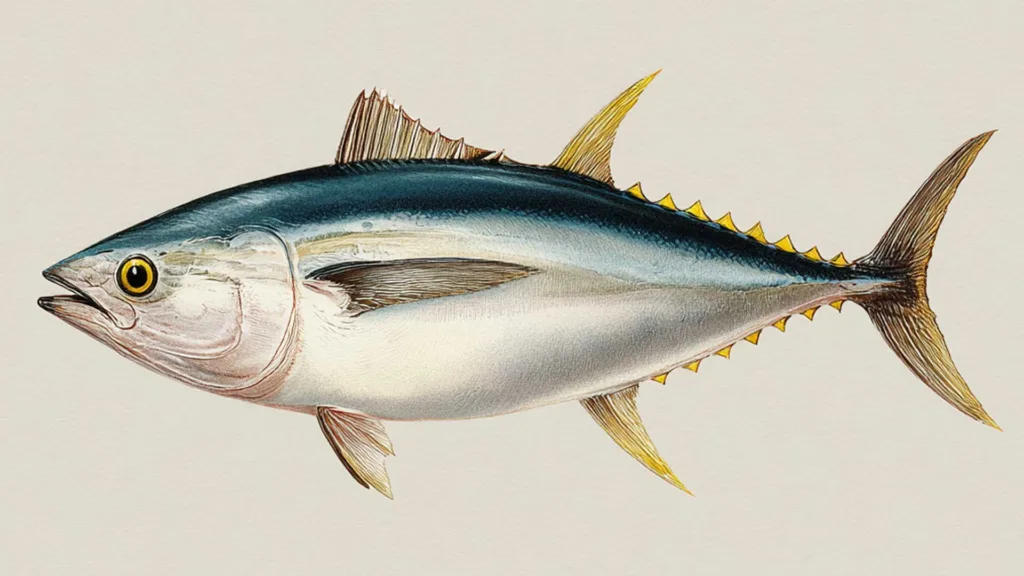
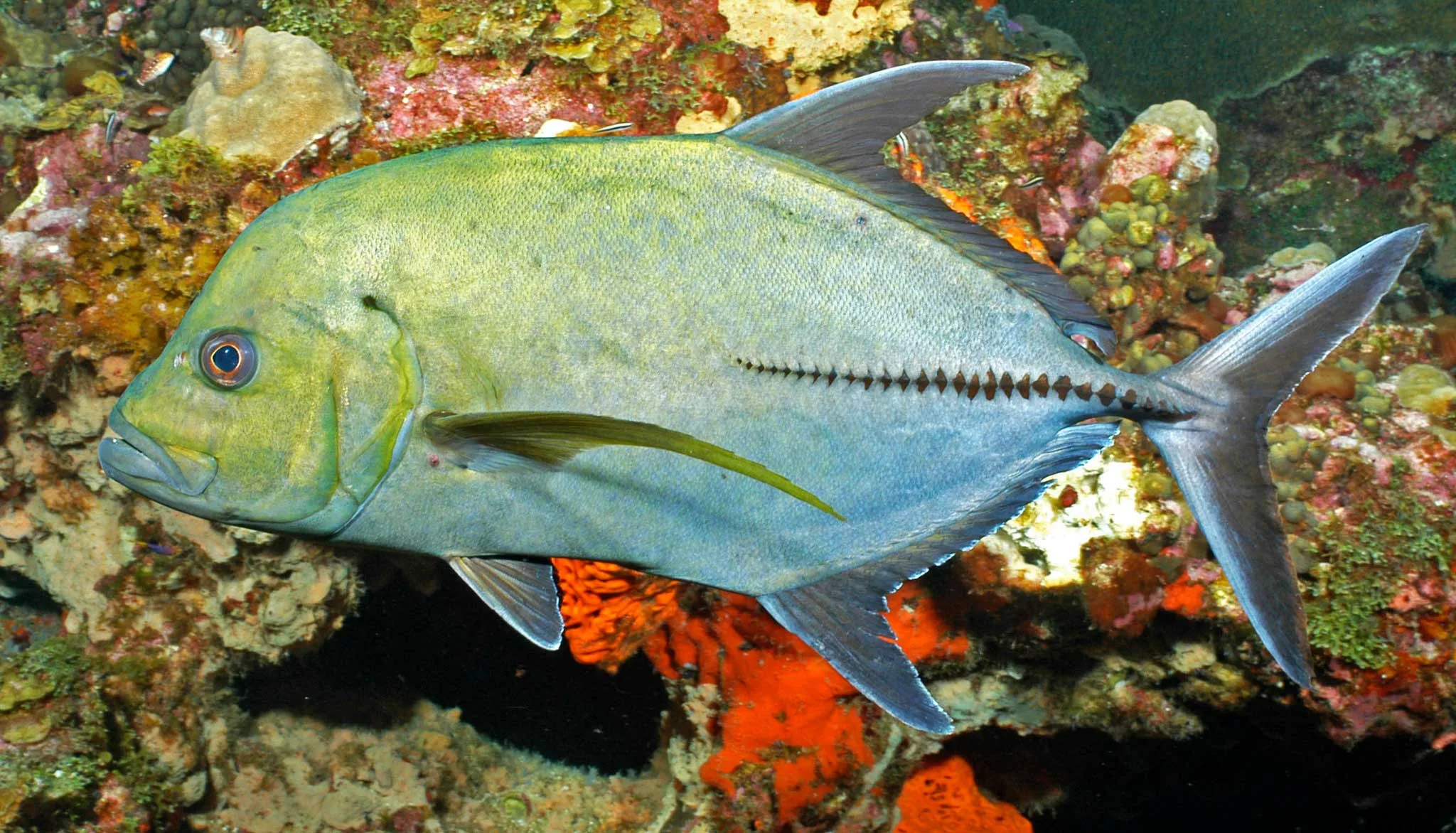
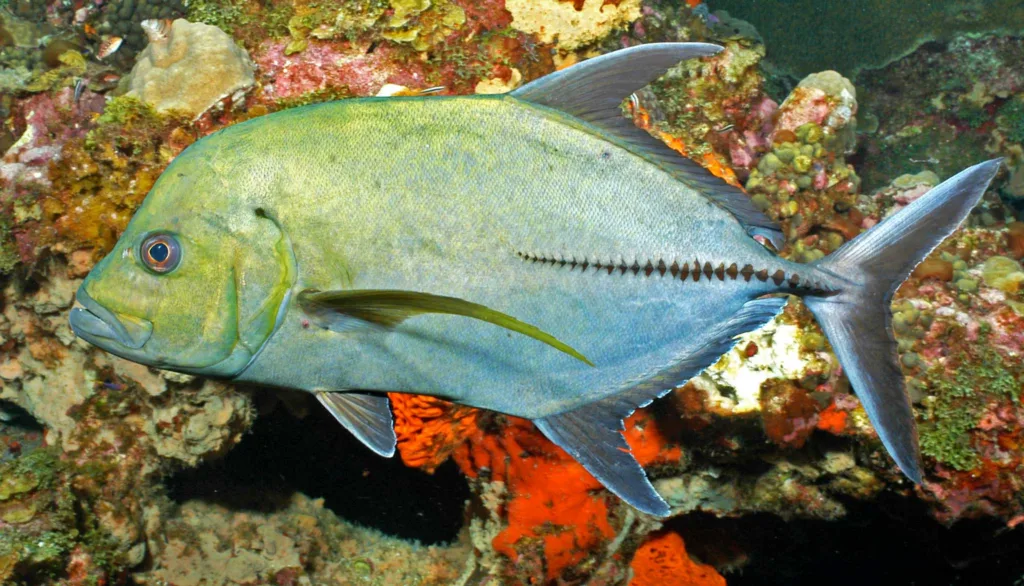
The Black Trevally’s form reflects its role as an active predator. The profile of the head is steep and angular, giving the fish a purposeful, forward-driven appearance. Its structural outline is defined by two distinct dorsal fins: the first supported by eight spines, and the second beginning with a single spine followed by a long sweep of soft rays. The anal fin mirrors this architecture, starting with two detached spines before continuing with a spine and a series of soft rays.
The lobe of the dorsal fin is relatively long, providing essential stability during fast, sustained swimming. Notably, the breast of the Black Trevally is completely scaled. This is a key diagnostic feature that distinguishes it from many of its relatives, providing both protection and streamlining during high-speed movement through the water column.
A colour shaped by shadow and depth
In appearance, the Black Trevally is unmistakable. Its body and fins are mostly a uniform grey to black, absorbing light rather than reflecting it. A small, distinct dark spot marks the upper edge of the opercle (gill cover), and the scutes—the bony plates along the lateral line—are often deep black, reinforcing the fish’s solid, shadow-like appearance.
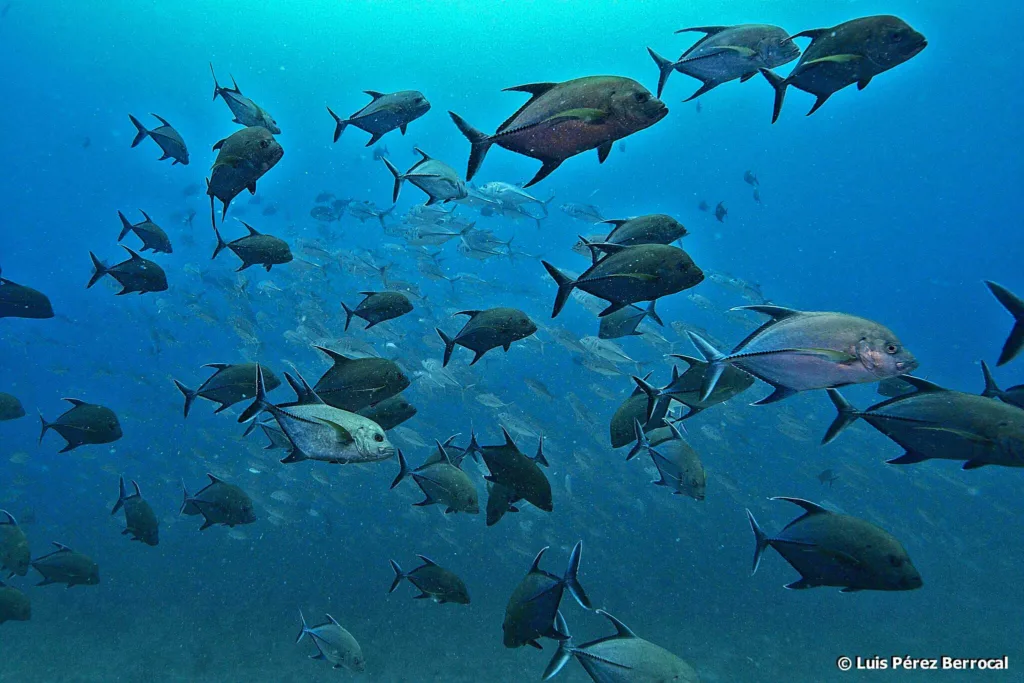
This subdued coloration provides effective camouflage in deeper water, where light is reduced and contrast is low. Against the blue-black background of offshore reefs, the Black Trevally becomes difficult to track—a lethal advantage for a hunter that relies on surprise and sudden acceleration.
A home shaped by outer reefs and clear water
The Black Trevally is most commonly encountered on outer reef slopes and in clear offshore waters, typically at depths between 25 and 65 meters. These habitats are exposed, current-swept, and rich in pelagic life.
It feeds primarily on other fish, using its immense speed and coordinated strikes to capture prey. Individuals may be seen hunting alone or loosely associated with other large reef predators, moving steadily along the steep edges where deep oceanic water meets the reef structure. With a circumtropical distribution around oceanic islands, the species is closely tied to isolated reef systems rather than continental coastlines.
A dark silhouette among giants
The Black Trevally is sometimes confused with the Giant Trevally (Muda handhi), its more famous and aggressive relative. However, careful observation reveals clear differences. While the Giant Trevally is often silvery with a blunter head and frequently possesses a patch of skin on its breast missing scales, the Black Trevally’s darker overall colour, steeper head profile, and fully scaled breast set it apart.
In the Maldives, it remains a familiar but understated presence—less dramatic than the Giant Trevally, yet perfectly adapted to life where the reef fades into the deep.
A symbol of the outer reef
The Black Trevally embodies the character of the outer reef itself: powerful, restrained, and shaped by open space. It is a fish of margins, occupying the boundary between reef and ocean, light and shadow.
For those who venture beyond the shallows, its dark form moving through the blue water is a reminder that the reef does not end at the coral edge—it continues into the depths, inhabited by hunters built for the open sea.
Species Snapshot
| Scientific Name | Caranx lugubris |
| English Name | Black trevally |
| Local Name | Kalha handhi |
| Family | Carangidae |
| Maximum Size | 85 cm |
| Habitat | Outer reef slopes (25–65 m) |
| Diet | Fish |
References
- M.R.S. (1997). Fishes of the Maldives. Marine Research Section, Ministry of Fisheries and Agriculture, Republic of Maldives. 408 pp.
- Froese, R. and D. Pauly. Editors. (2024). FishBase. World Wide Web electronic publication. www.fishbase.org.
- Smith-Vaniz, W.F. (1984). Carangidae. In FAO species identification sheets for fishery purposes. Western Indian Ocean (Fishing Area 51).