The bigeye tuna’s powerful life beneath the surface
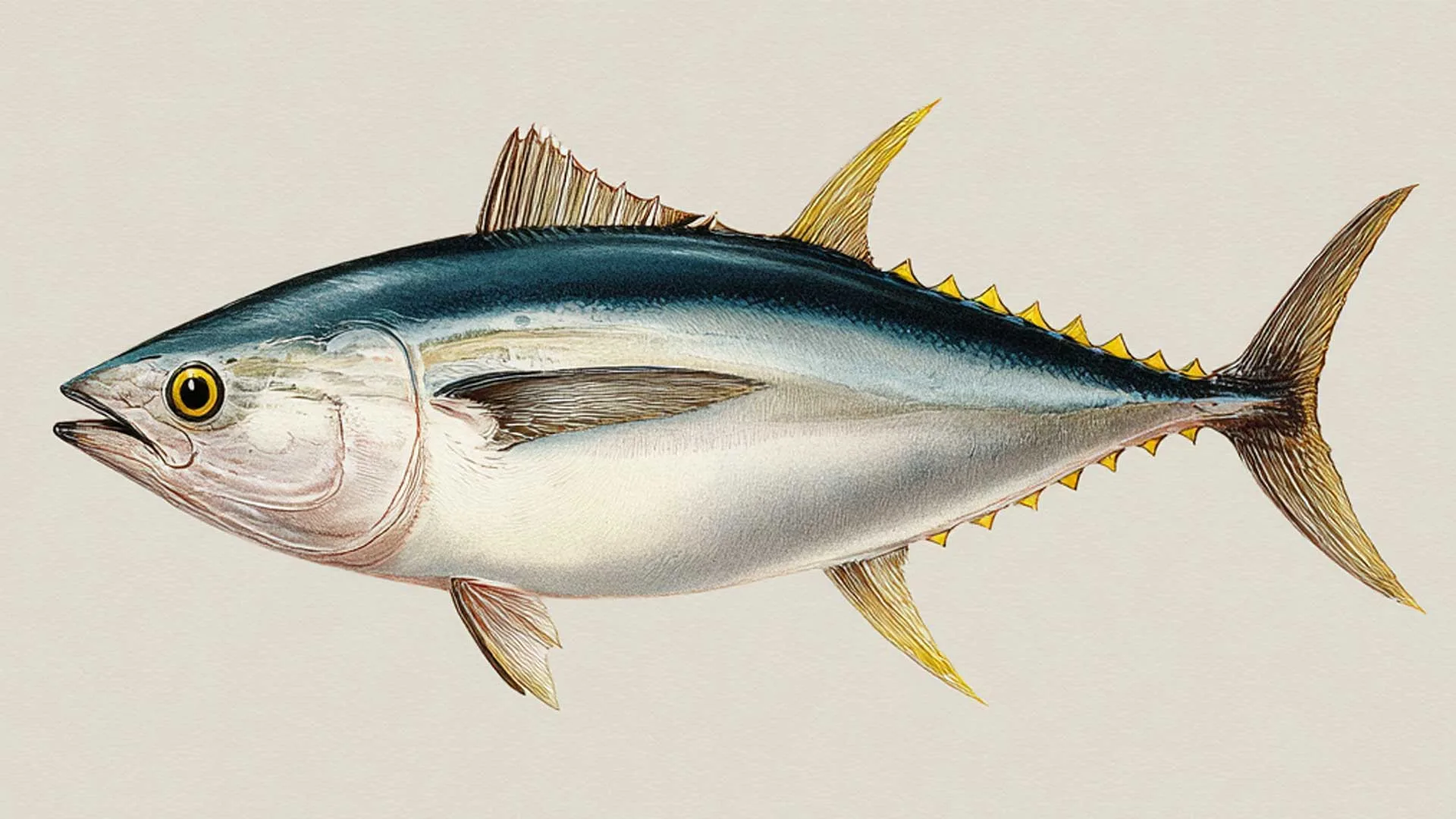
In the open ocean—where light thins quickly and distances are measured in kilometers rather than meters—the bigeye tuna thrives. Built for a life spent moving between sunlit surface waters and the dim blue world below, Thunnus obesus occupies a realm that few fast-swimming fishes can endure for long. Known locally as Loabodu kanneli, it is a creature of depth as much as speed, adapted to a vertical world where pressure rises and daylight fades.
One of the largest members of the mackerel family, the bigeye tuna can grow to an impressive 2.1 meters in length. Its body is thick and muscular—heavier and more robust than that of its close relative, the yellowfin tuna. Two dorsal fins sit close together along its back: the first armed with 13 to 15 spines, the second sweeping rearward in a graceful sickle. The anal fin mirrors this curve, followed by a row of 8 to 10 finlets that smooth the flow of water and reduce drag at high speed.
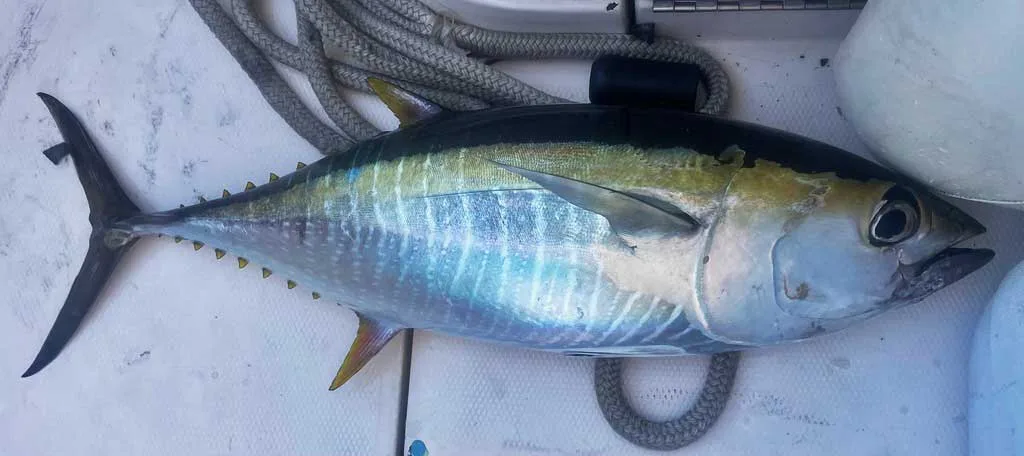
Its coloration is both striking and functional. The upper body shimmers in deep metallic blue, fading to a pale underside that blends seamlessly with the brighter waters above when viewed from below. The dorsal and anal fins glow yellow, echoed by yellow finlets edged in black. Along the flanks, eight to ten faint, near-vertical pale lines create a subtle pattern—one of the visual cues used to distinguish this species from other tunas.
The bigeye tuna is uniquely adapted to life across depth zones. Both epipelagic and mesopelagic, it ranges from the surface down to roughly 250 meters, following prey into cooler, darker waters. Juveniles often travel in mixed schools with yellowfin or skipjack tuna, but adults tend to become more solitary, spending much of their time below the reach of light. Their diet reflects this deep-diving lifestyle, consisting largely of fishes, squid, and a variety of crustaceans.
Marine Species
Bigeye Tuna
| Scientific Name | Loabodu kanneli Thunnus obesus |
| Family | Scombridae (mackerel and tuna family) |
| ID Marker | Thick-bodied tuna with large eyes, shorter second dorsal and anal fins, and faint pale vertical lines along the sides. |
| Habitat | Open ocean; ranges from surface waters to depths of approximately 250 meters. |
| Biology | Fast-swimming predator adapted to deep, low-light environments; feeds on fish, squid, and crustaceans. |
| Distribution | Tropical and subtropical oceans worldwide; particularly common in the Indian Ocean. |
Found throughout tropical and subtropical oceans worldwide, the bigeye tuna is especially common in the Indian Ocean. Yet in the Maldives, it is seldom encountered in everyday catches. Unlike yellowfin tuna, which frequent surface waters, bigeye tuna spend much of their lives at depth, slipping beneath traditional fishing zones and remaining largely unseen.
This hidden existence has also led to frequent confusion with yellowfin tuna. At a glance, the two species can appear similar. Closer inspection reveals clear differences: the bigeye tuna’s heavier build, shorter second dorsal and anal fins, and distinct pale side markings set it apart. Internally, the liver provides a definitive clue—bigeye tuna have three lobes of roughly equal length, all distinctly striated, a feature absent in yellowfin tuna.
Fast, wide-ranging, and exquisitely adapted to a world where light begins to disappear, the bigeye tuna embodies the quiet power of the open ocean. It is a reminder that some of the sea’s most remarkable giants do not live at the surface, but just beyond easy reach—moving silently through the deep blue realm below.