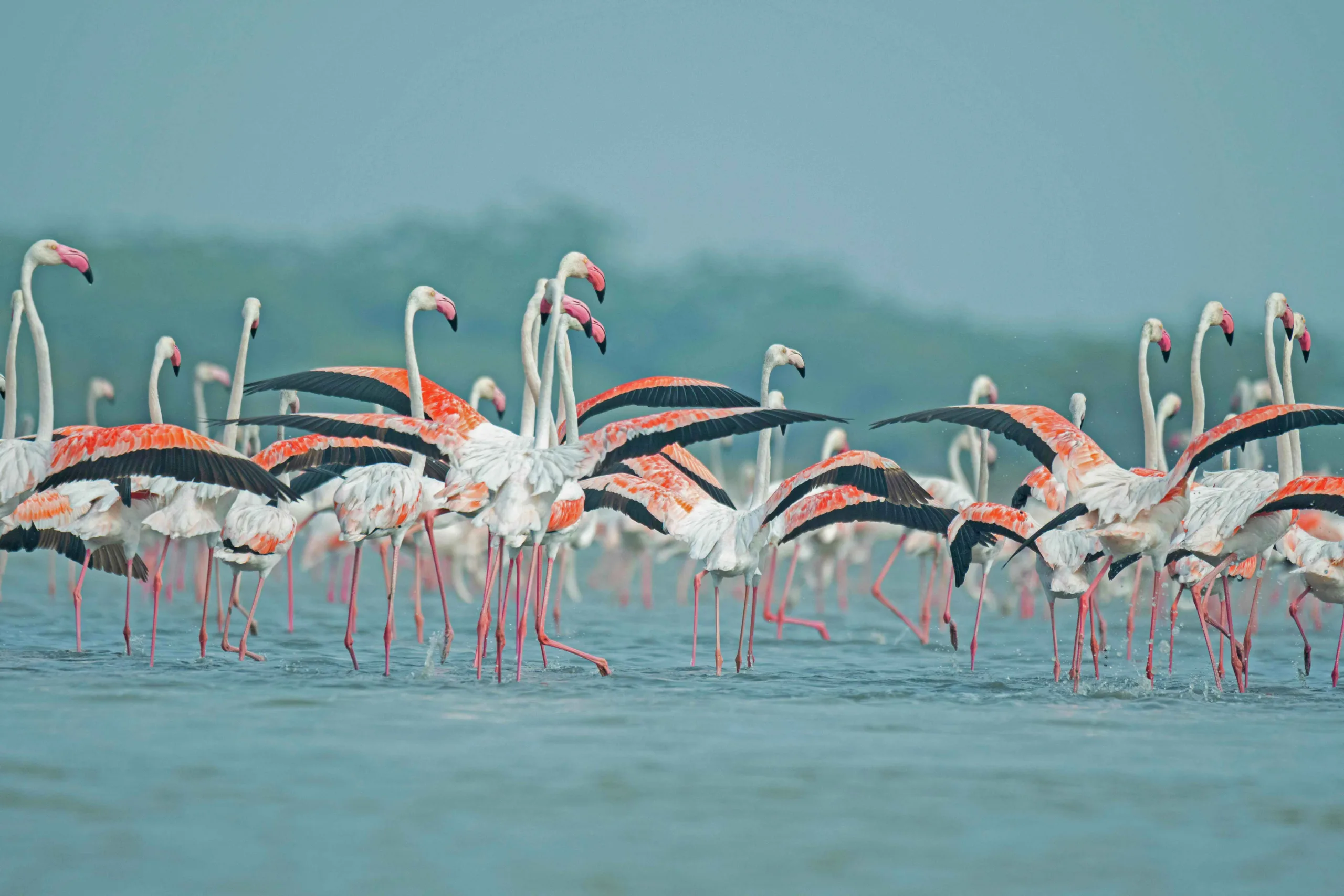
For centuries, the Maldives has been defined by blue. Azure lagoons, sapphire reefs, and cobalt drop-offs have shaped the nation’s identity as surely as tides shape its shores. But in recent winters, a new color has begun to punctuate that endless spectrum. Soft rose. Pale coral. Flamingo pink.
Each year, as the Northeast Monsoon—known locally as Iruvai—ruffles the Indian Ocean, the Greater Flamingo makes an appearance that is no longer extraordinary, but expected. What was once a biological anomaly—a lone “vagrant” bird blown off course—has become a seasonal phenomenon, transforming the mangroves and inland lakes of the northern Maldives into an unlikely migratory waypoint.
Wayfarers of the Flyway
The flamingos arriving in the Maldives are veterans of the Central Asian Flyway, an aerial superhighway stretching from the salt pans of Kazakhstan and Iran, across the Indian subcontinent, to the wetlands of East Africa. Their journey can exceed 18,000 kilometers round-trip—much of it over open ocean.
In Dhivehi, they are known as Gudugudaa Dhooni, a name echoing the bubbling drone of a traditional pipe and mimicking their low, goose-like calls. To the birds, the Maldives is not a destination but a sanctuary: a brief, essential pause to refuel, rest, and survive.
The Shift That Changed Everything
Until recently, flamingos in the Maldives were the stuff of legend—spoken of in hushed tones by birders and fishermen. That changed abruptly in 2021, when images of dozens of flamingos wading through northern wetlands went viral.
By January 2025, flocks were again reported with consistency in Kulhudhuffushi, confirming that the earlier sightings were not a fluke, but a pattern.
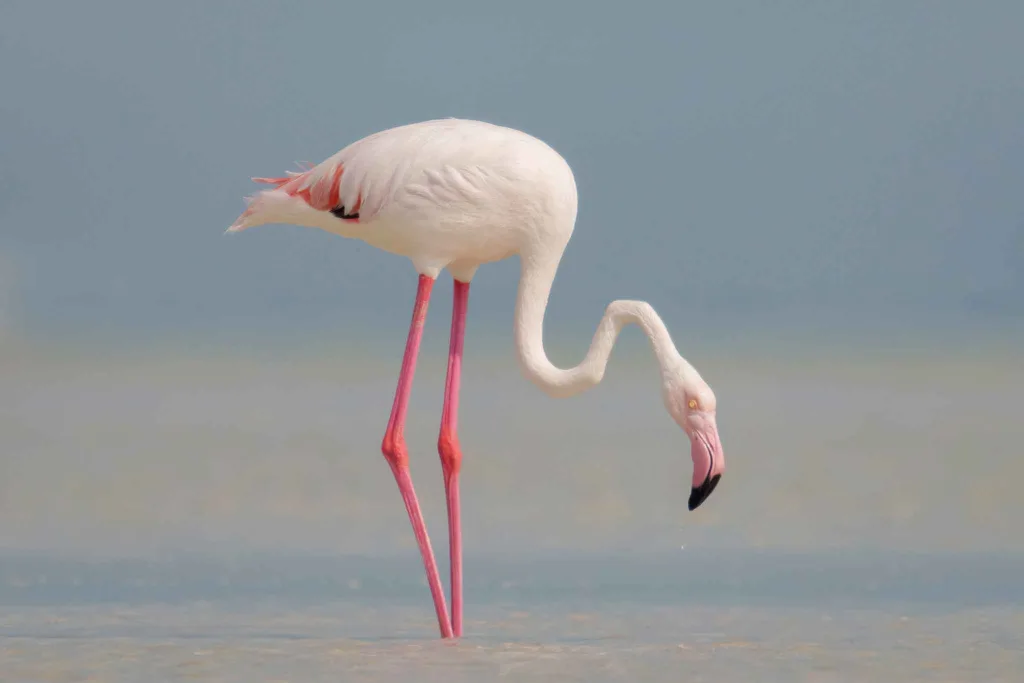
The reason lies in geography and chemistry. Brackish kulhi—inland lakes—on islands such as Funadhoo and Baarah are rich in brine shrimp and cyanobacteria. These organisms contain carotenoids, the pigments that stain flamingo feathers pink, and provide the dense nutrition needed after trans-oceanic flight.
Anatomy of a Stopover
When flamingos arrive, they do so on the edge of exhaustion.
For the first 48 hours, most remain motionless, balanced on one leg, heads tucked backward in deep recovery sleep. Only then do they begin to feed—sweeping the silty lakebeds with specialized, upside-down beaks that filter microscopic life from the water.
In the process, the birds reshape their temporary home. Their trampling feet churn sediments, releasing nutrients that fertilize mangroves and microorganisms alike. Ecologists describe them as inadvertent “ecosystem engineers.”
Within a week—sometimes ten days at most—the flock becomes restless. As barometric pressure shifts and winds align, the birds lift off in spiraling columns, settle into a loose V formation, and disappear into the horizon, leaving only ripples behind.
A Fragile Welcome
The flamingos’ popularity has been swift—and risky. In a country where land is scarce and wildlife lives close to people, wonder can easily tip into disturbance.
The birds are protected under Maldivian law, enforced by the Environmental Regulatory Authority. For the 2025 season, authorities reiterated zero tolerance: capturing, harming, or clipping wings—a practice recorded during the first influx in 2021—is a serious criminal offense.
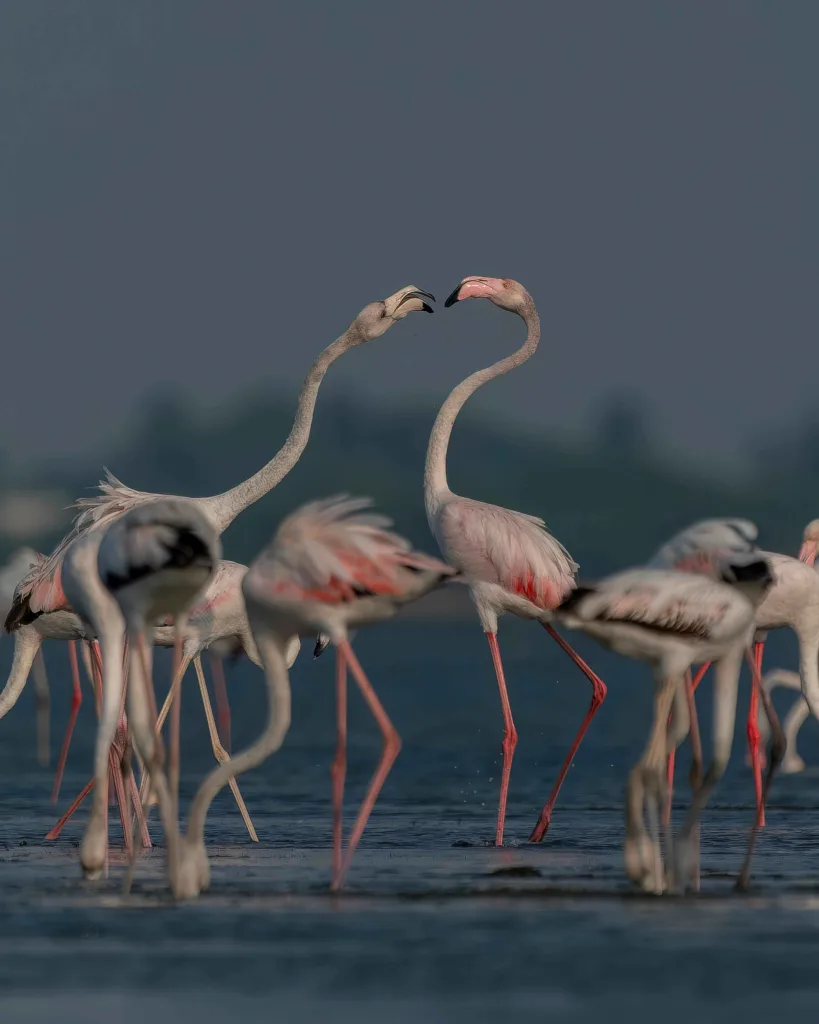
Conservationists urge restraint. Observers are advised to keep at least 50 meters away, limiting stress on birds already operating at the edge of their physiological limits.
Early Records: When Flamingos Were Only Rare Visitors
Long before flamingos began appearing regularly in the northern Maldives, their presence in the archipelago was documented only as a biological rarity. One of the most authoritative early records comes from ornithologist R. Charles Anderson’s 2007 study, New records of birds from the Maldives, published in Forktail. In this comprehensive review of Maldivian avifauna, Anderson reports just a handful of sightings of the Greater Flamingo, all involving solitary individuals rather than flocks.
The study records an immature flamingo observed in March 2001 at Eidigali Kili, a brackish lake in Addu Atoll, with the same bird likely present again in June that year. A single adult was noted at the same site in February 2002, though it was unclear whether this was the same individual. Crucially, Anderson characterizes these sightings as exceptional and irregular, consistent with vagrant birds straying far beyond their usual range.
At the time, flamingos were neither considered seasonal visitors nor part of any established migratory pattern in the Maldives. Against this historical backdrop, the repeated multi-year arrivals now being observed represent a marked departure from what was once thought possible—and underscore a significant shift in regional migratory behavior.
What the Pink Feathers Foretell
Scientists are now asking whether this shift marks a permanent change in flamingo migration—perhaps driven by altered wind patterns and climate instability across the Indian Ocean basin.
For Maldivians, the meaning feels more immediate. The flamingos are a reminder that even the world’s most isolated coral atolls are woven into global systems of survival. That a bird born on distant salt flats might depend, briefly, on a quiet mangrove pool in the far north of the Maldives.
Against the nation’s endless blue, the flamingos arrive like a living punctuation mark—brief, brilliant, and impossibly pink.