The Maldives is celebrated for its extraordinary marine biodiversity, and there are many reasons why its underwater world is unlike any other on Earth. Marine life here varies dramatically from one region to another, shaped by the country’s unique geography and ocean dynamics. As Dr. Ahmed Riyaz Jauhary, a renowned Maldivian marine biologist, explained when asked about this diversity:
“Everything in the deep is different from north to south: the marvelous sea mounts, pinnacles, and dynamic channels.”
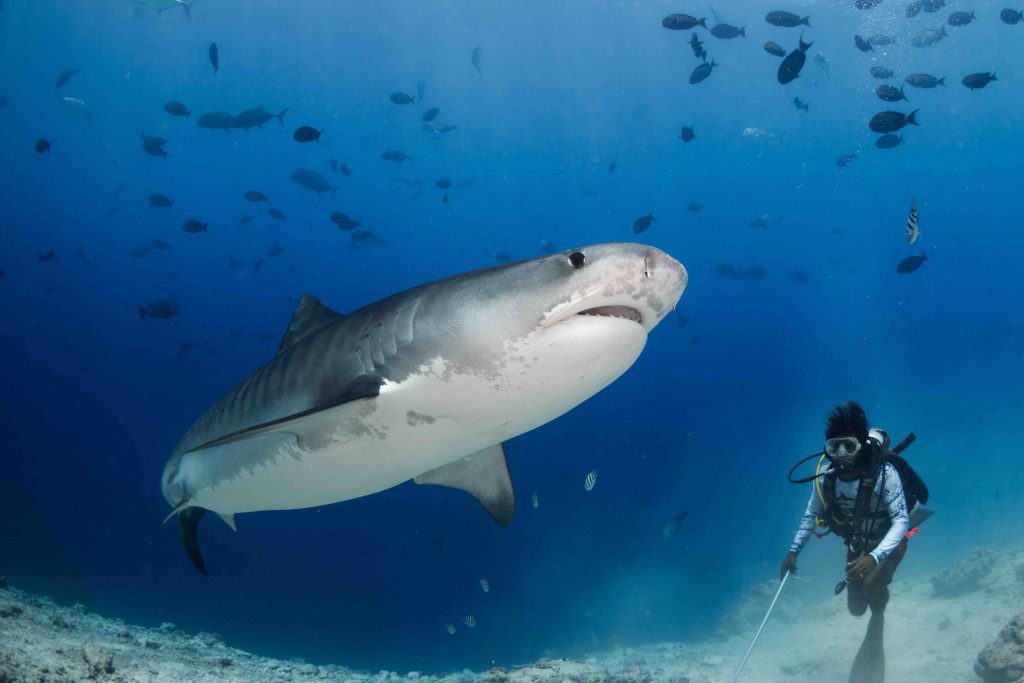
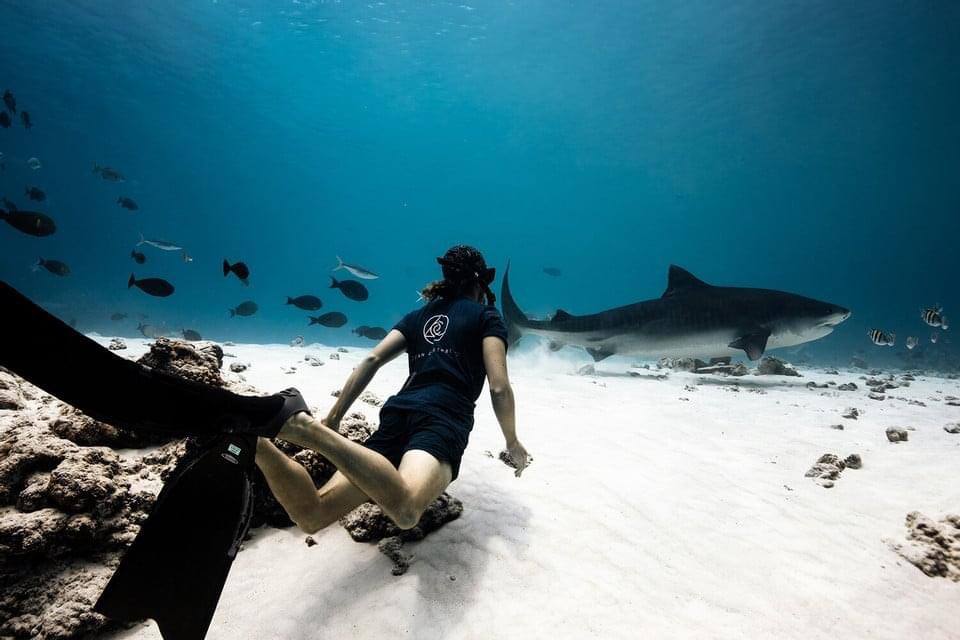
This diversity gives rise to an underwater world filled with color, movement, and mystery. Nowhere is this more evident than in Fuvahmulah—an island that rises dramatically from the depths of the Indian Ocean, standing alone and surrounded entirely by open sea. This rare geological formation has made Fuvahmulah a natural phenomenon and one of the world’s most renowned destinations for tiger sharks.
I am often reminded of my childhood days spent along the island’s pristine sandy shores. I recall going out with my late uncle, Abdulla Rafeeq, and watching large sharks swimming near a bokkoraa, a small traditional fishing boat. One memory remains especially vivid: the day the bokkoraa sped through the Neregando passage with a massive female shark onboard. It was a striped tiger shark. After the shark was brought ashore, the fishermen used a large knife to cut open its belly.
Inside were eight baby sharks, still alive. Eager and fascinated, my companions and I rushed to see them. We carefully released the newborn sharks into Nere’s passageways, watching in awe as they immediately swam away. This happened around 35 years ago, at a time when shark fishing was still legal in the Maldives.
According to elders of the island, large sharks have always gathered near fishing vessels. Fishermen frequently observed numerous sharks circling their boats when fish waste was discarded into the water. These powerful predators play a vital role in maintaining balance within the marine ecosystem. Tiger sharks are especially common around Fuvahmulah. The island is encircled by a shallow fringing reef that drops sharply into depths exceeding 2,000 meters. This close proximity to deep water is what makes Fuvahmulah truly unique, allowing both oceanic and coastal species to be observed nearshore (Araujo, Scotts, Zareer, 2024).
In recent years, scientists have reported unusually large aggregations of tiger sharks (Galeocerdo cuvier) around the island. A six-year study recorded 239 individual tiger sharks, representing the highest number ever documented within such a limited geographic area. The waters around Fuvahmulah are now recognized as a critical habitat for these sharks. Female tiger sharks frequently visit the area during gestation and display strong site fidelity, although their migration routes and birthing grounds remain unknown (Riyaz, Araujo, Crouch, Ivanova, Siyan, Dudek, and Vossgaetter, 2024).
Tiger sharks are generally regarded as coastal pelagic predators inhabiting warm and temperate oceans worldwide. They are commonly found near coastlines, continental shelves, and island slopes, yet they are capable of traveling vast distances across oceans. At times, they dive to depths of up to 500 meters during extended vertical migrations (Domingo, Coelho, Cortes, Mas, Mejuto, Miller, Cartelle, Santos, Yokawa, n.d.). Despite this ability, tiger sharks spend much of their time in shallow waters—approximately 36% on average, according to Heithaus, Dill, Marshall, and Buhleier (2001).
Seasonal patterns also influence shark movement. During spring and summer, sharks are more frequently observed over continental shelves. Factors such as ocean currents, water temperature, and prey availability are believed to drive these movements. Nutrient-rich upwellings often occur where continental shelves narrow, increasing primary productivity. Papastamatiou et al. (2013) observed that these movement shifts were associated with warmer ocean temperatures (23–26°C) and elevated chlorophyll-a levels. Warmer summer waters combined with higher productivity may therefore signal increased presence of G. cuvier in coastal areas.
Research conducted in eastern Australia further supports these findings. Studies on tiger shark habitat use revealed that tagged sharks spent 71% of their time near the surface and 96% of their time within the top 100 meters of the water column (Lipscombe, Spaet, Scott, Lam, Brand, Butcher, 2020).
Today, Fuvahmulah holds the prestigious designation of a UNESCO Biosphere Reserve. Its warm waters, year-round food availability, and striking underwater topography make it a global hotspot for tiger sharks. The surrounding seas also exhibit high site fidelity and temporal residence for these animals, further emphasizing the island’s importance as a critical marine habitat (Vossgaetter, Dudek, Crouch, Cope, Ivanova, Siyan, Niyaz, Riyaz, & Araujo, 2024).
Dr. Ahmed Riyaz Jauhary also shared that scientific findings from the 2022 Nekton expedition around the waters of Fuvahmulah are expected to be published soon. As an iconic species with immense ecological and economic value, the tiger shark’s protection remains a priority—ensuring that the mysterious waters of Fuvahmulah continue to thrive for generations to come.