In the vast, turquoise expanse of the Maldivian atolls, a unique group of foragers plays a silent but vital role in the health of the coral reef ecosystem. These are the Goatfishes (Family Mullidae), known locally by the general name Kalhu-oh. While they may not have the vibrant flash of a butterflyfish or the imposing presence of a reef shark, their specialized biology makes them the ultimate “detectives” of the sandy lagoon floors.
The Living Sensors
The most striking feature of the goatfish is its pair of highly mobile chin barbels. These fleshy whiskers are packed with chemosensory organs, allowing the fish to “taste” the sediment as they probe for hidden prey. As they move across the seabed, these barbels flicker constantly, detecting the faint signatures of worms and small crustaceans buried beneath the grains.
Species and Habitats
The Maldives serves as a diverse playground for several goatfish species, each occupying its own niche within the atoll structure:
01. Longbarbel Goatfish
Scientific Name: Parupeneus macronemus
Local Name: Kandu kalhuoh’
The Narrative: This species carries an air of elegance, defined by trailing, thread-like filaments on its dorsal and anal fins that drift behind it like silk ribbons. It is easily distinguished from its cousins by these elongated rays which reach all the way to the tail base.
- Key Identifier: Exceptionally long, slender barbels that sweep back as far as the pelvic fin base.
- Habitat: Most at home on shallow, sandy, or weedy bottoms throughout the Indo-West Pacific.
02. Side-spot Goatfish
Scientific Name: Parupeneus pleurostigma
Local Name: Lah kalhuoh’
The Narrative: The “beauty mark” of the reef, identified by a large, round black spot on its flank followed by a pale white patch. It is a common resident of the Maldives’ vibrant coral structures.
- Behavioral Hook: During courtship, males engage in a high-speed shimmering display, rapidly wriggling their barbels to signal to potential mates.
- Diet: A dedicated reef-dweller, it sifts through the substrate for benthic invertebrates.
03. Dash-dot Goatfish
Scientific Name: Parupeneus barberinus
Local Name: Maa kalhuoh’
The Narrative: The “heavyweight” of the group, growing up to 50cm. It is recognized by its signature “Morse code” markings: a dark reddish-brown stripe (the dash) running through the eye, followed by a bold black spot (the dot) at the tail.
- The Deep Diver: While others prefer the shallows, this powerhouse forager has been recorded at depths of 100 meters.
- The Hunt: It uses its barbels to probe the sand; once prey is detected, it roots its entire long snout into the sediment to extract crustaceans.
04. Yellow-striped Goatfish
Scientific Name: Mulloides flavolineatus
Local Name: Reendhoo-thiri kalhu-oh
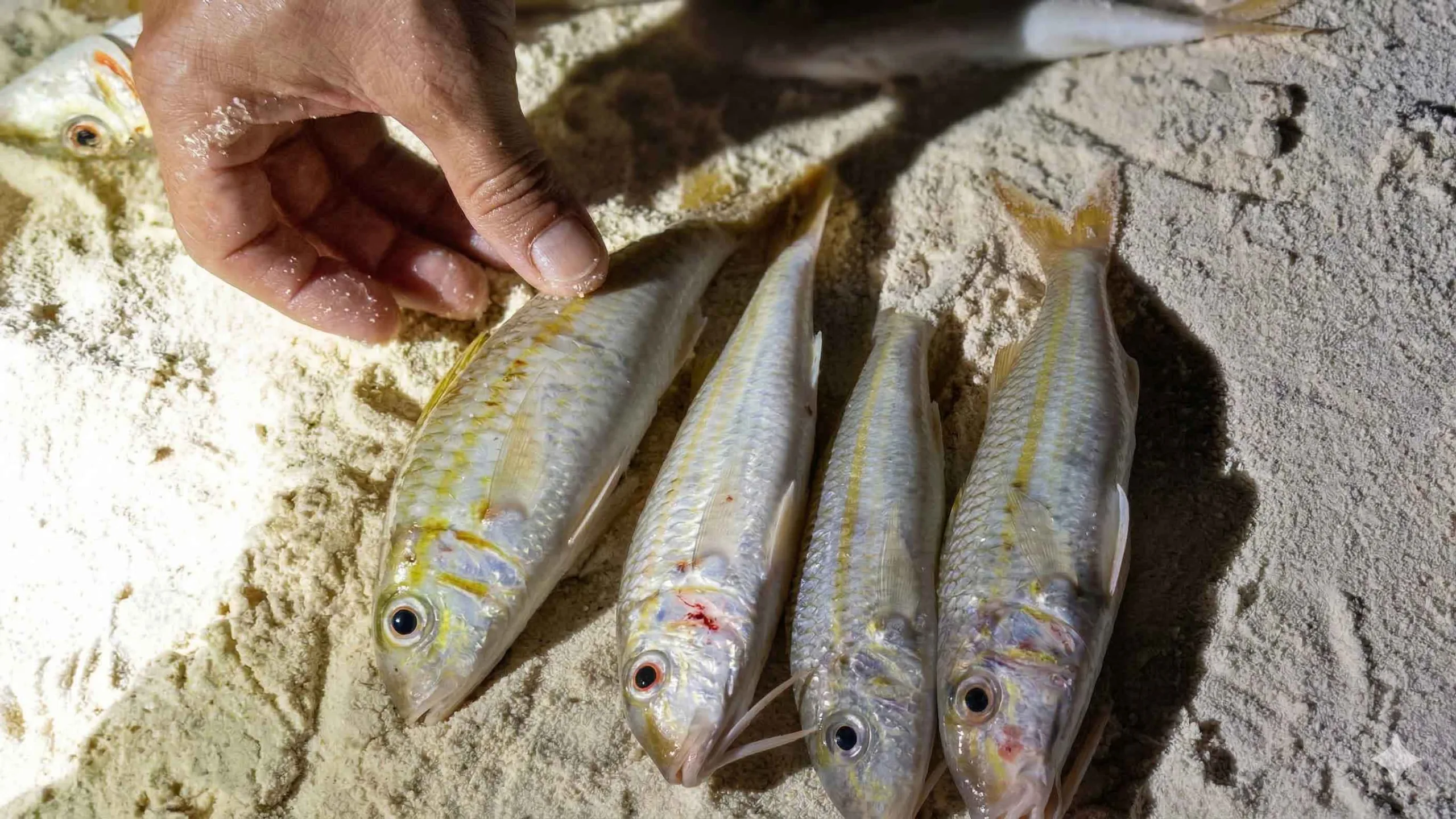
The Narrative: The quintessential schooling goatfish of the Maldives. These fish are the social architects of the shallows, often found in disciplined, shimmering groups that hover over sandy patches.
- Survival Strategy: Their strength lies in numbers. By schooling near reef edges, they create a confusing visual “shimmer” that protects them from larger predators.
05. Yellow-fin Goatfish
Scientific Name: Mulloides vanicolensis
Local Name: Dhon kalhu-oh
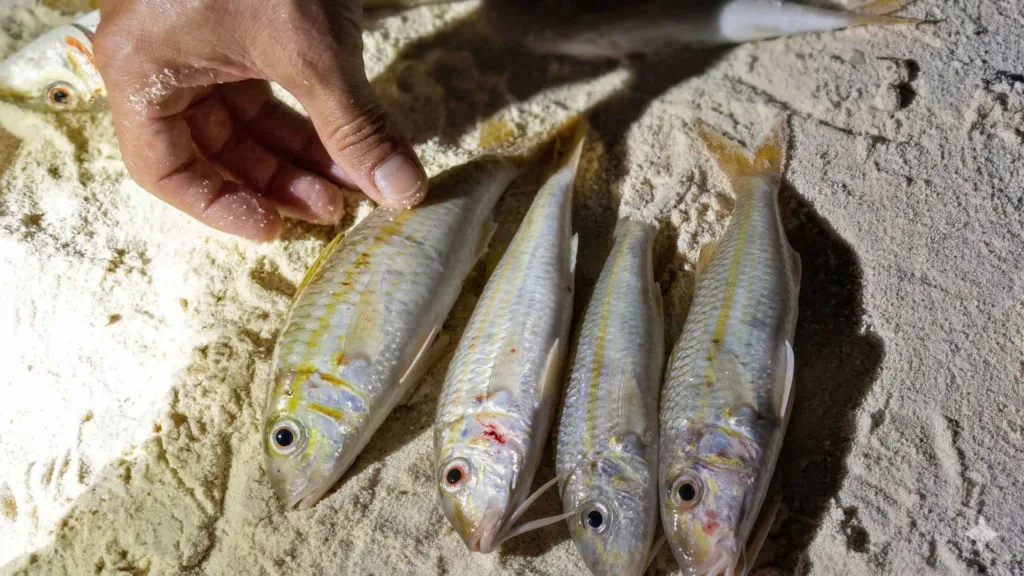
The Narrative: Vivid and unmistakable, this species is defined by its brilliant, sun-colored fins. It is one of the most versatile members of the family, bringing a splash of gold to various underwater landscapes.
Goatfish Fishing Methods
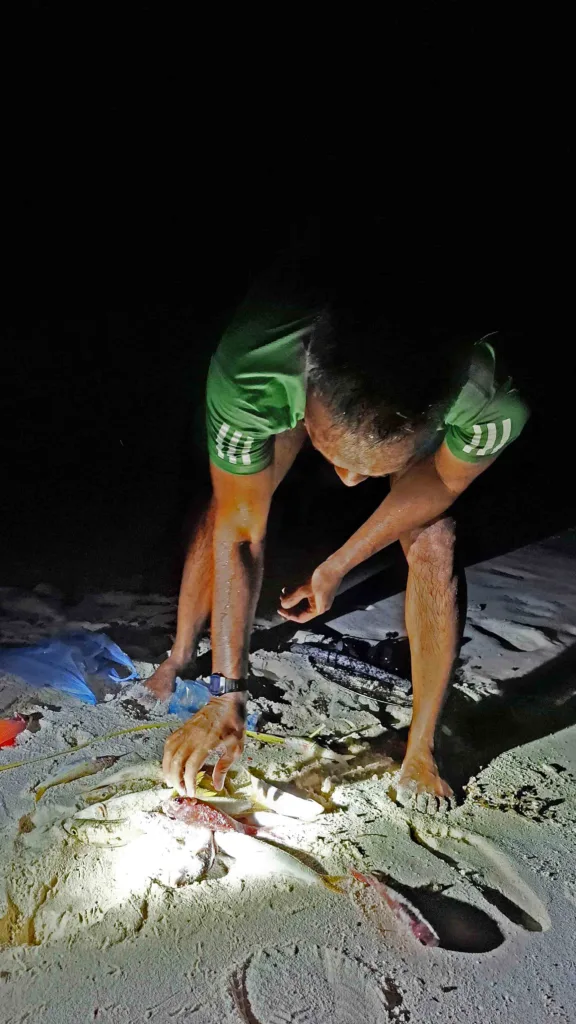
Goatfish are primarily caught using the handline fishing method. To attract the fish, a mixture of ground crab and hermit crab meat is scattered into the water as chum. For bait, the meat of these same species is rigged directly onto the hook. Occasionally, crushed sea lettuce leaves are mixed into the ground bait to enhance its effectiveness.
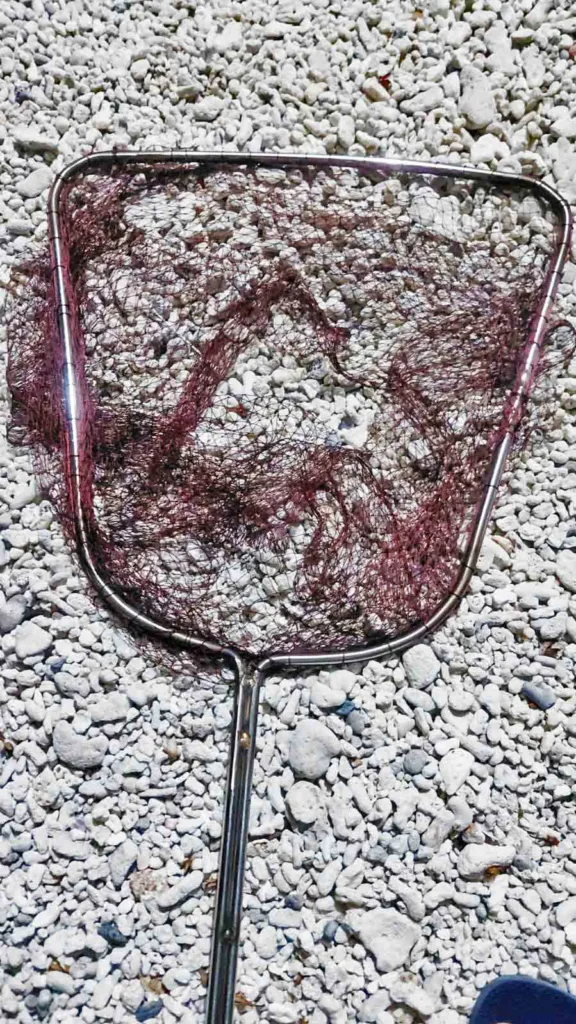
Alternatively, goatfish can be caught using specialized nets. Since these fish tend to swim slowly or rest near the seabed, fishermen use circular nets—typically ranging from 12 to 15 inches in diameter—to scoop them up.
Ecological Significance
Goatfishes are the natural “gardeners” of the reef. By constantly plowing through the sand, they aerate the sediment and prevent it from becoming stagnant. This behavior also has a “commensal” effect; other fish, such as wrasses and jacks, often shadow goatfishes to snatch up any small organisms stirred up by their vigorous digging.
Cultural and Commercial Value
In Maldivian culture, the goatfish holds a steady place of importance. They are recognized as a commercial fish species, providing a reliable food source for island communities. The detailed knowledge Maldivian fishers have of these species—reflected in the specific Dhivehi names given to each—underscores their significance in the local diet and the national fishing economy.
Whether darting through a seagrass meadow or schooling in the shadow of a coral bommie, the goatfish remains an essential link in the intricate web of life that defines the Maldivian archipelago.