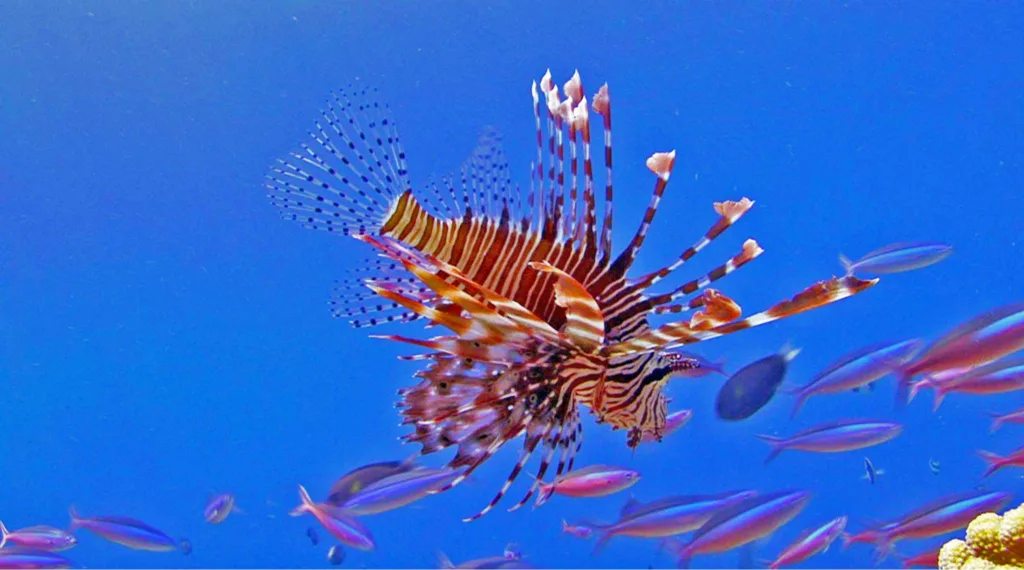
The first time I saw a lionfish was in 1994, when we kept a seawater fish tank at home. We often went to the eastern side of Malé to snorkel between the tetrapod rocks and the edge of the wall along the marine drive road (Boduthakurufaanu Magu) to catch small, colourful fish for the tank. One day, my friend and I went fishing in this familiar spot.
We snorkelled towards the tetrapods, where many beautiful fish swam among the corals. Some hid deep inside the rocks, so we positioned our net beside a stone and gently tilted it to coax the fish out. To our surprise, a stunning lionfish appeared. We knew that lionfish were poisonous, and we were frightened at first. But its beauty captivated us, and we decided to catch it for our home tank. We carefully netted the fish and brought it home, where it lived in our aquarium. Lionfish are among the most striking species found in the sea. They typically inhabit depths below 60 metres and prefer calm environments. Many people fear lionfish because they have 13 venomous spines on their dorsal fins (Anderson, 1997).
The Scorpaenidae family, to which lionfish belong, is large and complex, consisting of at least ten subfamilies, around 70 genera, and more than 350 species worldwide—many of which are still poorly understood (Kuiter, 2014). In the Maldives, approximately 25 species from this family have been recorded, though more are expected. Several species, including stonefish and lionfish, are venomous or potentially dangerous. All scorpionfish can inflict painful stings with the spines on their dorsal fins. When threatened, these fish raise their fins, and if cornered, they may charge.
Most stings occur when they are handled or accidentally touched. Their venom is heat-labile, meaning it can be neutralized with heat. Many species in this family are also well camouflaged, hiding effectively within reefs. Some are rarely encountered because they live deep or secretively within coral structures and are known mainly from trawled or chemically collected specimens. Their diet consists primarily of fish and mobile invertebrates.
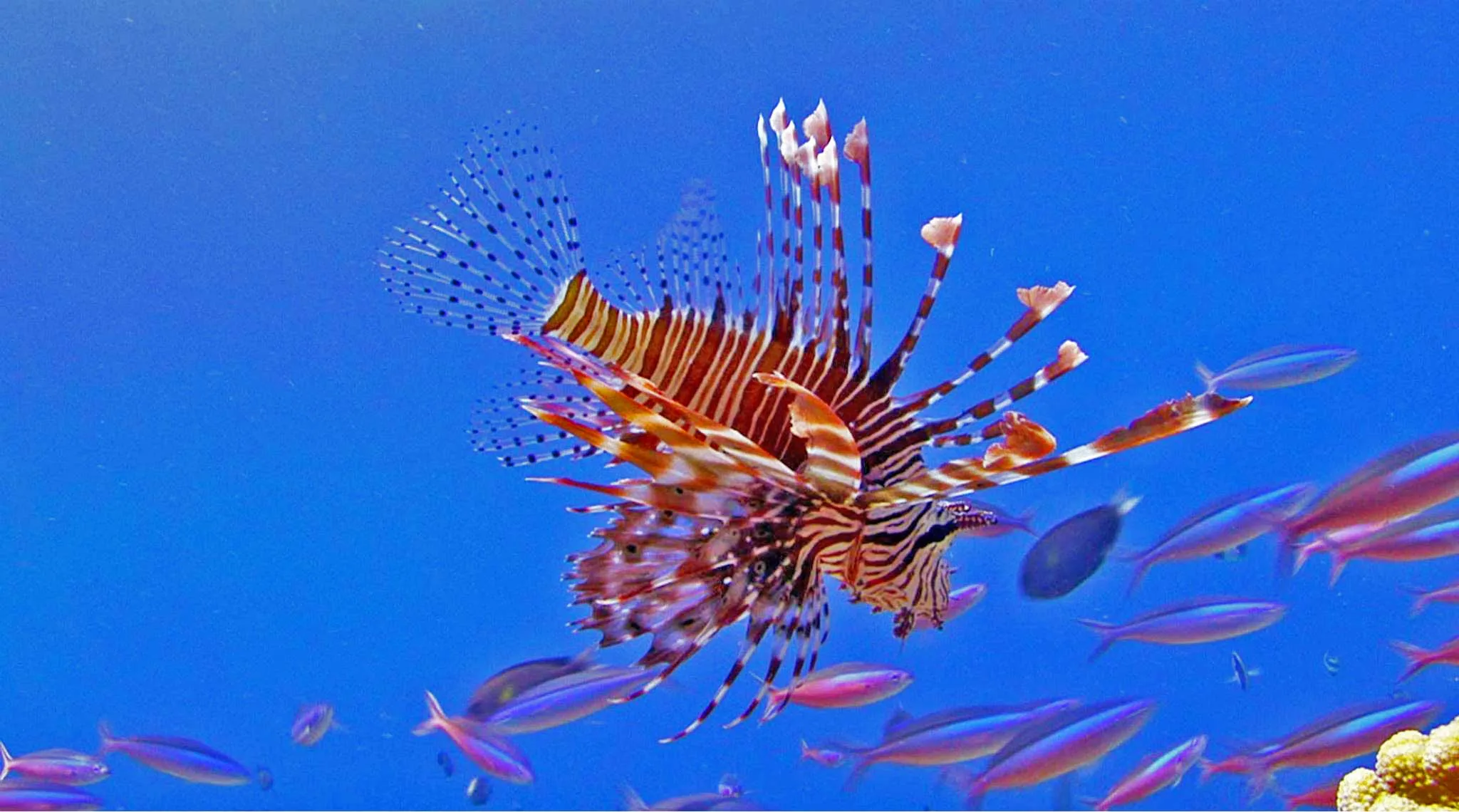
The most recognizable lionfish species has long, feathery fins and venomous dorsal spines. The classification of Pterois miles versus P. volitans is complex, but some experts believe the continental form (P. miles) does not occur in the Maldives, though it is often studied as the Indian Lionfish. Lionfish are widespread throughout the Indo-Pacific (Kuiter, 2014).
Common Lionfish
English names: Common lionfish, Zebra lionfish, Lionfish, Red Lionfish
Scientific name: Pterois volitans Family: Scorpaenidae
Local name: Kanfaiykuda Fanhaamas
Order: Scorpaeniformes
Maximum size: 20 cm (Kuiter, 2014)
This lionfish is commonly seen in shallow reef habitats, particularly in lagoons, but it also inhabits a range of environments—from isolated coral bommies to caves along deep reef drop-offs. It feeds on small fish, using its large, fan-like fins to corner prey, and is instantly recognisable by its long, feathery fins and venomous dorsal spines (Kuiter, 2014).
Indian Lionfish
English names: Indian lionfish, Soldier turkeyfish
Scientific name: Pterois miles
Family: Scorpaenidae
Local name: Fanhaamas
Order: Scorpaeniformes
Maximum size: 35 cm (Anderson, 1997)
This lionfish is primarily benthic, spending most of its time on or near the seafloor. It is commonly found among coral heads, rocky crevices, and sandy patches at depths reaching roughly 60 m (Anderson, 1997).
Clearfin Lionfish
English names: Clearfin lionfish Clearfin turkeyfish
Scientific name: Pterois radiata
Family: Scorpaenidae
Local name: Hulhu Fanhaamas
Order: Scorpaeniformes
Maximum size: 20 cm (Anderson, 1997)
This lionfish is a benthic species found in shallow waters, usually down to about 30 m. It is shy and mainly nocturnal, spending the daytime hidden among coral crevices or beneath rocky ledges. After nightfall, it becomes more active and moves out to forage. Its diet consists largely of crabs and shrimps, which it captures using swift, well-aimed strikes and the help of its broad pectoral fins (Anderson, 1997).
Sources
- Anderson, R. C. (1997). Fishes of the Maldives. Marine Research Centre.
- Kuiter, R. (2014). Fishes of the Maldives. Atoll Editions.