The Reef’s Bounty: Five Maldivian Fish Loved by Locals
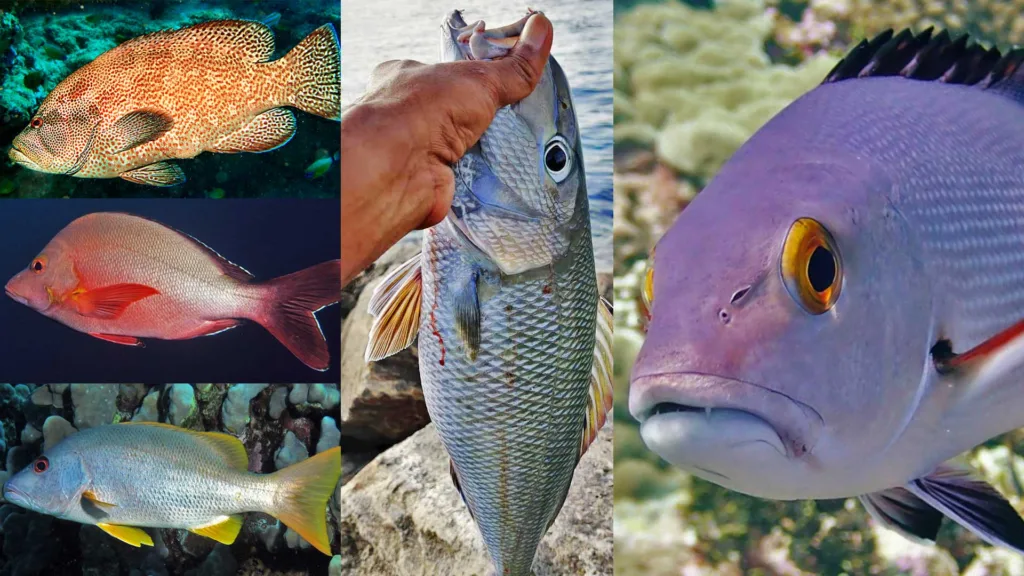
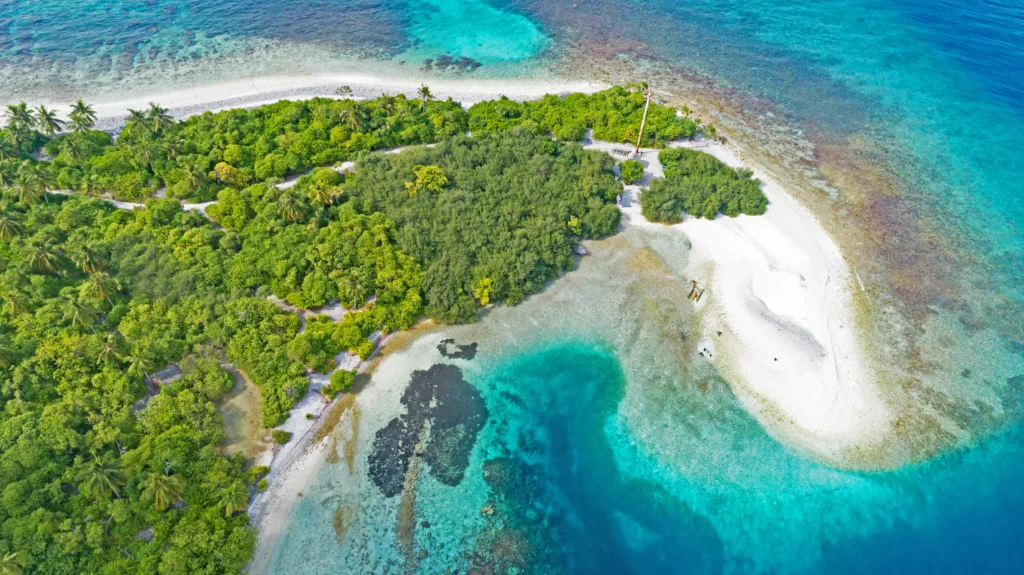
The Maldives—a nation stitched together by sunlit islands and crystalline seas—has a cuisine shaped profoundly by the ocean. While tuna dominates industrial fishing and export, it is the coral reefs that quietly sustain everyday island life.
These reefs are home to an extraordinary diversity of fish, prized by Maldivians for their firm white flesh, clean flavor, and versatility in the kitchen. Caught largely through traditional, low-impact methods such as hand-lining, reef fish remain at the heart of authentic Maldivian cooking.
The list of favorite reef fish varies from island to island and household to household. Many more species could be named. For this article, however, I have limited the selection to five species that are widely recognized, deeply familiar, and consistently loved across the Maldives. It would be too lengthy to cover additional details related to these species in a single piece. In future pieces, I will explore other reef fish from different perspectives.
These are five reef fish that hold a special place on the Maldivian plate.
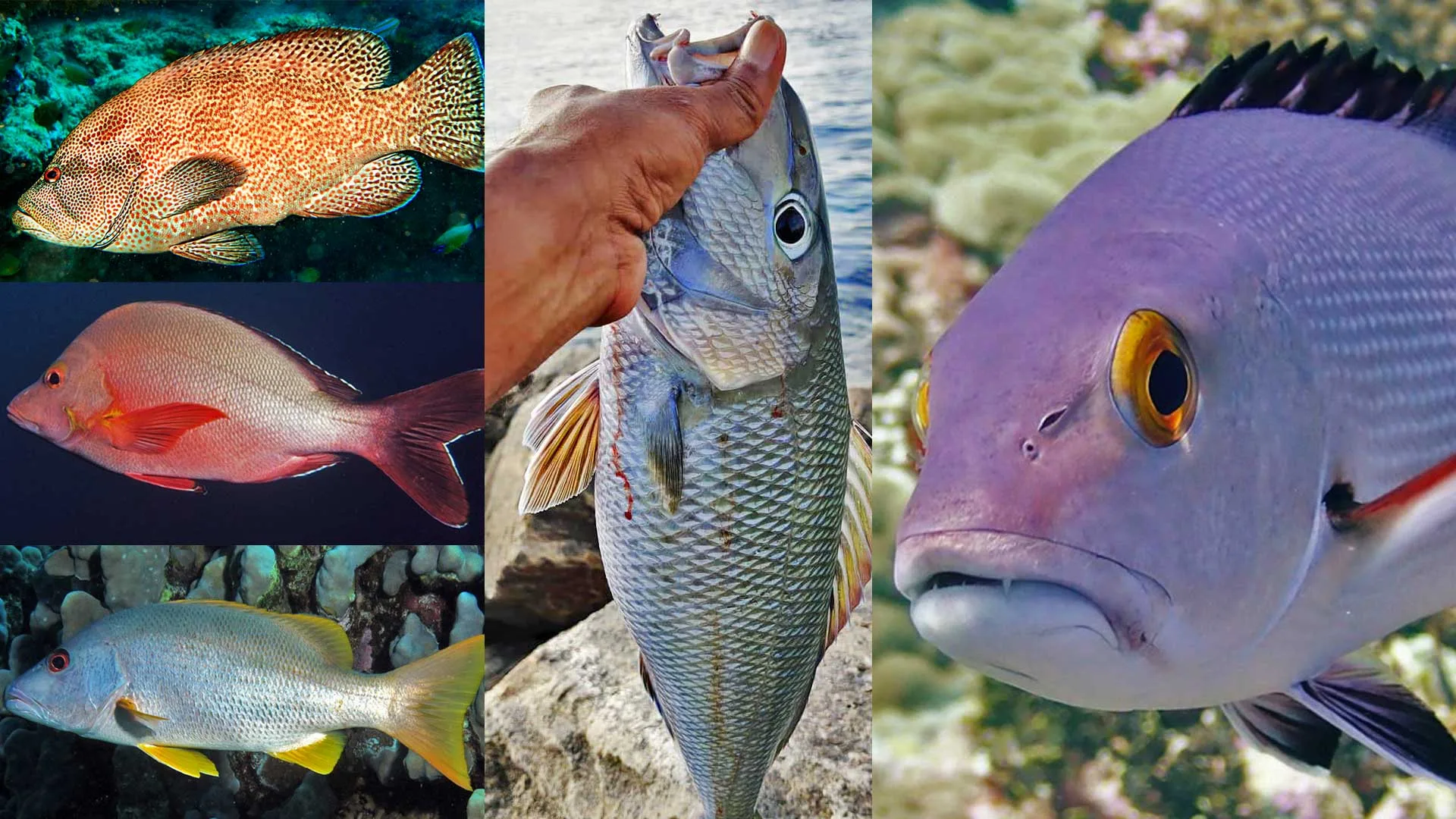
1. Humpback Red Snapper (Lutjanus gibbus)
Local name: Ginimas

Arguably one of the most recognizable snappers on Maldivian reefs, the humpback red snapper is both abundant and iconic.
- Distinctive features: As adults, these fish develop a steep, humped dorsal profile that gives the species its name. Their coloration ranges from deep red to grayish tones. During daylight hours, they are often seen resting in large, stationary schools along outer reef slopes.
- Culinary appeal: An important commercial and subsistence species, ginimas offers firm, flavorful flesh that adapts well to many styles of cooking.
- Local preparation: Its robust texture makes it ideal for grilling (fihunu mas), roasting whole, or cutting into chunks for fish curry (mas riha). One of its most cherished preparations, however, is garudhiya—a clear fish broth gently boiled with minimal ingredients. Light yet deeply aromatic, garudhiya carries the pure scent of the sea, enriched by fish oils and collagen. Ginimas and garudhiya are typically eaten with rice, lime, onion, and chili.
2. Green Jobfish (Aprion virescens)
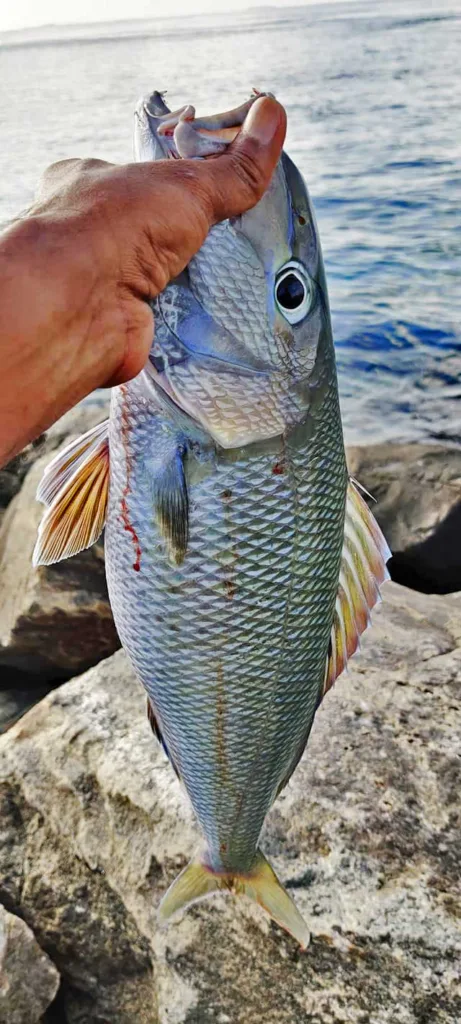
Local name: Giulhu
Sleek, fast, and powerful, the green jobfish is one of the most respected catches in the Maldivian archipelago.
- Distinctive features: Elongate and muscular, giulhu displays dark green to bluish tones along its back, fading to pale gray below. It inhabits open waters near deep lagoons, reef edges, and seaward slopes and is well known among fishers for its strength when hooked on a handline.
- Culinary appeal: Highly prized for its excellent flesh quality, green jobfish offers firm, white meat with a mild sweetness.
- Local preparation: Giulhu is commonly grilled or fried and is also favored for garudhiya, where its clean flavor is allowed to stand on its own. Its versatility makes it a prime fish in both everyday meals and special occasions.
3. Two-Spot Red Snapper (Lutjanus bohar)
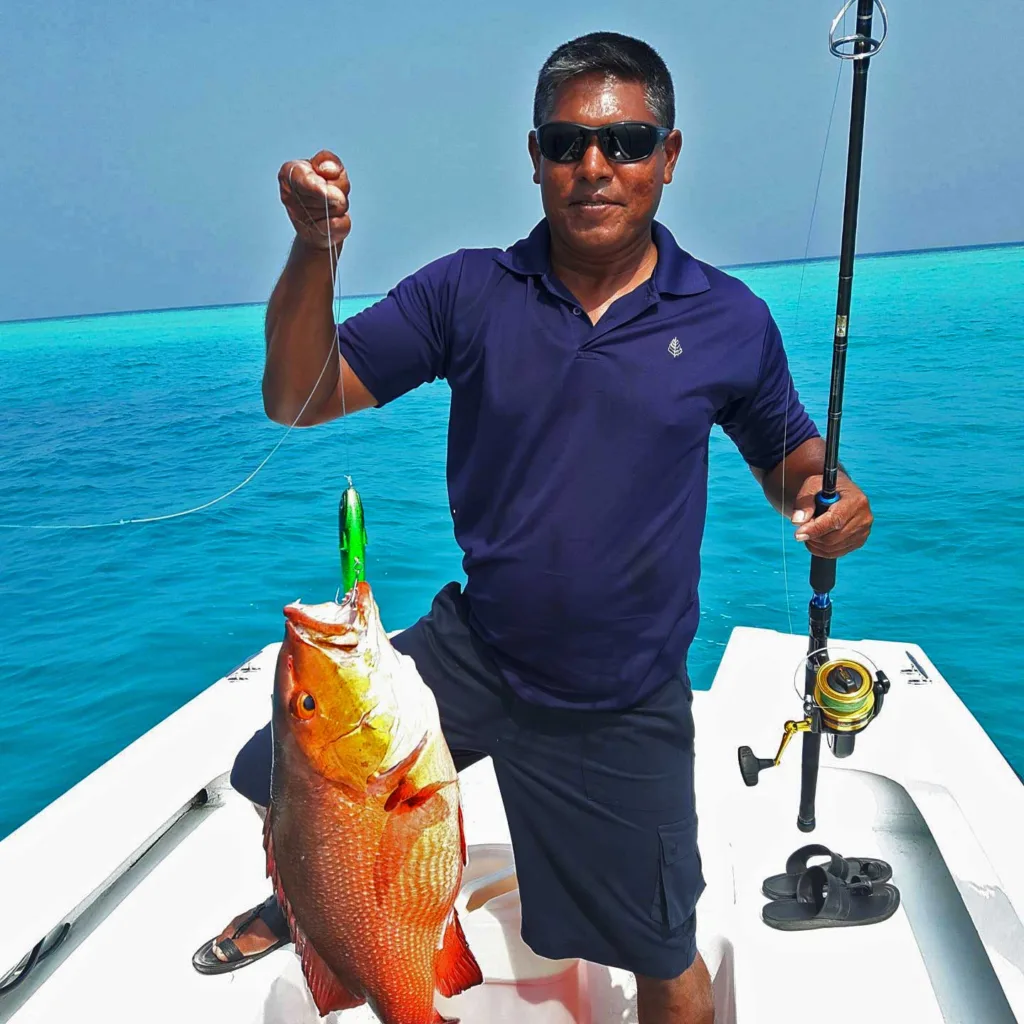
Local name: Raiymas
Large, powerful, and deeply respected, the two-spot red snapper is often considered the signature reef fish of the Maldives.
- Distinctive features: Juveniles and sub-adults display two pale or dark spots beneath the dorsal fin, from which the species takes its name. Adults lose these markings and turn a rich, deep red. Mature fish are typically solitary, inhabiting steep outer reef slopes.
- Culinary appeal: One of the most common large snappers in Maldivian waters, raimas is widely regarded as a top-tier food fish.
- Local preparation: Most commonly prepared as curry, raimas is cubed and cooked in spiced coconut-based mas riha. It is also widely consumed grilled, where its firm flesh and rich flavor truly shine.
4. One-Spot Snapper (Lutjanus monostigma)
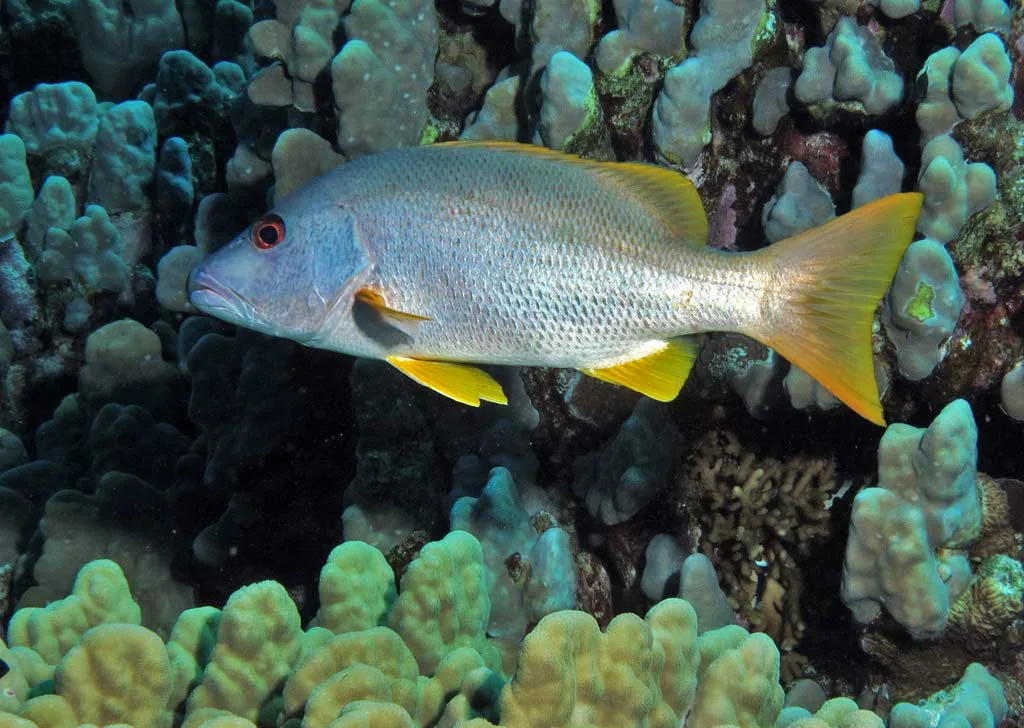
Local name: Filolhu
Smaller but no less valued, the one-spot snapper is a familiar presence in both reefs and markets.
- Distinctive features: Identified by a single dark spot on its upper flank—sometimes faint in large adults—filolhu is typically yellow to bronze in color. It inhabits coral reefs and lagoons, often in shallow waters.
- Culinary appeal: Its moderately sized body yields firm, white, mildly sweet flesh, making it a reliable and popular choice for home cooking.
- Local preparation: Filolhu is excellent grilled and well suited for coconut-based curries. It is also commonly used in both curry and garudhiya.
5. Grouper (Epinephelinae family)
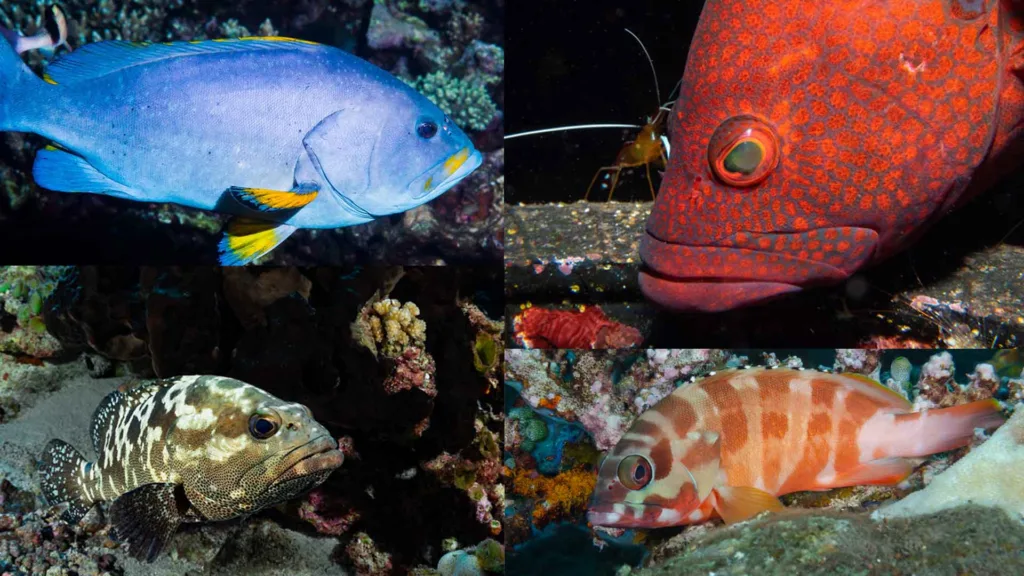
Local name: Faana (with species-specific names)
Few reef fish command as much respect in Maldivian cuisine as the grouper. There are several species of groupers that Maldivians love to eat, a topic for a separate article. But I have already written: Maldives Reef Fish: Popular Grouper Species You Need to Know.”
- Distinctive features: Groupers are heavy-bodied fish with large mouths, adapted for ambush hunting. Solitary by nature, they are usually found hiding in reef caves, crevices, and coral overhangs.
- Culinary appeal: Celebrated for their snow-white, flaky, and succulent flesh, groupers are considered a premium catch—equally prized for festive meals and upscale dining.
- Local preparation: Because of their delicate texture, groupers are often prepared simply: grilled, roasted whole, or lightly fried. They are also excellent for garudhiya, lending the broth a rich yet clean flavor.
Reef, Food, and Continuity
Together, these five reef fish represent more than taste alone. They reflect the Maldives’ enduring relationship with its coral reefs—an ecosystem that feeds both body and culture. In an era of environmental change, these species stand as reminders that healthy reefs are not only ecological treasures but living pantries that sustain island life, tradition, and identity.
Fishing Methods for the Five Maldivian Reef Fish
The primary method for catching the species listed—Humpback Red Snapper (Ginimas), Green Jobfish (Giulhu), Two-Spot Red Snapper (Raiymas), One-Spot Snapper (Filolhu), and Grouper (Faana)—is handline fishing.
This traditional technique is favored for reef fish across the Maldives because it is selective, low-impact, and perfectly suited to the behavior and habitat of these species.
The Dominant Method: Traditional Handline Fishing (Hook and Line)
This method is the backbone of reef fishing in the Maldives and is directly referenced for its role in sustaining everyday life.
| Species Group | Why Handline is Used | Key Characteristics of the Catch |
| Snappers (Ginimas, Raiymas, Filolhu) | Snappers are ambush predators or form stationary schools near reef slopes. Handlines allow fishers to precisely drop baited hooks to the desired depth near reef slopes, canyons, or school locations. | Ginimas (Humpback Red Snapper) forms large schools, making it a reliable target for a well-placed line. Raiymas (Two-Spot Red Snapper) is a powerful, solitary fish, prized for the fighting challenge on the line. |
| Green Jobfish (Giulhu) | This species is described as “sleek, fast, and powerful” and inhabits open waters near deep lagoons and seaward slopes. Handlining is essential for tackling its strength and reaching its habitat. | Giulhu is respected for its “strength when hooked,” making the capture a test of skill and endurance for the fisher holding the line. |
| Groupers (Faana) | Groupers hide in caves and crevices (ambush hunters). A handline allows a fisher to drop bait directly near or into the known hiding spot of a grouper. | The challenge is hauling the heavy, large-mouthed Faana out quickly before it can wedge itself firmly into the reef structure. |
Equipment and Technique Details
- Line: Traditionally, simple, strong monofilament lines (often wrapped around a wooden spool or plastic tube) are used.
- Bait: Small live or fresh-cut bait fish (like smaller reef fish or squid/octopus) are used to lure the target species.
- Skill: The Maldivian fisher relies entirely on the feel of the line in their hands to detect the subtle take of the bait, the strike of the fish, and the subsequent fight, which is crucial for preventing the fish from cutting the line on the sharp coral.
Other Methods
While handlining is dominant, the nature of these species means a few other low-impact techniques may also be used:
- Lure Fishing: Casting from a boat using stick baits and other artificial lures (often from speed launches or boats) is used to catch these fish.
- Trolling: The fast-moving, pelagic-like Green Jobfish (Giulhu) may occasionally be caught by small-scale trolling near reef edges, though hand-lining remains the most dedicated method.
- Spearfishing: Historically and in some subsistence contexts, snorkeler or diver spearfishing may target the large, solitary Groupers (Faana) and Two-Spot Red Snappers (Raiymas) found hiding in caves, but this method is often tightly regulated or prohibited in protected areas.
- Gill Nets/Traps: These methods are generally avoided for high-value reef fish in the Maldives due to concerns over bycatch, damage to the coral reef, and potential to injure the quality of the fish’s flesh. The local preference is for the clean, high-quality catch provided by the handline.