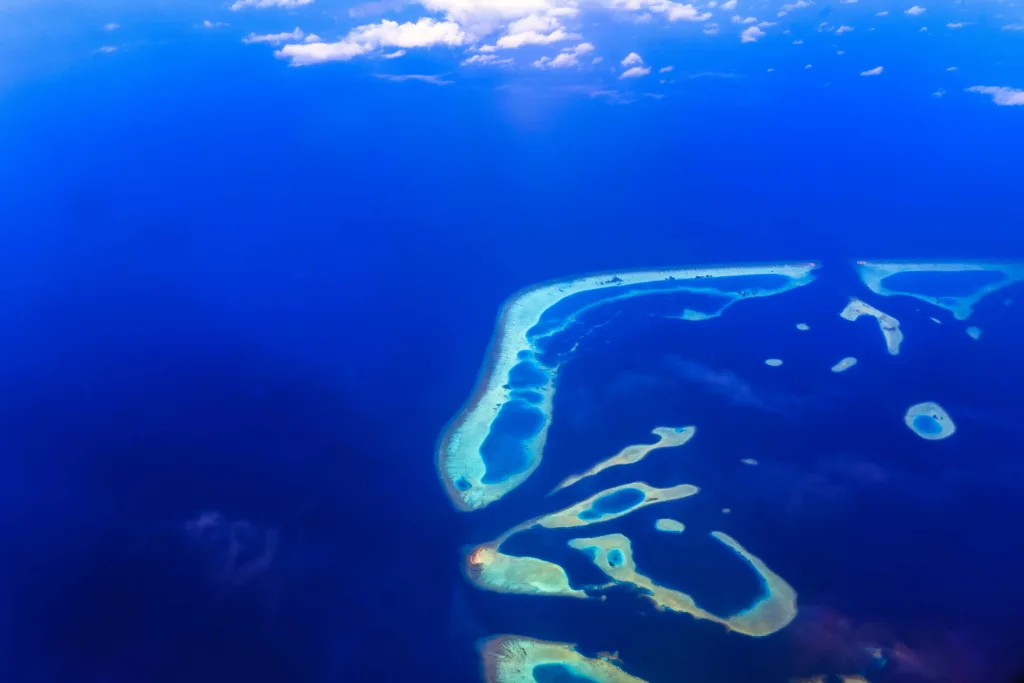
At first light, the sea around the Maldives is calm enough to mirror the sky. A wooden fishing boat drifts offshore, its crew scanning the water in silence. Then the stillness breaks—a flash of silver, a sudden pull, a fisherman’s pole bowing as a tuna surges against the line. There are no nets, no machines. Just muscle, timing, and knowledge passed down through generations.
For more than a thousand years, Maldivians have fished this way, taking tuna one at a time. In an era of industrial fleets and overfished oceans, this ancient practice endures—sustaining livelihoods, protecting marine ecosystems, and binding island communities to the sea that has always defined them.At sunrise in the Maldives, the sea is calm and bright. A wooden fishing boat moves slowly out of a lagoon. The engine hums softly. On deck, fishermen stand barefoot, poles resting along the rail, eyes fixed on the water ahead.
There are no large nets on this boat.
There are no long lines stretching far into the sea.
Instead, there are fishing poles, live bait swimming in tanks, and knowledge shaped by centuries of life with the ocean.
This is pole-and-line fishing. In the Maldives, it is not just a way to catch fish. It is a living tradition.
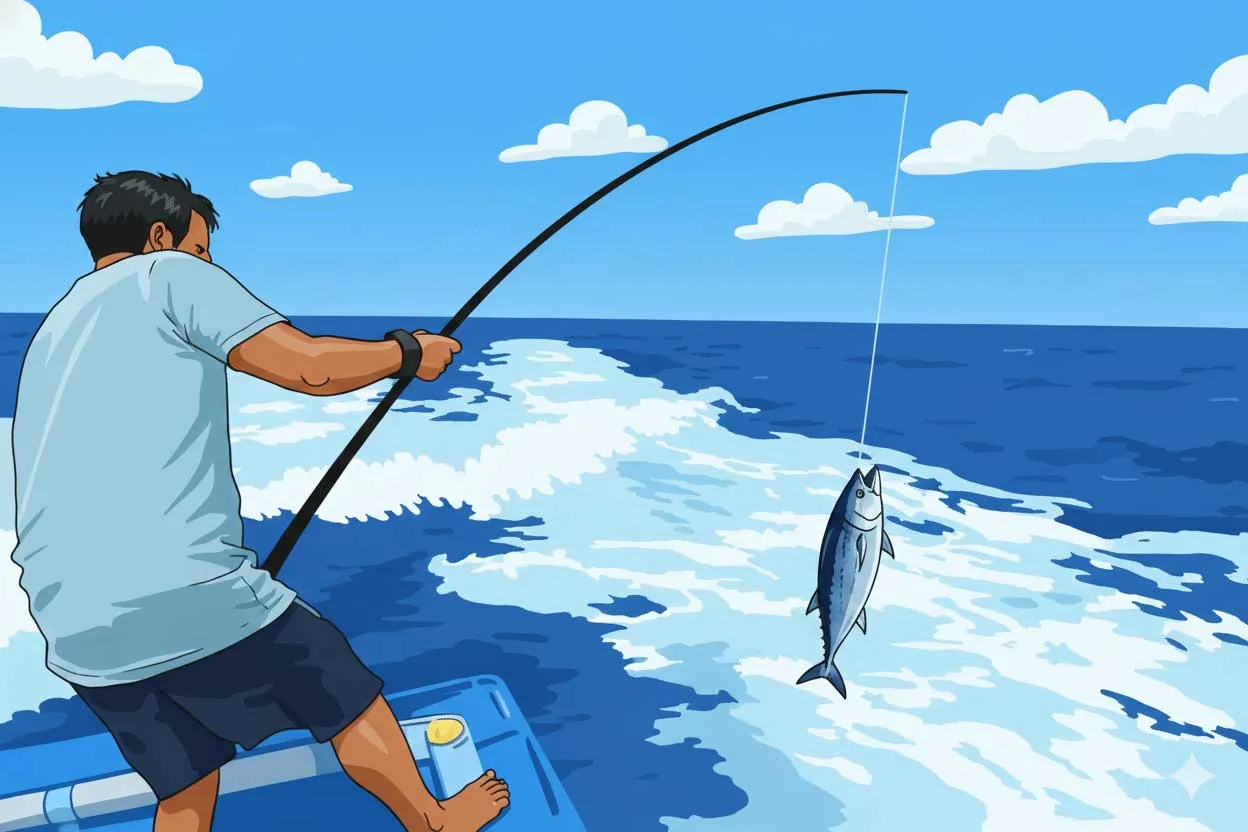
The rhythmic motion of pole-and-line fishing: Hook, lift, and release.
A Fast and Careful Way to Fish
When a school of tuna breaks the surface, everything happens quickly. Small live bait fish are thrown into the water. The tuna rush in, chasing them.
Each fisherman lifts a pole. The line is short. The hook is small and barbless. One tuna is caught at a time, lifted cleanly over the shoulder, and dropped onto the deck. As soon as the fish lands, it slips free. The line goes back into the water at once.
Hook. Lift. Release.
Again and again.
This speed is the secret of pole-and-line fishing. It allows many fish to be caught quickly without heavy gear. Fishermen choose what they catch. They do not trap everything in their path.
The Heart of the Tuna Fishery
Pole-and-line fishing is the backbone of the Maldivian tuna fishery. It supplies most of the country’s tuna, especially skipjack tuna, which forms the bulk of daily catches.
A local community coming together over the daily catch.
For hundreds of years, tuna has fed island communities, supported trade, and shaped daily life. Even today, tuna remains the country’s most valuable export and a main source of income for many outer islands.
While tourism now brings more money to the Maldives, fishing continues to tie people closely to the sea.
Gentle on the Ocean
Pole-and-line fishing causes very little harm to marine life.
Because fishermen catch one fish at a time, unwanted catch is rare. Sharks, turtles, seabirds, and dolphins are almost never caught. There are no large nets left drifting in the water. No long lines remain after fishing ends.
When the boat leaves, the ocean looks the same as before.
This matches the Maldives’ strong protection of marine life. Sharks are protected. Marine turtles are protected. Whales and dolphins are protected. Pole-and-line fishing works naturally with these rules, rather than against them.
A Tradition Older Than the Nation
The Maldives has a recorded history stretching back over 3,000 years. Yet its most lasting technology may be this simple fishing method.
Researchers believe pole-and-line fishing has been practiced in the islands for at least 1,000 years. It developed as a perfect response to island life—allowing people to harvest the rich tuna schools of the Indian Ocean without damaging the coral reefs that protect the land.
The exact moment this method began is unknown. It belongs to a time before written history. But later records confirm its importance.
Voices from the Past
In the 14th century, the traveler Ibn Battuta visited the Maldives. He described an island economy built around dried tuna, known as “Maldive Fish,” which was traded widely across the Indian Ocean. Such trade could only exist with a reliable and organized fishing system.
Two centuries later, the French sailor François Pyrard de Laval lived in the Maldives for several years after being shipwrecked. He wrote about fishermen catching tuna using poles, short lines, and barbless hooks, with live bait thrown into the sea to excite the fish.
The method he described is almost exactly the same one used today.
Tools Shaped by Nature
Before modern materials, Maldivian fishers relied on nature and trade.
Fishing poles were made from bamboo, valued for being light, strong, and flexible. A skilled fisher could flick a struggling tuna into the boat in one smooth motion. Because bamboo does not grow easily in the Maldives, it often arrived through trade or as driftwood.

Fishing lines were made from natural fibers. Coconut husks were twisted into strong coir rope. Cotton and hemp, often imported, were treated with natural oils to keep them light in water.
The hooks were small and barbless. Early hooks were carved from shell, bone, or wood. Later, iron hooks arrived through trade. The lack of a barb was a smart design choice. It allowed fish to fall free instantly, saving time during the rush of a feeding frenzy.
An Ancient Answer to a Modern Problem
Today, the Maldives is one of the few countries where large-scale net fishing for tuna is banned. Instead, an ancient method continues at a modern scale.
The same ideas recorded centuries ago—live bait, barbless hooks, skilled hands—are now seen around the world as a model for sustainable fishing.
As the sun climbs higher, the fishing boat turns back toward land. The hold is full. Seawater washes the deck clean as the islands come into view.
Behind the boat, the sea closes quietly once more, leaving no nets, no lines, and no trace of the morning’s work.
In a world searching for better ways to fish, the Maldives offers a simple lesson: sometimes the most modern solution is the one shaped long ago by patience, skill, and respect for the living sea.