

Inspired by the teachings of Toru “Totos” Ogasawara & Norihiro Sato
Slow-Pitch Jigging (SPJ) is a revolutionary Japanese technique, pioneered by masters like Norihiro Sato and Toru “Totos” Ogasawara, that is transforming the world of deep-sea fishing. Unlike traditional high-speed jigging which demands immense physical stamina, SPJ is a tactical, low-effort method that relies on rhythm and finesse to trigger strikes. By perfectly mimicking a weak or wounded baitfish through controlled pauses and glides, this technique proves surprisingly effective—catching everything from bottom dwellers to pelagics, especially when fish are lazy or inactive. If you’re tired of crank-and-wind jigging and want a strategy that works when nothing else does, this simple breakdown of SPJ is your solution.
Slow-pitch jigging (SPJ) looks slow and simple—but its effectiveness is surprising. Unlike traditional high-speed jigging, which demands strength and stamina, slow-pitch jigging focuses on letting the jig move naturally so fish can’t resist striking.
If you’ve ever thought “Jigging is too tiring”—this is the solution.
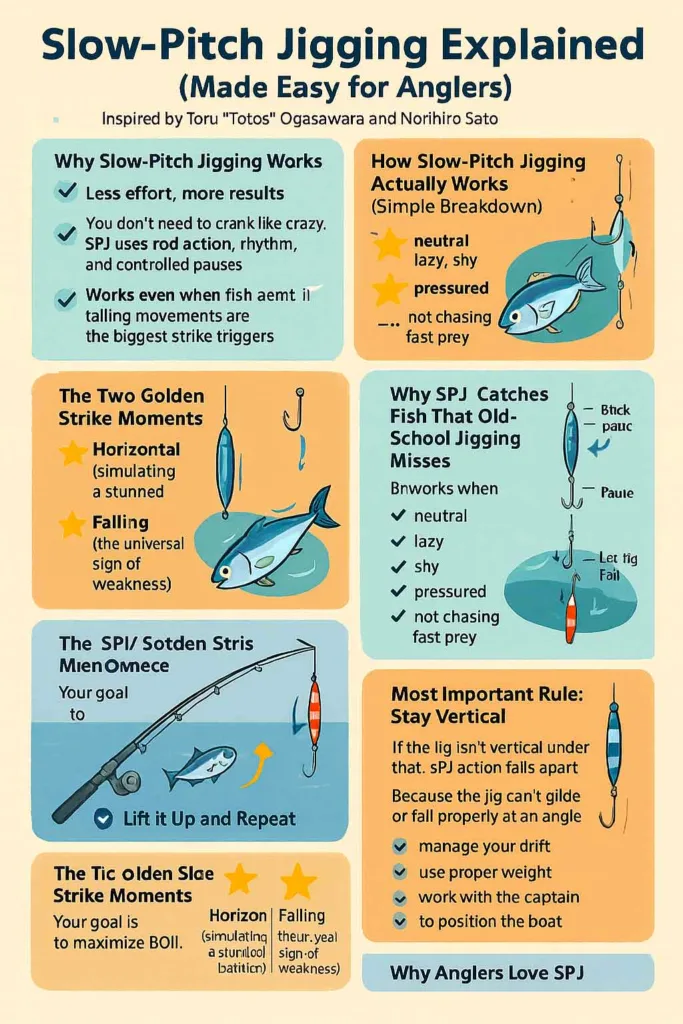
Why Slow-Pitch Jigging Works
✔ Less effort, more results
You don’t need to crank like crazy. SPJ uses rod action, rhythm, and controlled pauses.
✔ Triggers bites from many species
From tuna to grouper, from pelagic fish to bottom dwellers—SPJ works on them all.
✔ Works even when fish aren’t active
Traditional jigging shines when fish are aggressive.
SPJ shines when they’re not.
✔ Works in more sea conditions
Because the jig moves slowly and naturally, you remain productive even outside peak feeding windows.
The Core Principle: Mimic a Wounded Baitfish
Predators love easy meals. Weak baitfish:
- stop and start
- dart in random directions
- flash their sides
- fall downward when tired or injured
Slow-pitch jigging imitates exactly that.
That’s why horizontal glides and falling movements are the biggest strike triggers.
How Slow-Pitch Jigging Actually Works (Simple Breakdown)
Slow-pitch jigging is NOT slow reeling.
It’s a rhythm: pitch → pause → pitch → pause
Usually, 1 pitch per second.
1. Reel to Make the Jig Jump
A light reel turn (¼–1 full turn) loads the rod and pops the jig upward.
2. Pause and Let the Rod Kick
The rod springs back naturally, making the jig glide sideways—
this sideways “flash” is where many strikes happen.
3. Let the Jig Fall
This is where SPJ truly shines.
- Half-reel on the descent → a controlled fall
- No reel → a natural, fluttering free fall
Both are strike magnets.
4. Pick It Up and Repeat
Lift gently before the jig settles and continue the rhythm.
Often, the lift reveals a fish that already bit during the fall.
The Two Golden Strike Moments
Most SPJ bites happen when the jig is:
⭐ Horizontal
(simulating a stunned baitfish)
⭐ Falling
(the universal sign of weakness)
Your goal is to maximize BOTH.
Why SPJ Catches Fish That Old-School Jigging Misses
Traditional jigging works best when fish are fired up and feeding.
SPJ works when fish are:
- neutral
- lazy
- shy
- pressured
- not chasing fast prey
This makes it ideal for unpredictable conditions and mixed-species grounds.
Most Important Rule: Stay Vertical
If the jig isn’t vertical under you, SPJ action falls apart.
Why?
Because the jig can’t glide or fall properly at an angle.
To stay vertical:
- manage your drift
- use proper weight
- work with the captain to position the boat
When staying vertical becomes impossible, switching to high-speed jigging may work better.
Why Anglers Love SPJ
Slow-pitch jigging is a tactical game, not a strength contest.
You get to experiment with:
- rod types
- reel ratios
- jig weights and shapes
- hook styles
- assist lengths
- pitch rhythms
Every adjustment changes the jig’s behavior and bite opportunity. That’s why SPJ is both fun and addicting.
And yes—there is a learning curve.
Even Sato and Totos emphasize that understanding the system takes time. But once you “get it,” your results transform.
In Summary (Easy Takeaway)
Slow-pitch jigging is about:
- moving the jig slowly and naturally
- letting it fall and glide
- maximizing the moments fish like to strike
- using technique instead of muscle
- thinking like a predator watching wounded prey
If you stay vertical and control your rhythm, SPJ will catch fish even when nothing else works.