Slow Pitch Jigging: The Artful Revolution Redefining Modern Sport Fishing
Why travelers across the globe are trading brute force for finesse—and venturing to the world’s most remote oceans to master it.
For decades, offshore jigging lived in the realm of the relentless—a punishing, full-body contest between angler and sea. High-speed jigging demanded a near-athlete’s stamina: the rapid-fire pumping of the rod, the ceaseless cranking of the reel, the sweat and strain that left shoulders burning long after the fish box was filled. Yet the thrill was unmatched. When a dogtooth tuna or amberjack rocketed upward to hammer a fleeing lure, the violence of the strike justified every ache.
But in recent years, a quiet shift has swept across the world’s oceans. A new technique—born in Japan, refined with almost spiritual precision, and now embraced from the Maldives to the Caribbean—has transformed heavy-water fishing into something altogether different.
It’s called slow pitch jigging, and for many modern travelers, it has become less a method than a movement: a more artistic, more tactical, and infinitely more intimate way to experience the sea.
From Muscle to Melody: A New Philosophy of Fishing
Before slow pitch, offshore jigging was constrained by the limitations of its time. Thick monofilament lines bowed in the current, stretching under pressure until the jig’s movements vanished into mush. Anglers compensated with strength; boats drifted broadside; finesse was virtually impossible.
Then came a small but revolutionary invention: PE braided line—thin, sensitive, with almost zero stretch. Suddenly an angler could feel not just a bite, but the faintest vibration of the lure. Japanese captains refined boat-handling techniques, using spanker sails and sea anchors to keep the vessel aligned perfectly with the current. Jigs dropped vertically. Control, once elusive, became absolute.
Out of this new harmony between gear, boat, and water, a style emerged that abandoned the brute rhythm of old. Instead of driving a jig upward in frantic bursts, anglers learned to coax it—letting it suspend, flutter, and spiral downward in a wounded, irresistible drift.
High-speed jigging had always been a battle.
Slow pitch jigging felt more like a ballet.
What Slow Pitch Jigging Really Is
At its heart, slow pitch jigging is an exploration of nuance.
Each motion is deliberate: a half-turn of the reel, a measured lift of the rod, a pause long enough for the jig to surrender to gravity. On the fall, it glides sideways or tumbles unpredictably—an anguished imitation of a dying baitfish, and the most seductive trigger in the ocean.
Most strikes occur in that suspended moment of vulnerability, when the jig is no longer being worked at all.
The angler feels a tap, almost polite.
And then the ocean erupts.
It’s a style that invites immersion. You’re not overpowering the sea; you’re conversing with it.
Why the World’s Travelers Are Falling in Love With It
For anglers who chase wild experiences across the map, slow pitch jigging offers a combination of elegance, accessibility, and depth rarely found in modern sport fishing.
1. It’s gentle on the body, generous in reward.
Gone are the marathon workouts of high-speed jigging. Days on the water feel enjoyable, almost meditative—yet the fish remain as formidable as ever.
2. It unlocks the deep.
With minimal line stretch and impeccable vertical control, slow pitch jigs reach and perform in water hundreds of feet down, where predators cruise silently in the blue.
3. It attracts astonishing diversity.
From Caribbean groupers to Japanese amberjacks, from Indo-Pacific snappers to Mediterranean dentex, few species can resist the fall of a well-pitched jig.
4. It invites creativity.
Weights, shapes, fall styles, cadence—every decision is a brushstroke, allowing anglers to paint their own interpretation of movement beneath the waves.
5. It’s addictive.
Once you feel that first delicate bite followed by the surge of a powerful fish, slow pitch becomes more than a technique. It becomes a pursuit.
How a Global Technique Was Born
Slow pitch jigging wasn’t a lucky discovery—it was engineered.
When Japanese angler Norihiro “Sato Sensei” Sato began refining the system in the 1990s, he dissected every variable: rod taper, reel gearing, jig symmetry, hook angle, and even how current interacts with descending metal. His goal wasn’t just to catch fish. It was to understand how fish respond to the language of movement.
The result was a system so coherent, so meticulously designed, that once demonstrated, it spread across the world with breathtaking speed.
Today, Sato’s influence is felt from tropical atolls to volcanic archipelagos, as captains and anglers adopt a style that transforms the ocean from an opponent into a partner.
A Traveler’s Technique: Where Slow Pitch Jigging Thrives
Part of the technique’s magic lies in the places it takes you:
The Maldives
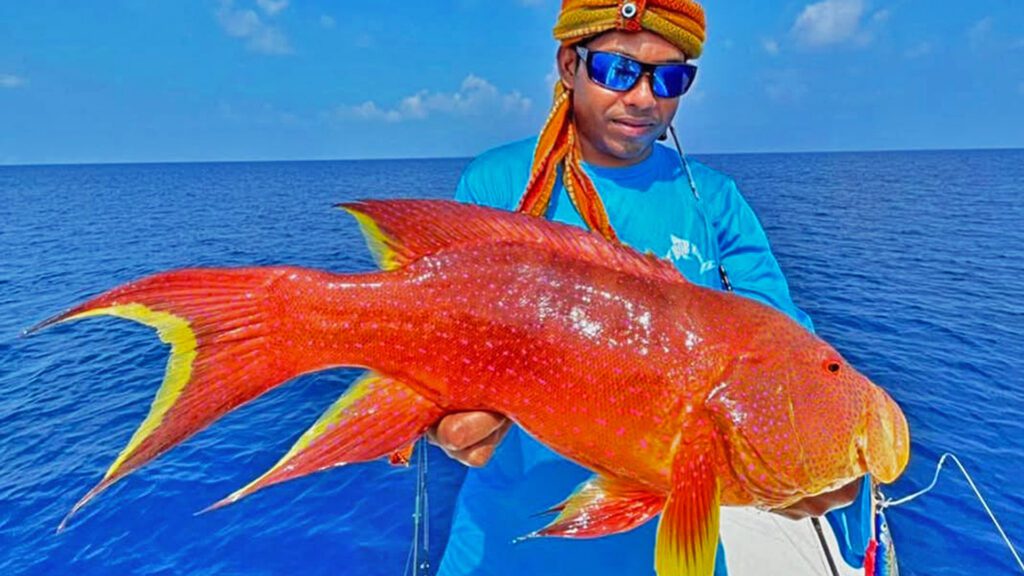
Over cobalt plunges and coral-rimmed reefs, jigs flutter down to snappers, groupers, and amberjacks patrolling the edge of the deep.
Okinawa & Japanese Reefs
At dawn, boats fan out in near-silence, dropping feather-light jigs over 100-meter plateaus where the method was born.
Southeast Asia’s volcanic straits
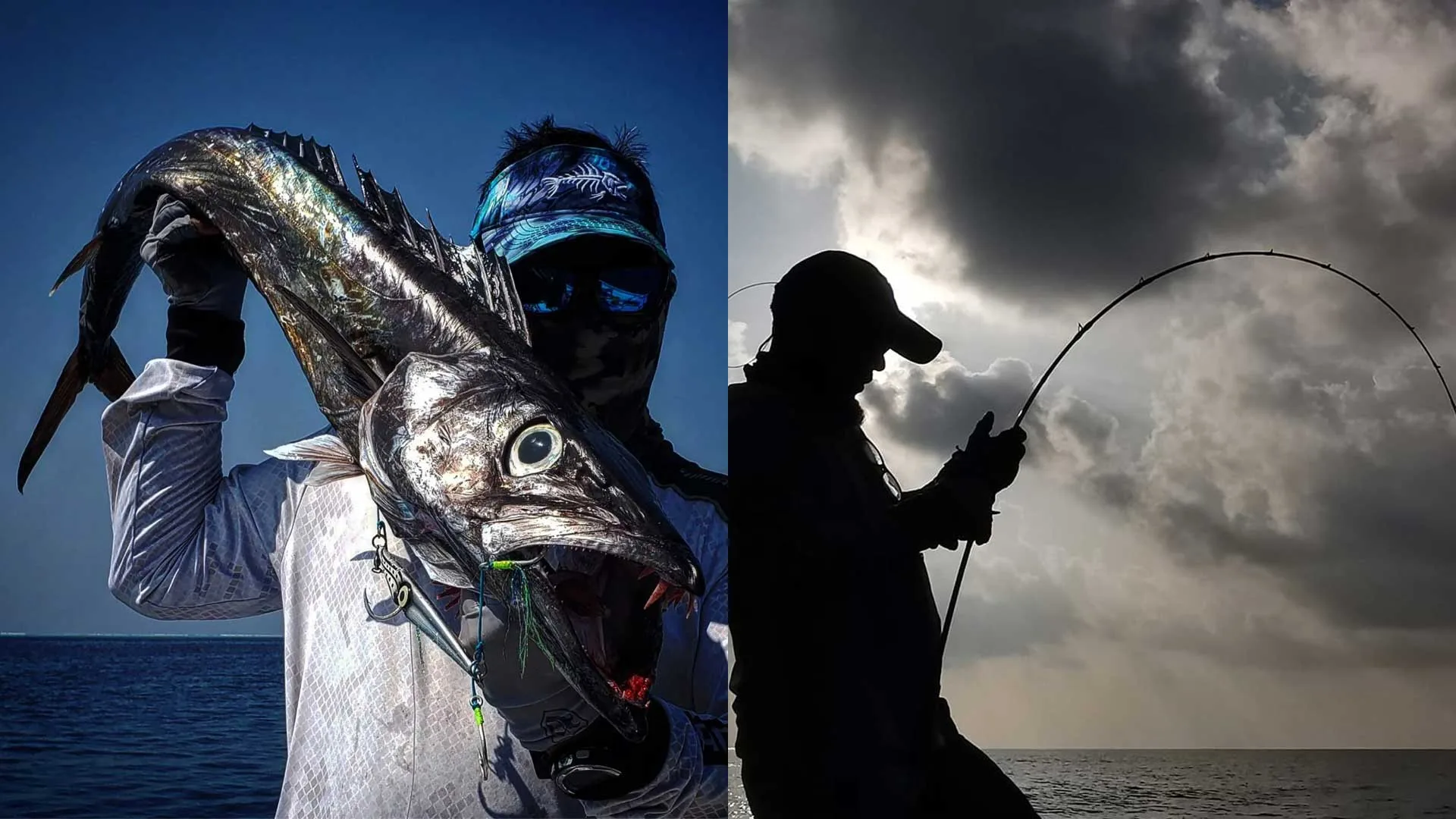
Powerful currents challenge anglers to master vertical presentation as dogtooth tuna lurk in the blue.
The Mediterranean
Here, slow pitch is winning converts among traditional bottom fishermen, who use it to tempt dentex, porgies, and deepwater predators.
Wherever it goes, the technique transforms a day on the water into something more immersive—part exploration, part meditation, part dance with the unseen.
The Evolution of a Sport
Slow pitch jigging hasn’t replaced high-speed jigging; it has expanded the spectrum of possibility. Where fast jigging mirrors the chase of a fleeing baitfish, slow pitch captures the poetry of the fall—the moment that triggers a predator’s deepest instinct.
It’s a shift from strength to sensitivity, from domination to harmony.
And for many modern travelers, it offers a new lens through which to experience the ocean: not as a battlefield, but as a world of motion, color, and hidden choreography.
So whether your next adventure takes you to the Maldives, Bali, Okinawa, or the deepwater frontier of your home coastline, consider packing a slow pitch setup.
You might not just discover a new technique—
You might discover an entirely new way to belong to the sea.