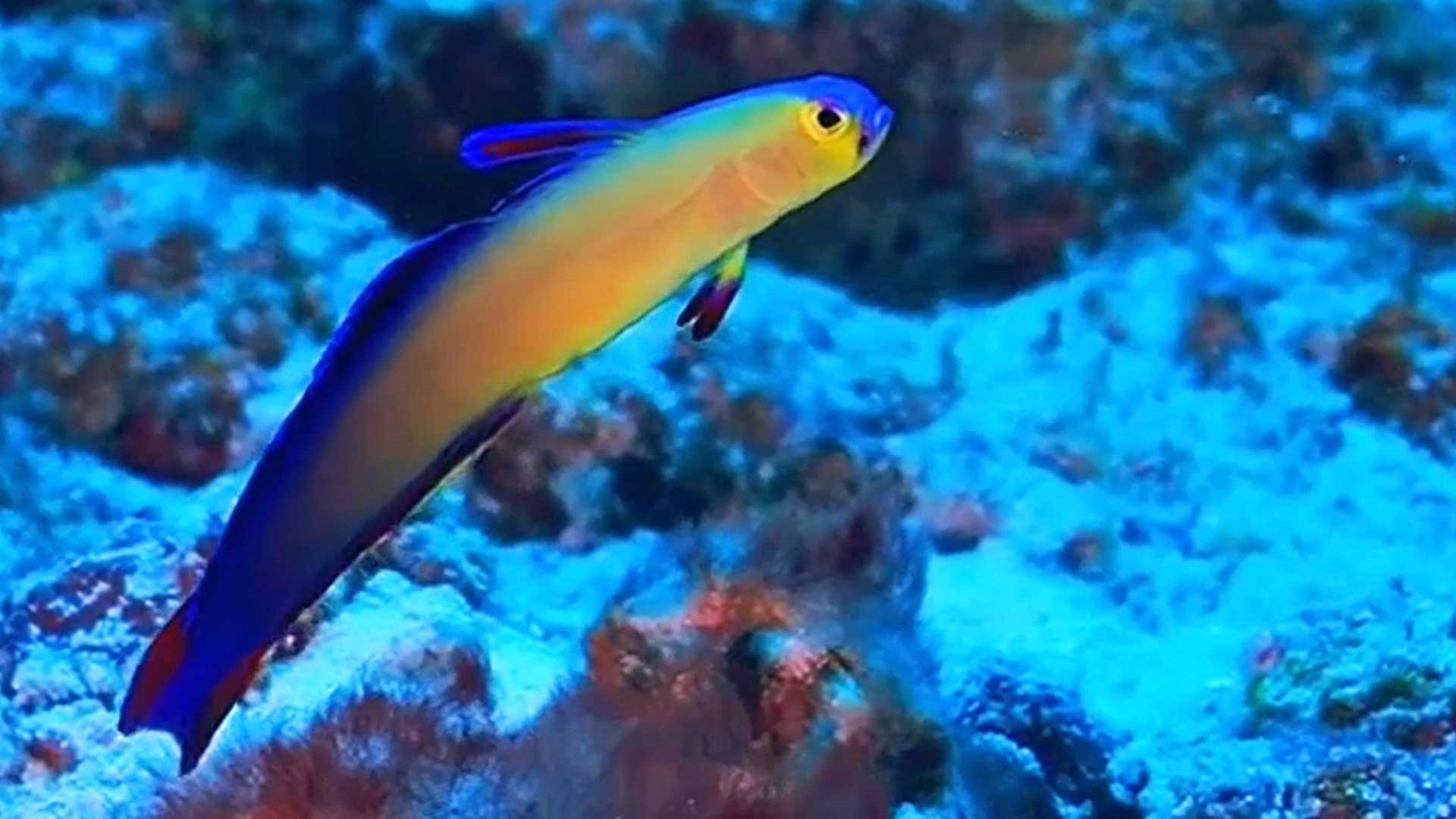
English Name : Elegant dartfish
Scientific Name: Nemateleotris decora
Family : MICRODESMIDAE
Local Name : Fari dhidha funna
Order : Perciformes
Size : Max. 6 cm
The underwater world is home to a spectacular array of species, many of which captivate divers, snorkelers, and scientists alike with their vibrant colours and graceful movements. Among these aquatic gems is the dartfish—better known as the decorated firefish—a small but striking species that commands attention despite its modest size.
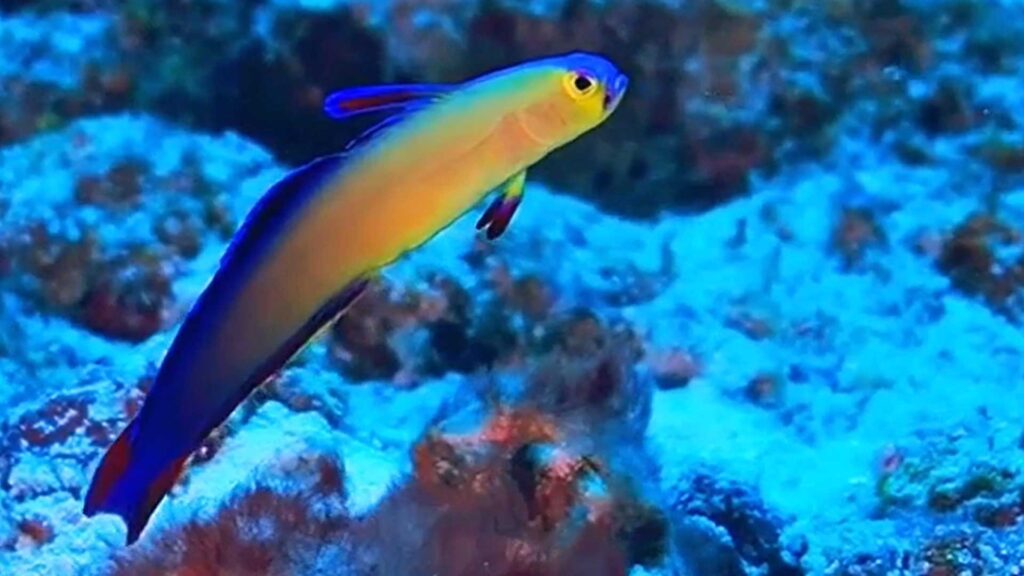
Recognisable by its elegant gradient from light pink or white to deep purple, the decorated firefish (Nemateleotris decora) is a living brushstroke of colour. Its delicate body fades from a white head to a rich, dark-purple tail, framed by purple-red fins that ripple like silk in the current. A member of the family Microdesmidae, this species is often simply called the “firefish” for its glowing palette and flickering, darting movements.
Firefish typically live in pairs and feed primarily on zooplankton—especially copepods and crustacean larvae (Frose & Paul, 2007). Their beauty and gentle behaviour have made N. decora a favourite among aquarium hobbyists worldwide, with individual specimens ranging from US$35 to $40 depending on size (Madhu & Madhu, 2013). In the wild, they inhabit deeper waters—usually between 25 and 75 metres—and are distributed across a wide swath of the Indo-Pacific, including Mauritius, Samoa, New Caledonia, the Maldives, the Philippines, Fiji, and the Ryukyu Islands.
Discovering a New Firefish: Nemateleotris exquisita
While researching N. decora, I came across a compelling article in the Journal of the Ocean Science Foundation describing a newly identified microdesmid: Nemateleotris exquisita. Like other members of its genus, this species resembles a goby, with a slender, graceful form and vibrant colouring.
This exquisite firefish was described from specimens collected in deep waters of the Red Sea, KwaZulu-Natal, and Mauritius, with confirmed occurrences around the Andaman Islands and the Thai coast of the Andaman Sea (Adams, 2013). The discovery adds another chapter to a long history of ichthyological exploration in the region.
Between 1907 and 1910, the US Bureau of Fisheries steamer Albatross conducted extensive fish-collecting expeditions across Indonesia and the Philippines. Specimens were gathered using a variety of methods—including seining, dynamiting, dredging, trapping, and nightlighting—culminating in a monumental collection (Randall & Connel, 2013). Based on these efforts, Fowler (1938) described 61 new species across 15 families, 25 new genera, and six new subgenera. Among these was the genus Nemateleotris, represented at the time by a single specimen he named N. magnifica.
The genus was later revised by Randall and Allen (1973), who identified three species: Fowler’s N. magnifica, along with two new additions—N. decora and N. helfrichi. Since then, sightings of N. decora have expanded to the Coral Sea, Papua New Guinea, the Solomon Islands, and Palau (Randall & Connel, 2013).
Tracing the Path to a New Species
In 1973, a specimen identified as N. decora was collected from Mauritius at a depth of 56 metres. A second was obtained in 1977 from the northern Red Sea at 69 metres, and additional specimens were contributed from Mauritius in subsequent years. Later reports from Satapoomin (2007) and Shibukawa (Kimura et al., 2009) documented the species in the Andaman Sea off southwest Thailand.
The distinctive colouration of western Indian Ocean populations—documented in illustrations by Satapoomin and later reproduced by Shibukawa—spurred renewed scientific interest. In 2011, a specimen matching this colour pattern was collected at 42 metres off Sodwana Bay, KwaZulu-Natal. Three more were gathered from the same region in 2012, along with sightings near Aliwal Shoal Marine Protected Area in South Africa and around Inhaca Island in southern Mozambique.
These findings ultimately led researchers to conclude that the Indian Ocean population represented a previously undescribed species: Nemateleotris exquisita. The publication describing the species included detailed colour plates comparing all four known members of the genus: N. magnifica, N. helfrichi, N. decora, and the newly recognised N. exquisita.
A Close Look at the Differences
While N. decora and N. exquisita share many features, the new species is distinct in several ways. N. exquisita has a more slender body, a longer snout, and a generally shorter first dorsal spine. Its colouration also differs: the pale yellow anterior portion of the body extends farther back than in N. decora. Size provides another clue—N. exquisita reaches a standard length of up to 66 mm, compared with N. decora’s maximum of 49.5 mm.
From coral reefs to deepwater slopes, firefish continue to fascinate both casual observers and scientists. Their delicate forms, vivid colours, and evolving taxonomy remind us how much of the underwater world remains undiscovered—and how every dive may bring us a little closer to the next remarkable find.