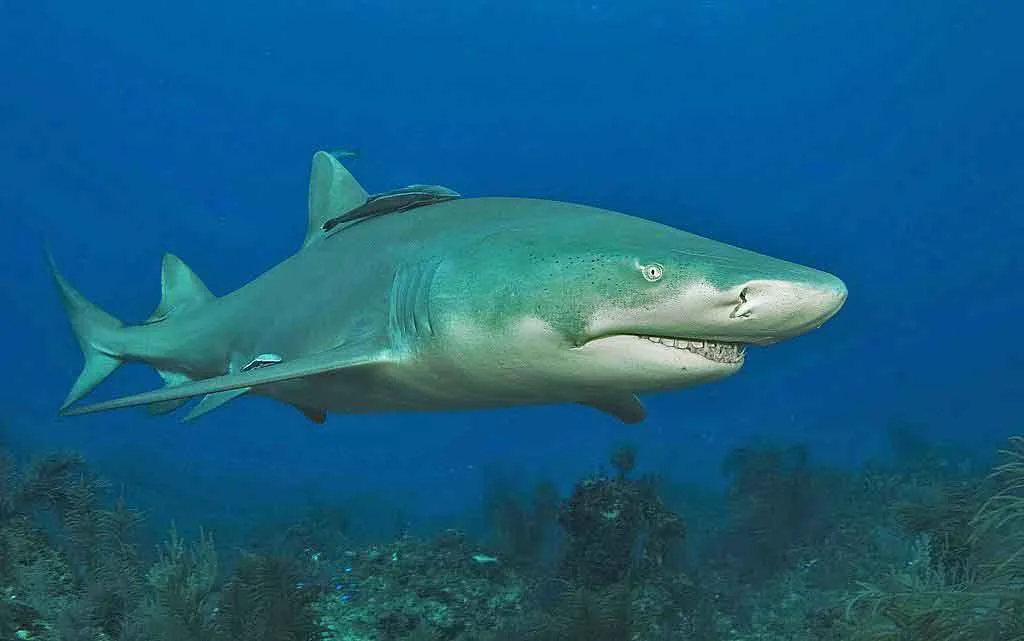
In the sun-drenched atolls of the Maldives, the Sicklefin lemon shark reigns as a master of the shallows—and a sentinel of a changing ocean.
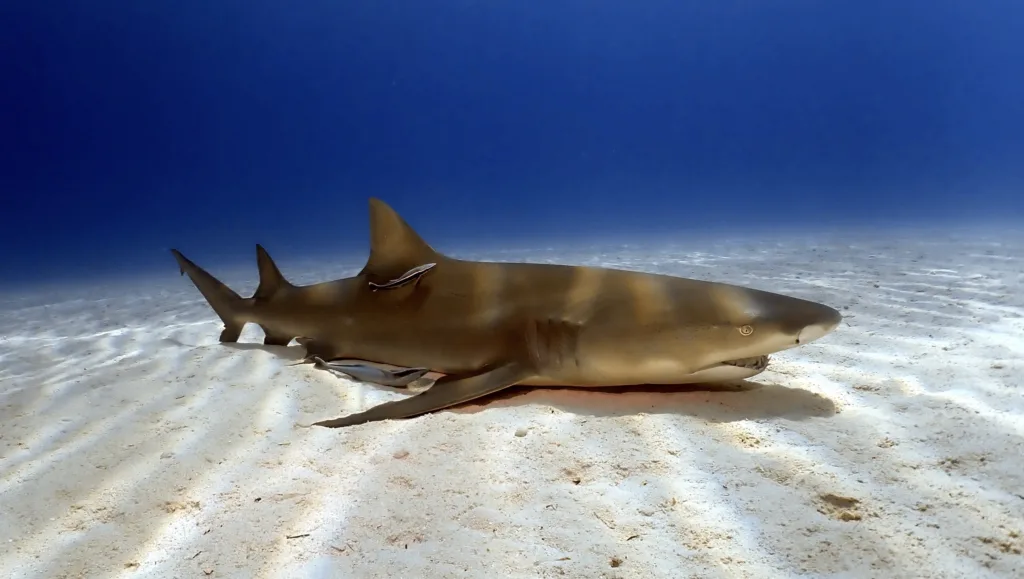
A shadow moves across a sun-dappled sandy plateau in the Maldives. It is subtle—a flicker of amber against the white carbonate floor. To the untrained eye, it might be the shifting reflection of a cloud. But to the reef’s inhabitants, it is the arrival of the Sicklefin lemon shark (Negaprion acutidens), known locally as the Falhu femunu, or “Lagoon Tiger.”
The Sicklefin lemon shark is a master of the middle ground. Neither a nomad of the open blue nor a cryptic dweller of the deep caves, it occupies the vibrant, high-energy world of the coral reef. Measuring up to 3.1 meters, this stocky titan is a testament to evolutionary specialized design, blending raw power with a startlingly sedentary lifestyle.
Design of a Specialist
The Sicklefin lemon shark is instantly recognizable by its “double-masted” profile. Unlike many of its cousins in the Carcharhinidae family, whose second dorsal fins are diminutive, the Sicklefin’s two dorsal fins are nearly equal in size. This symmetry, combined with the elegant, scythe-like curve of its pectorals, allows it to maneuver with surgical precision in the tight confines of a coral garden.
Its skin is a canvas of survival: a rich yellowish-brown that mimics the hues of sunlit water over sand. This camouflage allows it to utilize a hunting strategy rare among sharks: the art of the sit-and-wait. Using “buccal pumping” to draw oxygen over its gills while stationary, the shark can lie perfectly still on the seafloor, appearing as nothing more than a harmless ridge of sand until it is too late for its prey.
The Hunter and the Hunted
When the Sicklefin lemon shark does strike, it is with explosive efficiency. Its mouth is armed with narrow, smooth-edged teeth designed for gripping, which transform into finely serrated blades as the shark reaches maturity.
Its diet is a list of the reef’s most formidable residents. From the armored porcupine fish to the leathery hide of the stingray, the Sicklefin lemon shark handles them all. Yet, despite its prowess, this “Lagoon Tiger” is increasingly under threat. In the Maldives, it has long been a prize for fishers, sought for its meat, fine-grained leather, and the intricate architecture of its jaws.
A Fragile Dynasty
The survival of the species is a race against time. The Sicklefin lemon shark is a slow-burn breeder. Females are viviparous, nurturing a small litter of 1 to 13 pups for nearly a year inside the womb. These pups are born in the relative safety of shallow lagoons—natural nurseries that are increasingly threatened by coastal development and environmental change.
In the Maldives, where specimen MRS/0375/92 remains a benchmark for researchers, the species is not particularly common. Its localized nature—often spending its entire life within a few kilometers of its birth site—means that once a local population is overfished, it may never return.
To encounter a Sicklefin lemon shark today is to see a relic of a wilder ocean. It is a creature that demands respect, not just for its potential for aggression when provoked, but for its role as a sentinel of the reef. In the golden gaze of this shark, we see the reflection of the ocean’s health—and a reminder of the delicate balance we must work to preserve.
Marine Species Profile
The Lagoon Tiger
| Scientific Name | Sicklefin Lemon Shark Negaprion acutidens |
| Local Name | Falhu femunu. A name reflecting its reputation as the “Tiger of the Lagoon.” |
| Distinctive Build | Large, stocky body with a broad snout. Second dorsal fin nearly as large as the first. |
| Coloration | Yellowish-brown, blending with sandy seabeds; paler underside. |
| Feeding Habit | Feeds on bottom-dwelling bony fishes, stingrays, and porcupine fishes. |
| Biology | Viviparous; 1–13 pups. Known for strong site fidelity within coral reef systems. |
| Record Size | Maximum recorded length: 3.1 meters (Reference: MRS/0375/92). |
References
- Maldives Marine Research Centre (MRC): Primary data on specimen MRS/0375/92 and local nomenclature.
- IUCN Red List of Threatened Species: Global conservation status and population assessment for Negaprion acutidens.
- FishBase: Morphological measurements, depth distribution, and biological traits.
- Florida Museum of Natural History: Analysis of Negaprion dental structures and habitat preferences.
- Compagno, L.J.V. (FAO Species Catalogue): Taxonomic classification of the Carcharhinidae family.