A shy resident of the deep atoll slopes, the Spottail shark is a masterpiece of subtle camouflage and distinct ink-black markings.
A shy resident of the deep atoll slopes, the spottail shark is a masterpiece of subtle camouflage and distinct ink-black markings.
While the larger, more gregarious reef sharks often steal the spotlight in the Maldives, a more elusive predator patrols the sandy margins of the deep: the spottail shark (Carcharhinus sorrah). Known locally as the Dhon miyaru, this shark is a ghost of the inshore waters—rarely seen by casual snorkelers, but occasionally encountered by those who venture to the outer edges of the atoll at night.
Its Dhivehi name, “Dhon,” suggests paleness—a reference to its light, ghostly grey coloration that allows it to vanish against the vast sandy plateaus of the Maldivian seafloor.
A Study in Detail
The spottail shark is a sleek, moderate-sized member of the Carcharhinidae family, reaching a maximum length of about 1.6 meters. It is defined by a sharp, hydrodynamic profile, featuring a long, pointed snout and a distinct ridge running between its two dorsal fins.
What truly sets the Dhon miyaru apart, however, is its “paint job.” To identify this species in the wild, one must look for a specific set of ink-black markings:
- The Signature Spots: Distinct black tips on the second dorsal fin, the pectoral fins, and most notably, a bold black spot on the lower lobe of the tail (caudal) fin.
- The Flank Band: A conspicuous white band that runs along its side, contrasting sharply with its pale grey upper body.
- The Low Dorsal: A second dorsal fin that is unusually low, with a base length more than twice its height—a trait that distinguishes it from many of its cousins.
Master of the Bottom
The spottail shark is a demersal specialist. While it can be found in shallow inshore waters, it is more at home on reef slopes and sandy flats at depths of up to 140 meters. Its pale coloration is no accident; it is a highly evolved camouflage for a shark that lives near the light-colored sediments of coral reefs.
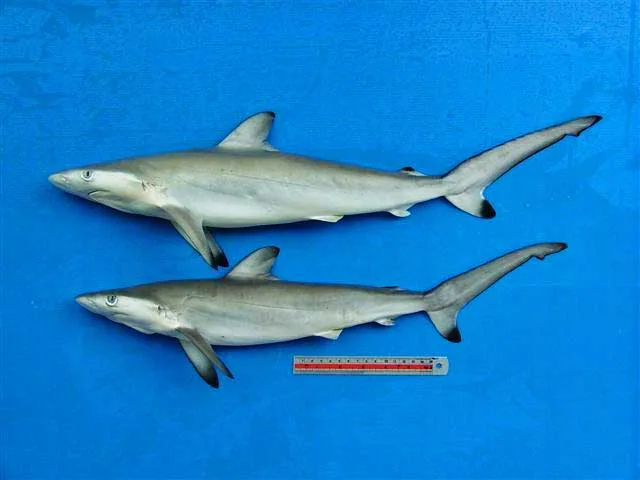
Feeding primarily on a diet of small bony fishes and cephalopods, it is an opportunistic and efficient hunter. It is viviparous, with females nurturing 3 to 6 young via a yolk-sac placenta. This reproductive strategy ensures that each pup is born ready to navigate the competitive world of the Indo-West Pacific.
The Night-Time Encounter
In the Maldives, the spottail shark remains something of a scientific rarity. It is not frequently observed by divers, but as local records (such as specimen MRS/P0318/88) suggest, it is occasionally caught by handline fishers working the deep atoll waters at night.
Marine Species
Spottail Shark
| Scientific Name | Dhon miyaru Carcharhinus sorrah |
| ID Marker | Black spots on second dorsal fin and tail lobe; distinct white band on flank. |
| Habitat | Inshore and offshore sandy bottoms; depths reaching 140m. |
| Biology | Viviparous (3–6 pups). Feeds on small fishes and cephalopods. |
Its presence is a reminder that the Maldivian atolls are three-dimensional worlds; while the reef tops are bustling with life, the deep, sandy slopes hold their own cast of specialized characters. The spottail shark remains one of the ocean’s understated beauties—a sleek, spotted wanderer of the deep blue shadows.
References
- Marine Research Centre (Maldives): Catalogue record MRS/P0318/88.
- FishBase: Biological metrics and distribution for Carcharhinus sorrah.
- Anderson, R.C. (1993): Reef Fish Resources Survey in the Maldives.
- IUCN Red List: Species assessment for the Spottail shark.