When Fishing Was Forged by Hand
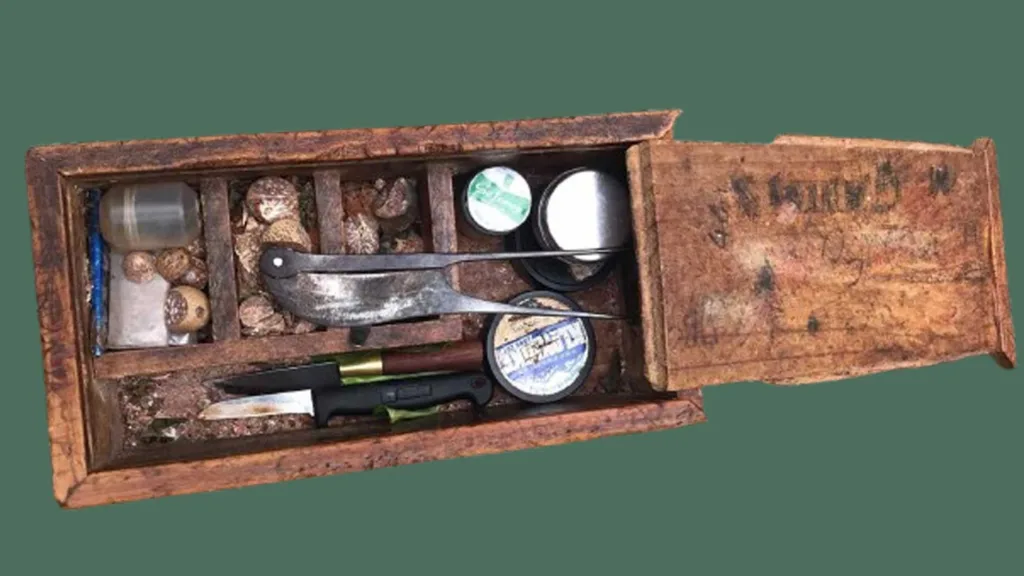
In the early 1980s, I remember my father and his friends returning home with impressive reef-fish catches—parrotfish, oriental sweetlips, humpback snappers, groupers, blue chub, and more. Their tools were simple but effective: a sharpened iron rod, about two and a half feet long and six to eight millimeters thick, lashed to a wooden pole. The pole, crafted from coconut palm wood, measured roughly five to seven feet in length. With these handmade spears, they fed their families and sustained a way of life closely tied to the sea.
A Tool Older Than Memory
For thousands of years, humans have relied on spears to harvest fish and survive. Early fishing spears were fashioned from wood, sharpened sticks, bone, stone, and tridents. Later, copper and iron tips were introduced, often fitted with backward-facing serrations to prevent prey from slipping free. In some parts of the world, fishers inserted thorns into reed shafts or used curved thorns, fish bones, and palm leaf stems to form barbed points. These were not crude weapons, but carefully designed tools shaped by necessity and knowledge.
Learning the Language of Water
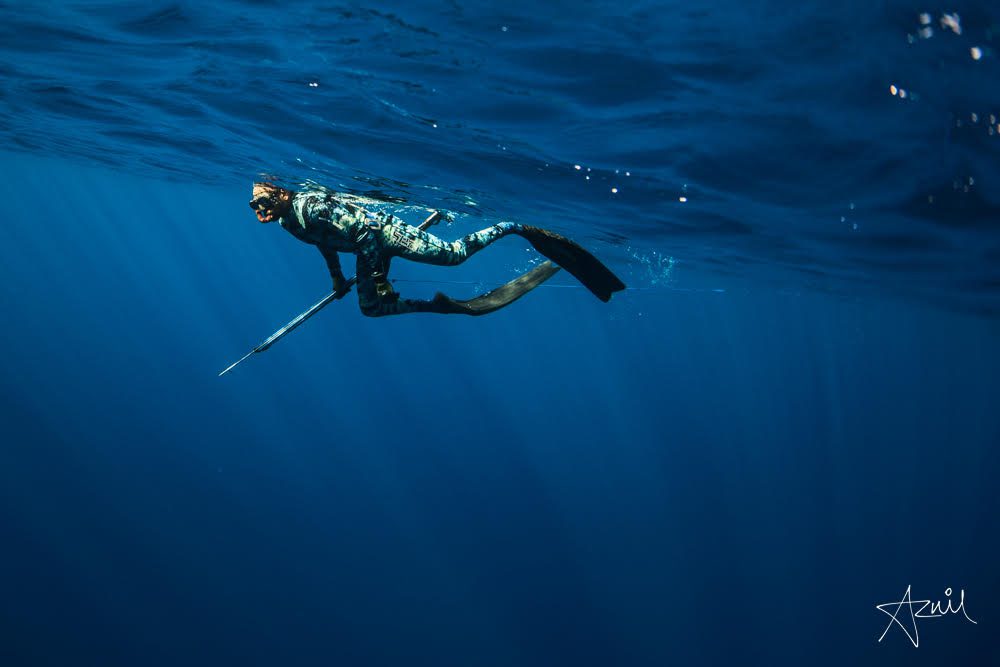
Spearfishing represents one of humanity’s oldest and most refined hunting skills. Over time, fishers learned to read currents, light, and movement beneath the surface. This understanding allowed them to strike with precision—and, in some cases, to harpoon massive sea creatures using finely crafted spears and extraordinary skill.
In the Maldives, this tradition evolved in rhythm with the ocean. Islanders developed techniques using pole spears, slings, and iron bars, relying on breath-hold diving and intimate familiarity with reef systems. Although spearguns are prohibited by law, these traditional methods remain widely practiced.
Strength, Silent and Focused
Highly skilled spearos are capable of landing an extraordinary range of species—from giant trevally and yellowfin tuna to mahi-mahi, dogtooth tuna, sailfish, marlin, and wahoo, as well as reef dwellers such as coral trout, groupers, snappers, emperors, and rainbow runners.
Among the most respected figures in Maldivian spearfishing is Muax, a fitness icon whose strength and agility make him a commanding presence beneath the surface. In the water, he moves like a stalking leopard—silent, controlled, and explosive. His sculpted physique is built not for display but for performance, translating into precise, decisive strikes against some of the ocean’s fastest predators.
View this post on Instagram
Choosing One Fish at a Time
Spearfishing remains one of the most sustainable methods of fishing known. From its beginnings with sharpened wooden sticks and iron bars used along river mouths and shallow shores, the practice has evolved alongside modern equipment. Today, fins and masks allow divers to descend deeper and select individual fish with intention.
It is a highly selective method with virtually zero bycatch. Reefs and seabeds remain intact as the spearo glides silently through the water, leaving healthy ecosystems undisturbed.
Where Tradition Meets Tomorrow
Maldivian law currently prohibits the use of spearguns, while rod fishing remains legal. As interest grows in sustainable fishing and marine tourism, policymakers may one day consider carefully regulated frameworks that balance tradition, conservation, and opportunity.
More than a sport, spearfishing is a living heritage. Mastering the skills practiced by spearos like Muax could inspire Maldivian youth, opening pathways into tourism, conservation, and ocean-based livelihoods—while preserving one of humanity’s oldest relationships with the sea.