In the blue waters off Fuvahmulah in the southern Maldives, tiger sharks move through the reef edge like shadows from another age. Broad-headed, scarred, and impossibly calm, they are among the ocean’s most formidable predators. Divers travel across the world to witness them circling the deep channels beyond the island’s volcanic reef.
But in one surprising corner of this underwater kingdom, the tiger shark is not always the one in control.
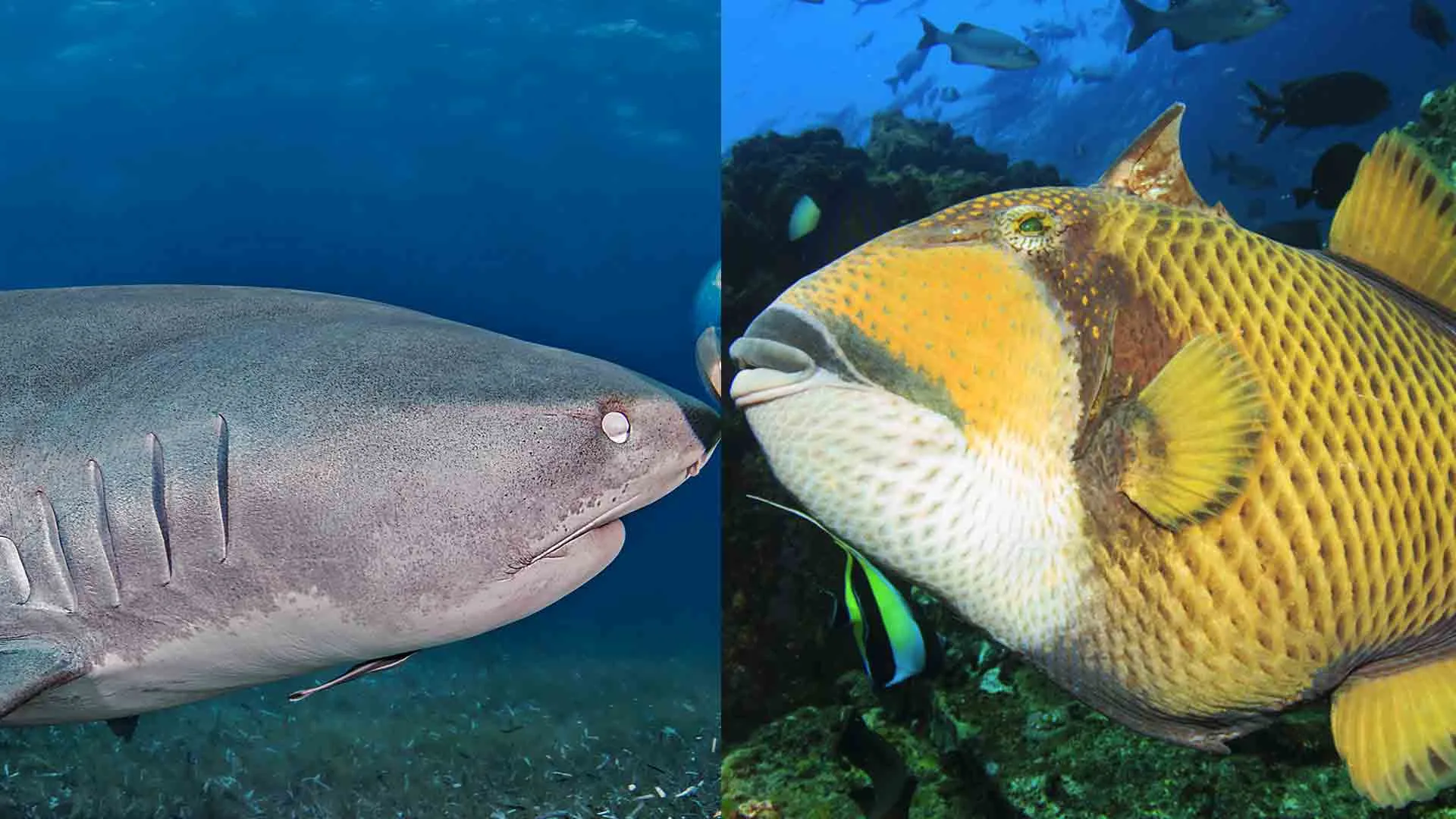
There, among coral outcrops and sandy nesting grounds, a reef fish no longer than a child’s arm has been seen charging directly at sharks several times its size. The titan triggerfish—famous among divers for its territorial aggression—has emerged as an unlikely defender of the reef, fearlessly confronting one of the sea’s apex predators.
Researchers from the Nature Friends of Maldives documented ten such encounters during dives in Fuvahmulah in 2024, recording a remarkable pattern of behavior: every aggressive interaction was initiated by the triggerfish.
The observations now form the basis of a new scientific publication, Defensive Responses of Titan Triggerfish to Tiger Sharks at a Provisioned Reef (2025), offering a rare glimpse into the hidden tensions shaping life beneath the surface.
A Small Fish With a Fearsome Reputation
While reading tiger shark studies conducted in Fuvahmulah, I spent time exploring publications produced by Nature Friends of Maldives. Curious about the work being carried out around our island’s famous sharks, I asked my friend Ahmed Inah — a well-known diver and shark specialist from Fuvahmulah — about the studies they had published on tiger shark behavior around the island.
While reading one of the papers, I came across a fascinating fish that immediately brought back memories from childhood—the titan triggerfish, locally known as maarondu. Many of us in Fuvahmulah have had encounters with this fish since we were young. Islanders have long known that despite its size, the maarondu can be surprisingly aggressive and incredibly strong.
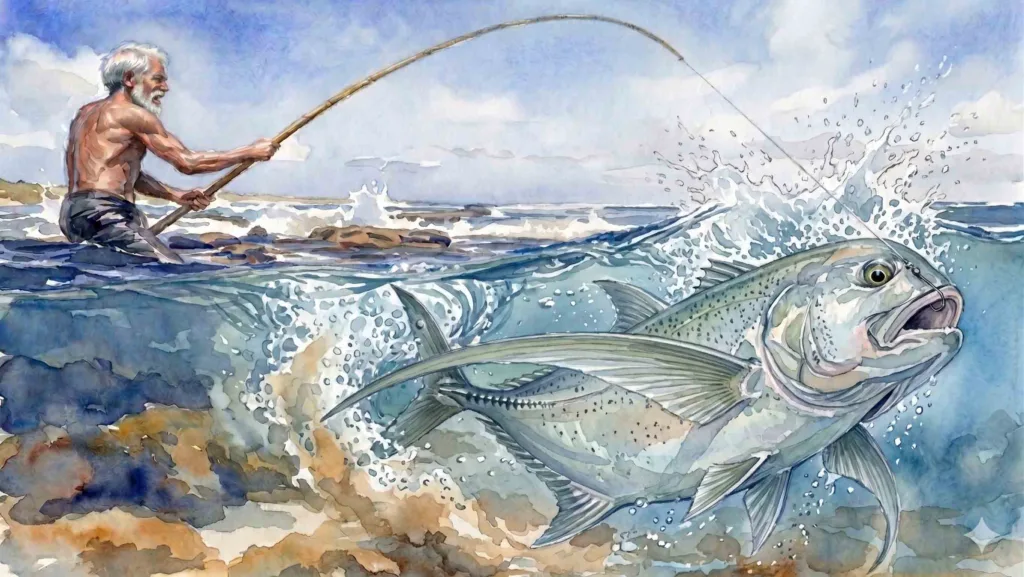
One dramatic incident happened to my friend Hussain from Raifusge in Dhadimagu Ward. He was line fishing along the Thoondu shoreline using around 60-pound monofilament with a piece of fish meat as bait. Suddenly, he screamed as something violently pulled the line seaward. His brother and several friends, who were standing on the beach, watched him being dragged farther into the water.
Within moments, the water had risen to his neck as the fish continued pulling him toward deeper water. Hearing his cries, the others rushed in to help. Together, they grabbed the line and struggled against the force pulling from below. After a tense fight, they finally managed to haul the animal toward the surface.
To their astonishment, it was an enormous titan triggerfish. The incident stayed in our memories for years. Long before researchers documented triggerfish chasing tiger sharks in Fuvahmulah, islanders already understood the fearless temperament of the maarondu.
Long before divers in Fuvahmulah documented titan triggerfish chasing tiger sharks through the reef slopes, Maldivian marine records had already hinted at the fish’s fearless temperament. In Fishes of the Maldives (1997), the titan triggerfish (Balistoides viridescens), locally known as Maarondu, is described as a common reef species that lays its eggs in nests on sandy or rubble-covered slopes, where adults “drive away any intruders including divers with great ferocity.”
Reaching up to 75 centimeters in length, the species feeds on hard-shelled reef prey such as sea urchins, corals, and molluscs, equipped with powerful jaws and an intensely territorial instinct. The recent observations of triggerfish attacking tiger sharks now appear less surprising: what researchers witnessed in Fuvahmulah may be an amplified version of a defensive behavior deeply rooted in the ecology of Maldivian reefs. For scientists, the encounters reveal something profound about reef ecosystems: size alone does not determine dominance underwater. Territory, reproduction, and instinct can override even the hierarchy of predators.
A Small Fish With a Fearsome Reputation
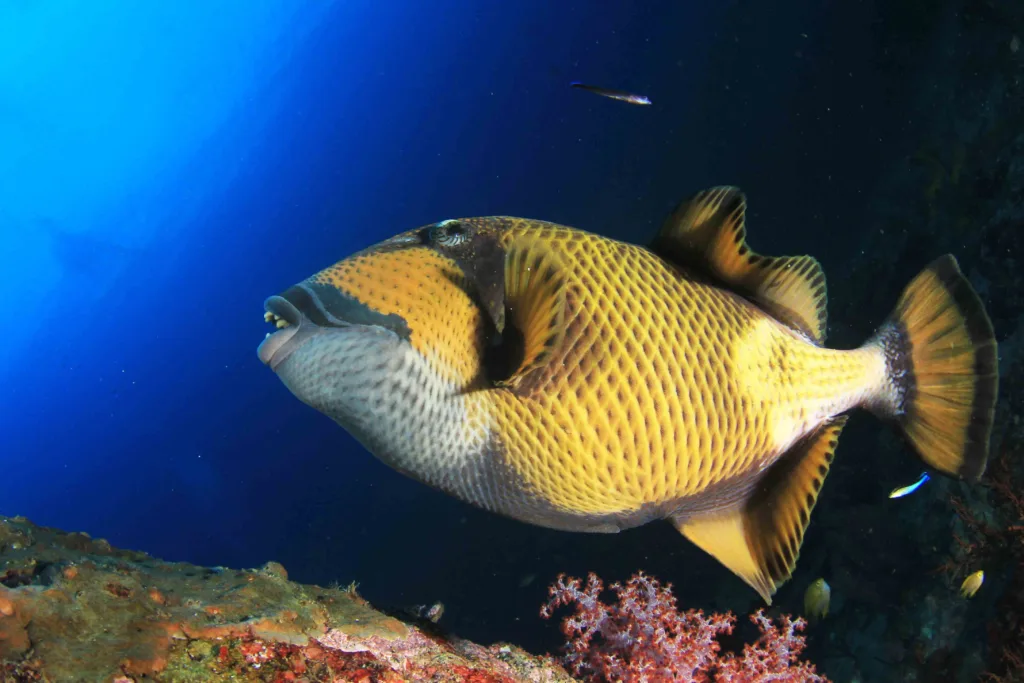
Titan triggerfish are already notorious on tropical reefs. During nesting season, they become fiercely defensive, guarding eggs laid in shallow sandy depressions. Divers who unknowingly swim above a nest are often chased away by the fish, which can bite hard enough to tear fins or puncture skin. Yet seeing this behavior directed toward tiger sharks stunned researchers.
The triggerfish repeatedly darted toward the sharks, biting at their tail fins and chasing them away from nesting territories. In many cases, the sharks appeared to tolerate the harassment rather than retaliate. The interactions occurred primarily around the new moon, a period associated with triggerfish nesting activity.
The Shark Hotspot of Fuvahmulah
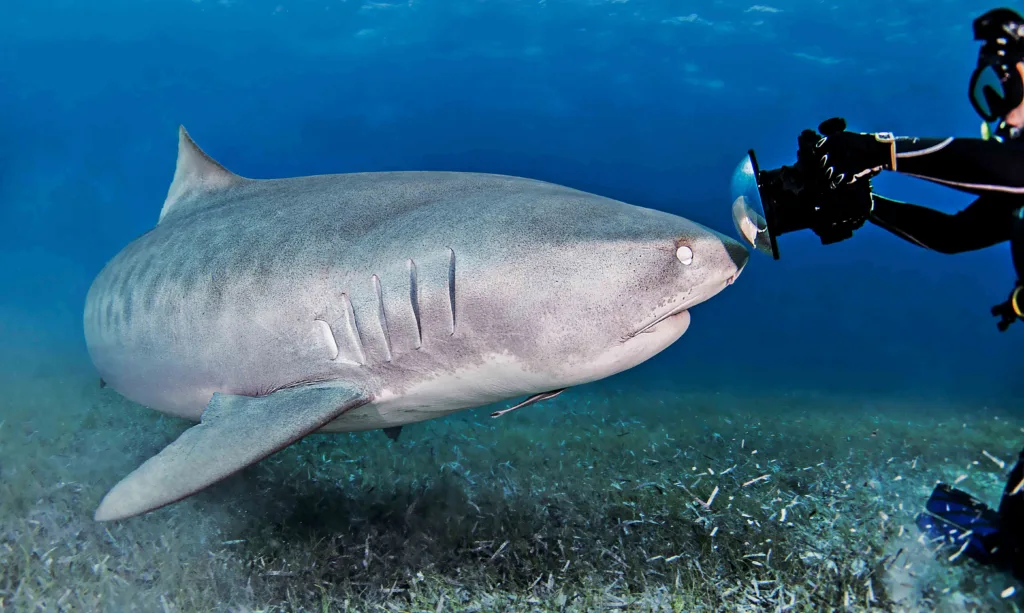
Fuvahmulah is unlike any other island in the Maldives. Rising alone from the deep Indian Ocean, its reefs plunge quickly into pelagic waters, creating an extraordinary meeting point between reef and open ocean ecosystems. The island hosts one of the world’s largest known aggregations of tiger sharks and supports numerous threatened shark species.
For marine researchers, it has become a living laboratory. Nature Friends of Maldives and collaborating dive centers have identified more than 300 individual tiger sharks around the atoll through long-term monitoring programs. Their work explores shark behavior, pregnancy cycles, social interactions, and movements around cleaning stations and reef habitats. But amid this large-scale research on apex predators, the triggerfish encounters offered a reminder that ecosystems are shaped as much by small defenders as by giant hunters.
A Reef Under Pressure
The study also raises broader ecological questions. Fuvahmulah’s tiger sharks are frequently encountered near dive sites where ecotourism activities bring sharks and reef habitats into close proximity. Researchers suggest that increased predator aggregation around provisioning sites may unintentionally intensify encounters between sharks and territorial reef species.
It is a subtle but important insight into how human activity can reshape natural interactions underwater—not always dramatically, but through countless behavioral shifts invisible to casual observers. In the reef world, balance is delicate. A nesting triggerfish defending its eggs against a tiger shark may seem like a curiosity. Yet these moments reveal the complexity of marine life in ways statistics alone cannot.
The Courage of the Reef
Perhaps the most striking image from the study is not the tiger shark itself, but the audacity of the much smaller fish confronting it. On coral reefs, survival often belongs not to the strongest, but to the most determined. And somewhere in the currents off Fuvahmulah, while tiger sharks patrol the blue edge of the abyss, tiny reef guardians continue to hold their ground.