The Fish Fishermen Fear Most
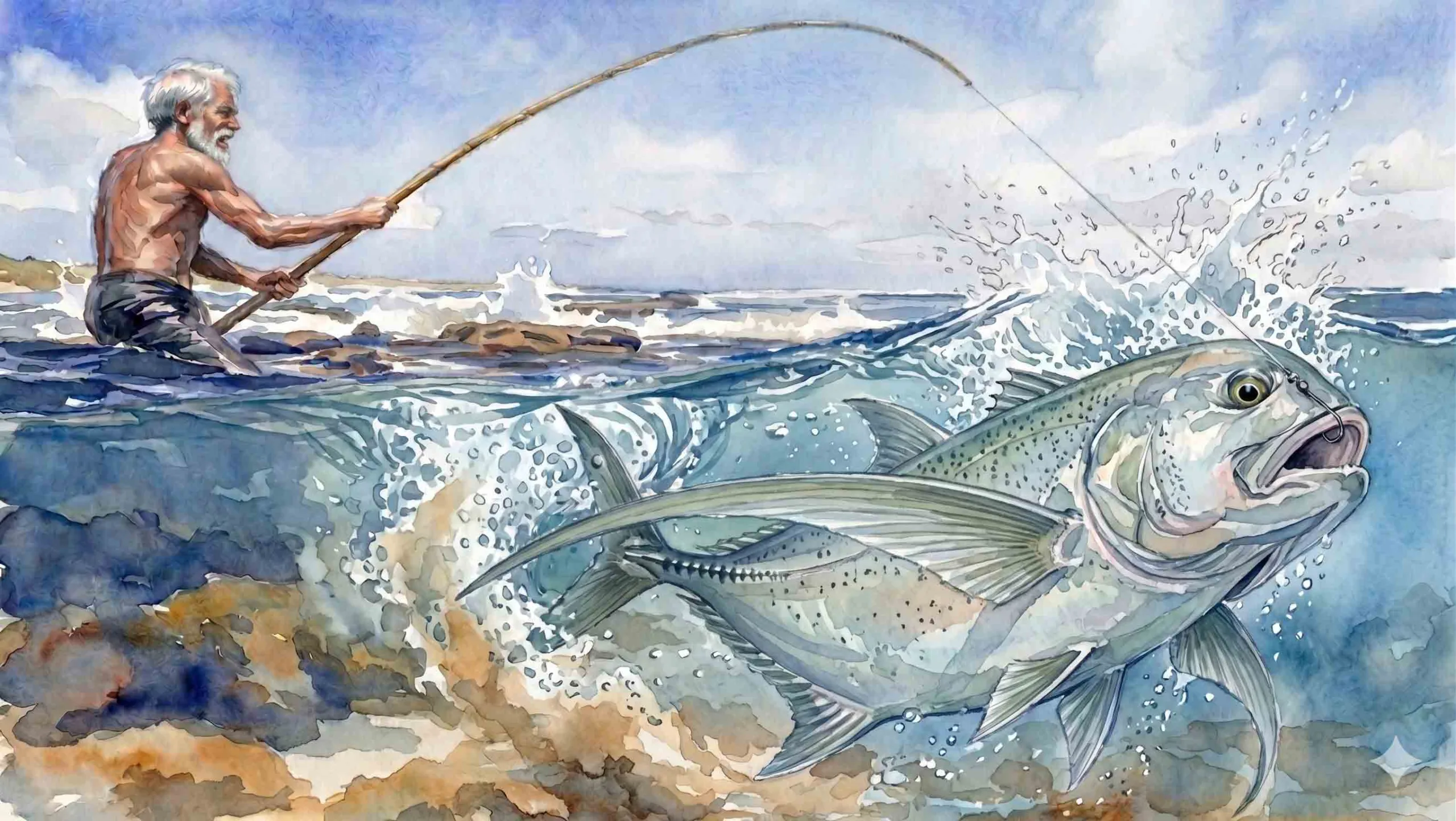
Along the storm-beaten reef edges of Fuvahmulah, fishermen still speak about a giant trevally unlike any other. They call it Hudhuhelakanfai — remembered not simply for its size, but for its astonishing strength, violent strikes and relentless fight against fishermen battling rough monsoon seas.
For generations, the fish has occupied a special place in Fuvahmulah’s fishing culture. Elder fishermen describe Hudhuhelakanfai as the hardest-fighting giant trevally encountered around the island’s reef fronts during the southwest monsoon season, locally known as Hulhangu.
Unlike scientific classifications used in marine biology, Hudhuhelakanfai is a name shaped through experience, observation and oral tradition passed between generations of island fishermen. Among the various giant trevally caught through traditional fishing methods, fishermen say this particular type stands apart in sheer power and endurance.
Stories of snapped bamboo poles, burning palms and fishermen dragged into rough seas remain part of oral history shared among generations of Fuvahmulah fishermen. For many islanders, Hudhuhelakanfai is not simply a fish, but a symbol of the island’s dangerous relationship with the open Indian Ocean.
The Anatomy of a Sea Brute
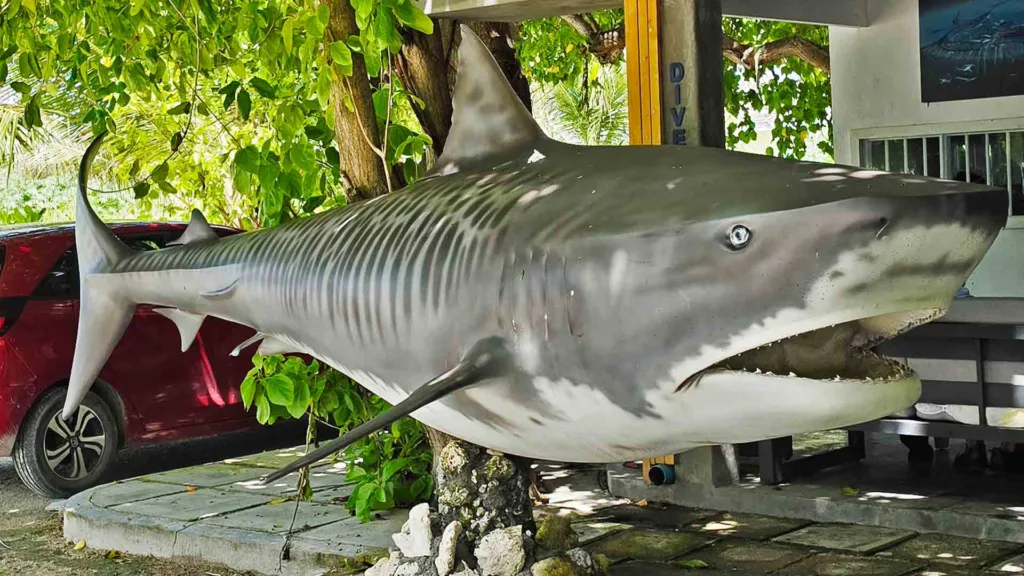
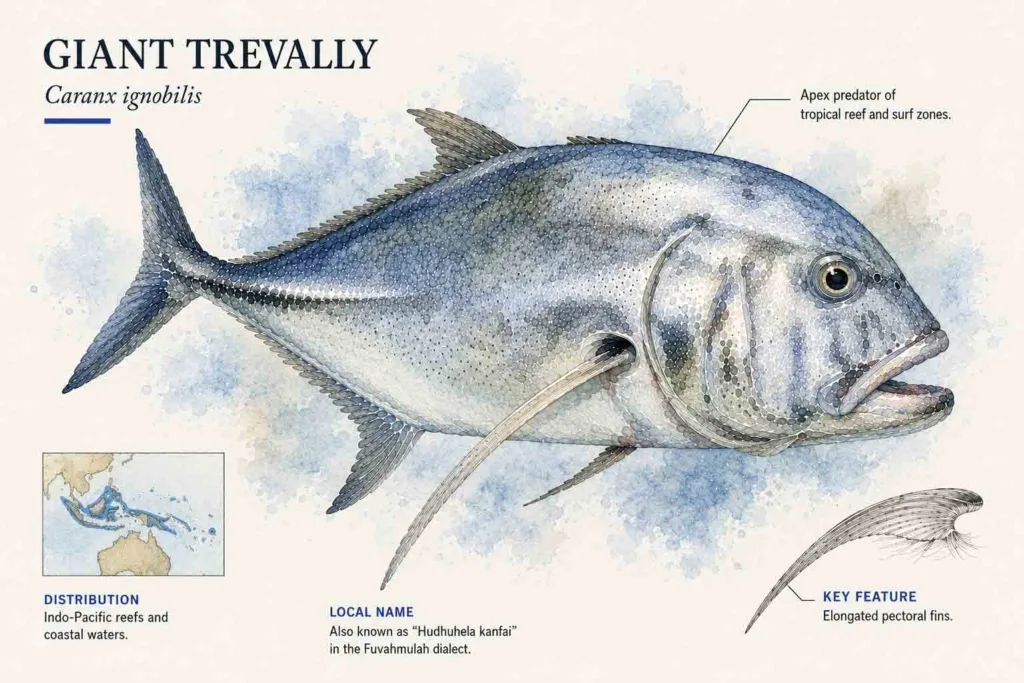
Fuvahmulah fishermen have long observed that some Hudhuhelakanfai possess unusually long, sickle-shaped pectoral fins known locally as kanfai — a Dhivehi term literally meaning “ear.” The name comes from the way the fins extend outward from the body like large curved ears when the fish moves through the water.
While these fish are scientifically classified as the Giant Trevally, Caranx ignobilis, the distinctive physical variations noticed by island fishermen may reflect a combination of genetics, habitat adaptation, swimming behavior, age, maturity and hydrodynamic efficiency.
From a biomechanical perspective, the elongated kanfai fins likely function as stabilizers in the violent turbulence surrounding Fuvahmulah’s monsoon reef fronts, helping the fish maintain balance, maneuverability and speed in chaotic surf conditions.
Elder fishermen also describe Hudhuhelakanfai as unusually thick and muscular toward the tail section — a body structure associated with explosive burst acceleration and immense pulling power. Combined with its long stabilizing fins, these traits may help explain why Fuvahmulah fishermen consistently regard Hudhuhelakanfai as the most formidable giant trevally encountered through Vevelhe Jehun. I found a “Hudhu Helakanfai” on Ocean Blue Fishing’s website. Check it out.
A Technique Found Only in Fuvahmulah
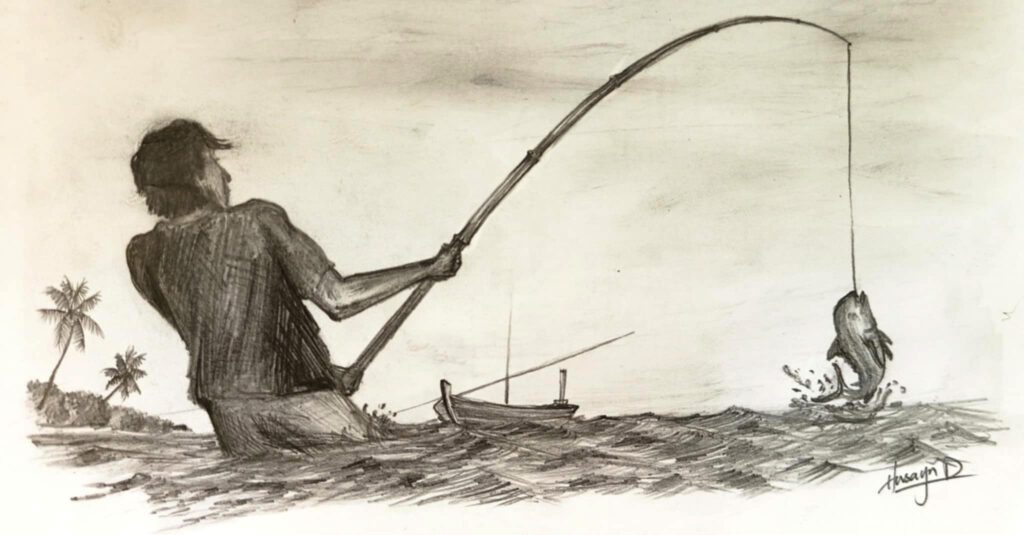
The fish is closely associated with one of the Maldives’ most remarkable indigenous fishing techniques: Vevelhe Jehun.
Practiced exclusively in Fuvahmulah, Vevelhe Jehun was developed to target giant trevally along the island’s exposed reef edges where heavy southwest monsoon swells crash directly against steep reef fronts. The technique reflects generations of ecological knowledge shaped by Fuvahmulah’s isolated geography and dangerous oceanic conditions.
To catch giant trevally, fishermen use long bamboo poles often measuring eight to ten feet in length. Attached to the pole is a traditional fishing line called meyvaali, usually extending twice the length of the bamboo itself.
The bait is traditionally dead flying fish.
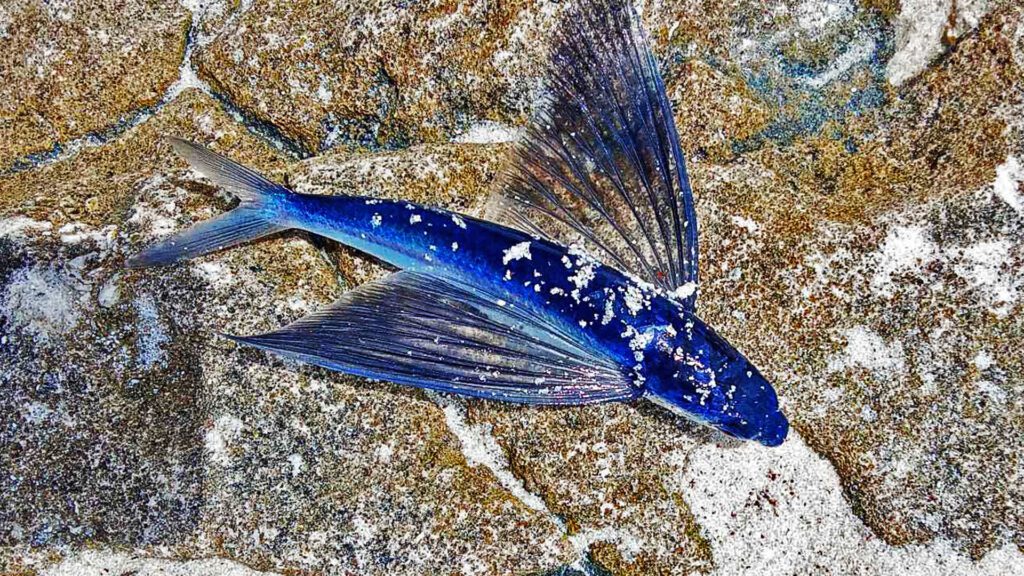
During Hulhangu, flying fish appear in large numbers around Fuvahmulah’s rough seas. Fishermen carefully hook the bait through the belly so the hook exits near the backbone before wrapping thread tightly around the fish to prevent it from tearing apart during violent strikes.
The fishermen stand dangerously close to the fore reef while waves from the open Indian Ocean crash onto the reef flat. Timing and presentation are everything. The bait is dragged across the surface through slow retrievals, pauses and sudden splashes designed to imitate an injured flying fish struggling in turbulent water.
Masters intentionally cast as close as possible to the breaking waves where giant trevally patrol in ambush.
Then comes the strike.
The ocean erupts.
Fishermen describe the explosion of water as sudden chaos — a violent surface eruption powerful enough to resemble a speedboat surging away from the reef.
When the Fish Pulls Men Into the Sea
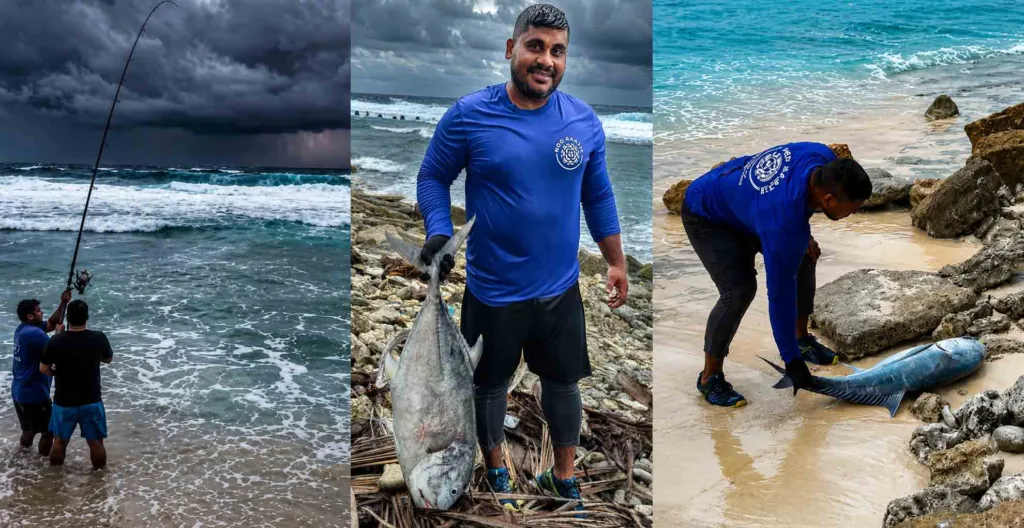
Among all the giant trevally encountered through Vevelhe Jehun, fishermen say Hudhuhelakanfai fights with unmatched aggression. Elder fishermen recall bamboo poles bent to breaking point and battles lasting nearly an hour in rough monsoon seas.
The violence of the fish’s first run created one of the most astonishing elements of Vevelhe Jehun.
When massive GTs proved impossible to control from the reef, fishermen would leap directly into the ocean while still gripping the bamboo pole. According to elderly islanders, this was often the only way to survive the force exerted by the fish. Remaining on the reef could mean instantly losing both the pole and the catch.
Once in the water, the fisherman would wedge the bamboo pole beneath the underarm while attempting to float on the surface and apply pressure against the fish. But the struggle remained dangerous. Powerful giant trevally could drag fishermen several feet beneath the surface during violent dives toward deep water.
Spectators watching from shore often remained prepared to rescue fishermen if something went wrong.
These encounters demanded extraordinary endurance. Some battles lasted thirty to forty minutes, while larger fish fought for more than an hour before exhausted fishermen finally swam back toward the reef flat with their catch.
The Last Masters of Vevelhe Jehun
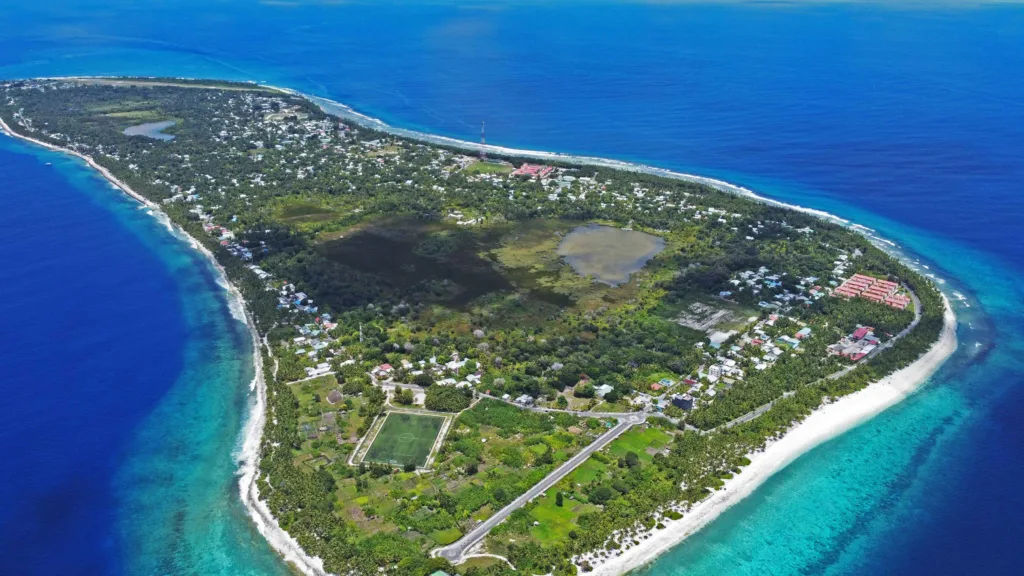
Older islanders still remember legendary masters of Vevelhe Jehun, including the late Hoonige Kudhubei, celebrated for his courage, physical strength and mastery of the technique.
What makes Vevelhe Jehun remarkable is not only the physical danger involved, but the deep ecological understanding behind it. Fishermen knew precisely where giant trevally hunted during certain monsoon conditions, how currents moved along reef edges and how flying fish behaved in rough seas.
Their knowledge came not from written manuals, but from generations of observation repeated across decades at the reef edge.
Today, modern tackle and changing island lifestyles have gradually replaced older fishing traditions. Many younger fishermen no longer practice Vevelhe Jehun, while some of its techniques survive mainly through memory and oral storytelling.
Yet among experienced fishermen in Fuvahmulah, stories of Hudhuhelakanfai still endure.
The southwest monsoon still arrives. Flying fish still scatter across the reef front. And somewhere beyond the crashing surf, fishermen believe the great sea brute still patrols the edge of the island.
Perhaps that is why the legend survives — not simply because of the fish itself, but because Hudhuhelakanfai represents a disappearing relationship between Fuvahmulah fishermen, monsoon seas and the untamed outer reef of the Maldives,