The sea around the Maldives is home to many kinds of tuna. Some are best known for their importance to the country’s fishing industry, while others are familiar to local fishers who encounter them around the islands. One of these is kawakawa (Euthynnus affinis), known in Dhivehi as latti.
A fast-swimming fish found in the warm waters of the Indo-Pacific, kawakawa is commonly caught in the Maldives by trolling from boats. But it can also be caught from the shore when schools venture close to the reef front. For anglers, spotting these fish and casting a lure at the right moment can make shore fishing an exciting experience.
Getting to Know Latti
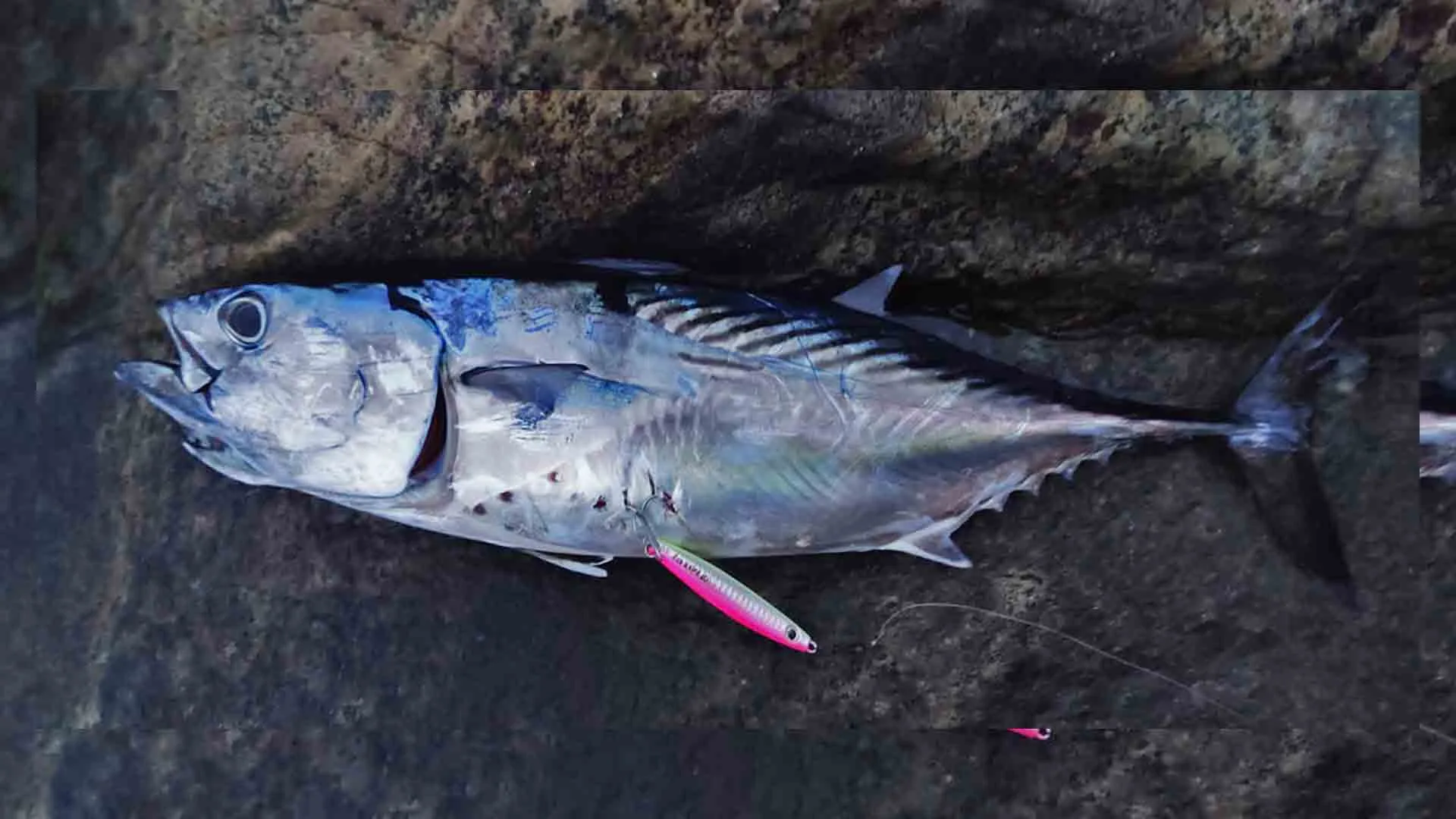
Kawakawa belongs to the tuna and mackerel family, Scombridae. Its streamlined body is built for speed, helping it move quickly through the water as it hunts for prey.
The upper body is bluish-black, while the underside is silvery white. Dark, oblique markings run across the upper sides of the fish, above the lateral line. Small black spots may also appear near the pectoral and pelvic fins, although they are not always easy to see.
Like other tuna, kawakawa has two dorsal fins along its back. A row of smaller finlets extends behind the second dorsal fin towards the tail. These features, together with its distinctive markings, help distinguish it from similar species.
Kawakawa commonly reaches around 55 centimetres in length, although larger individuals can grow to about a metre. It often forms schools that move through the upper layers of the sea in search of food.
A Hunter in the Blue
Kawakawa feeds on small fish and crustaceans, including shrimps and crabs. It hunts in the upper waters, where schools of baitfish can attract larger predators.
When feeding activity reaches the surface, the signs can be striking. Small fish scatter across the water as predators move among them, creating ripples and splashes. Some leap clear of the sea as they try to escape.
For shore anglers, this activity can offer a useful clue. A patch of disturbed water may indicate that kawakawa or another predator is chasing baitfish nearby. Although it does not guarantee a catch, it can help an angler choose where to cast.
Kawakawa occurs throughout the warm waters of the Indo-West Pacific, including the Maldives. Its presence around islands and coastal areas makes it a familiar species in the region’s fisheries.
Catching Kawakawa from the Beach

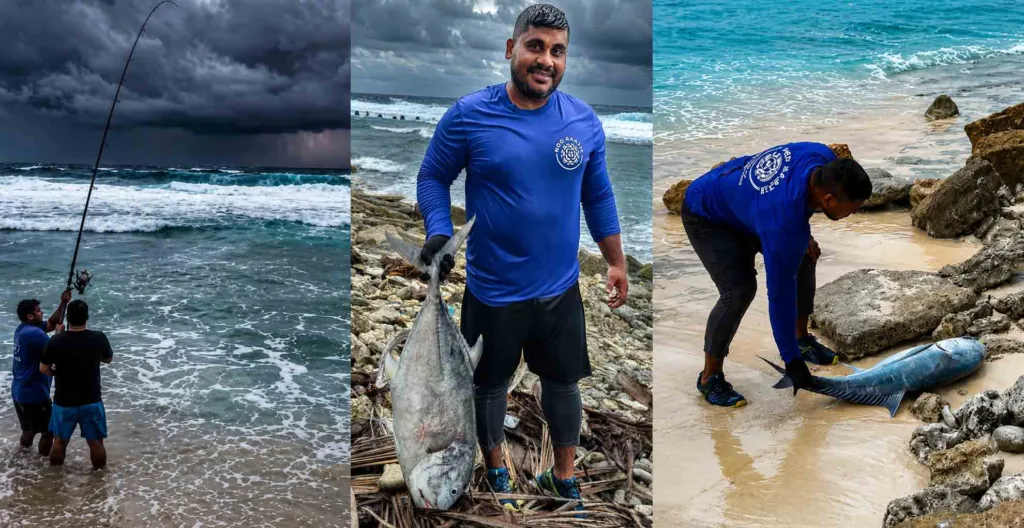
Fishing in the Maldives does not always mean heading out in a boat. Rocky shorelines facing the reef front can also offer opportunities to catch pelagic fish when they come within casting range.
In my article Beach Fishing to Catch Kawakawa, published on Maldives My Islands in December 2024, I shared my experience of targeting latti from the shore with artificial lures.
Metal jigs are useful for this type of fishing. They can be cast towards likely feeding areas and retrieved through the water to imitate the movement of a small fish. The appropriate lure weight depends on conditions, casting distance and the depth being targeted.
Success requires patience. Feeding fish may appear briefly and disappear just as quickly, while at other times the sea can remain quiet for a long period. Knowing when to cast and where to look comes with experience.
The reef presents its own challenges. A hooked kawakawa may run towards deeper water or around the reef, where the fishing line can become trapped or damaged. The angler’s position and the way the fish is retrieved can make a difference between landing the catch and losing it.
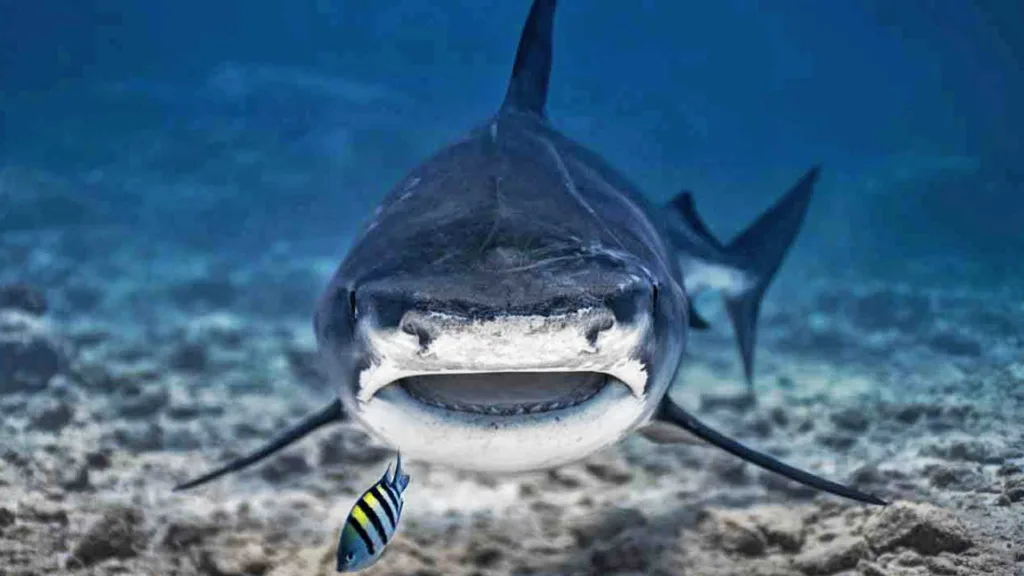
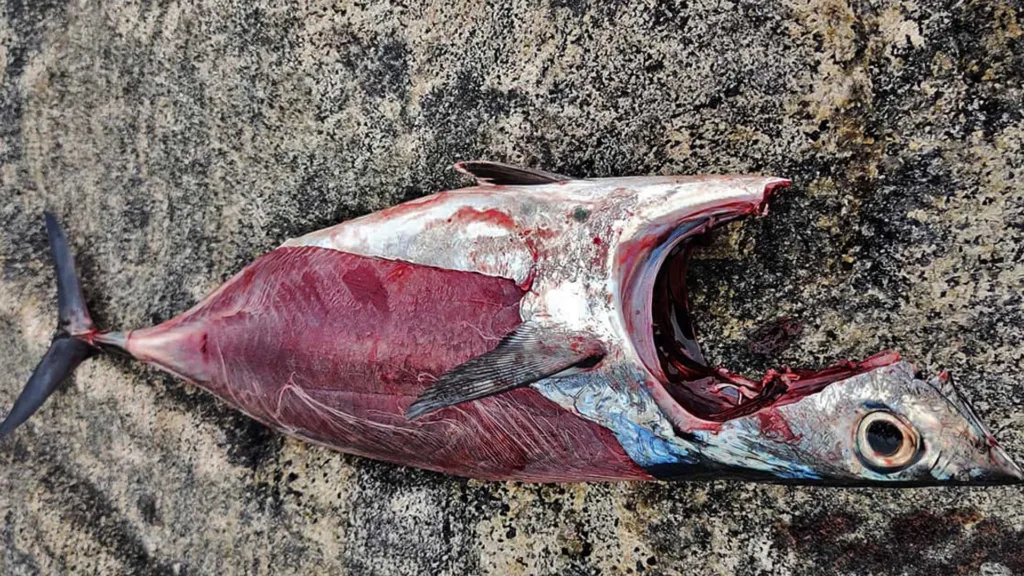
One unexpected challenge is the possibility of encountering sharks. In my own shore-fishing experiences, sharks have sometimes attacked kawakawa while I was bringing a hooked fish towards land. The outcome can change in seconds. A fish that seems almost within reach may suddenly be taken by a larger predator, leaving only part of it on the line.
Although such encounters can be frustrating, they reveal the complex relationships between predators and prey in the marine environment. A struggling fish can attract the attention of sharks nearby, turning an ordinary fishing attempt into an unexpected encounter.
Latti and the Fishing Life of the Maldives
Fishing has shaped life in the Maldives for generations. It has provided food and livelihoods, while knowledge of fish, currents, weather and fishing grounds has passed from one generation to the next.
Kawakawa is caught by trolling, in which lines are drawn behind a moving boat, and by shore anglers using rods and lures when the fish come close enough to reach from land. These methods reflect the different ways fishers pursue the same species in the waters around the islands.
Kawakawa may not be the largest tuna found in Maldivian waters, but its speed, distinctive markings and hunting behaviour make it an interesting species to know. For local fishers, latti is more than a name in a fish guide. It is a fish encountered in everyday fishing life, caught behind moving boats or pursued from rocky shores with a rod and lure.
Combining scientific knowledge with firsthand experience helps us better understand kawakawa and its place in the marine life surrounding our islands.
The next time you fish from a Maldivian shore, look towards the reef front. Beyond the breaking waves, latti may be moving through the blue, part of the rich marine life that has sustained island communities for generations.