A reef fish shaped by distance and depth
Along the outer edges of Maldivian reefs, where lagoons give way to deeper blue and land feels far away, the Island Trevally (Carangoides orthogrammus) moves with quiet authority. Known locally as Thumba handhi, this species is closely tied to oceanic islands, appearing wherever reefs rise from deep water and the open sea dominates the horizon.
Commonly reaching around 40 centimeters—though capable of growing up to 75 centimeters—the Island Trevally is a familiar yet powerful presence. It does not announce itself with dramatic colour or surface-breaking speed. Instead, it patrols reef slopes and lagoon edges with measured confidence, a fish shaped by space, depth, and distance from shore.
A body shaped for endurance and control
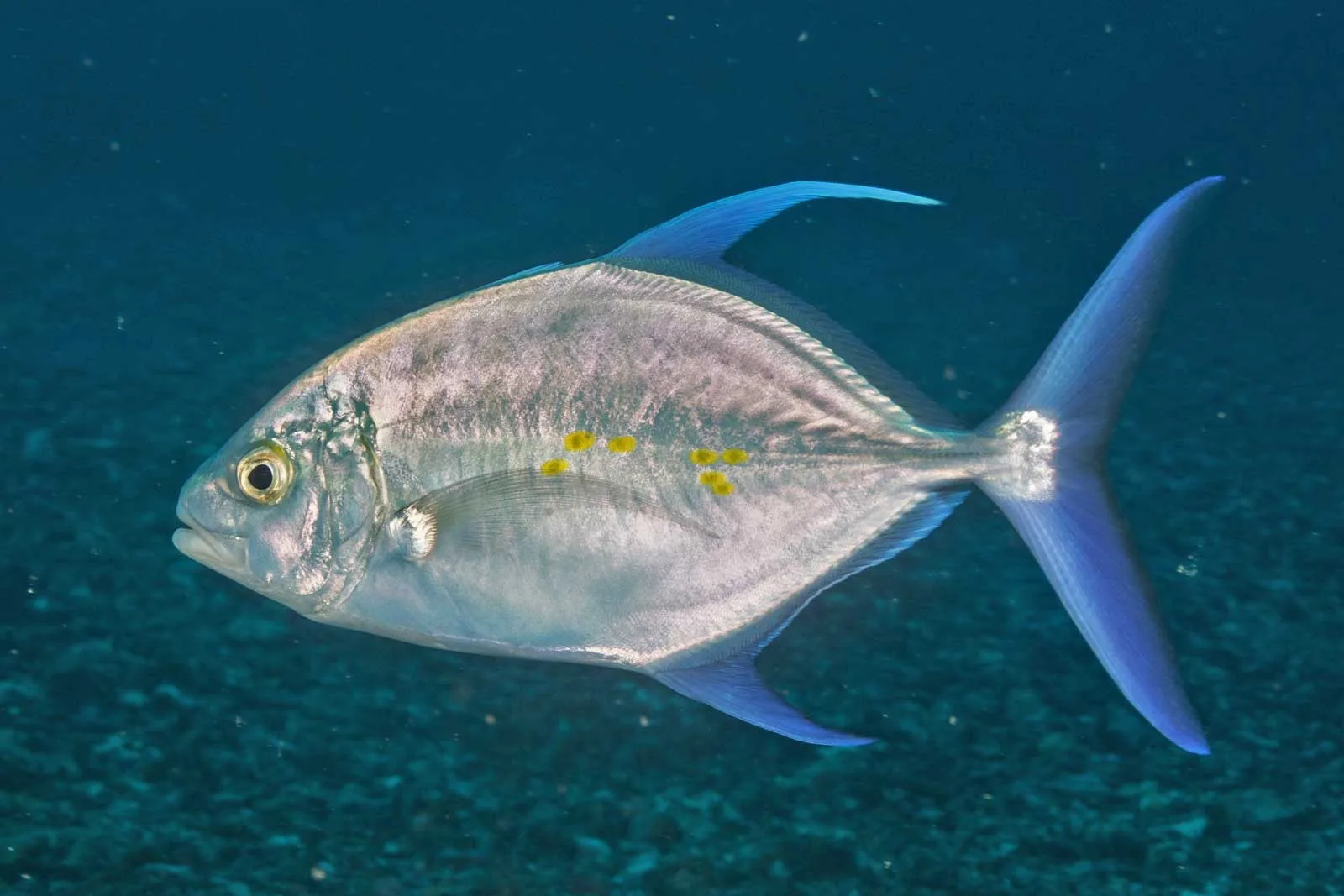
The form of the Island Trevally reflects its nomadic lifestyle. Its snout is usually slightly angular, and in adults, the lips become noticeably fleshy and textured, giving the head a robust profile. Its structural outline is defined by two dorsal fins: the first with eight spines, and the second supported by a single spine followed by 28 to 31 soft rays.
A key identifying feature is the breast scaling. Unlike the Black Trevally, the Island Trevally has a “naked” (unscaled) underside that extends up to the origin of the pelvic fins. This anatomical trait, along with numerous gill rakers, reflects a feeding strategy tuned to active hunting across diverse reef environments.
A colour shaped by reef shadow and open water
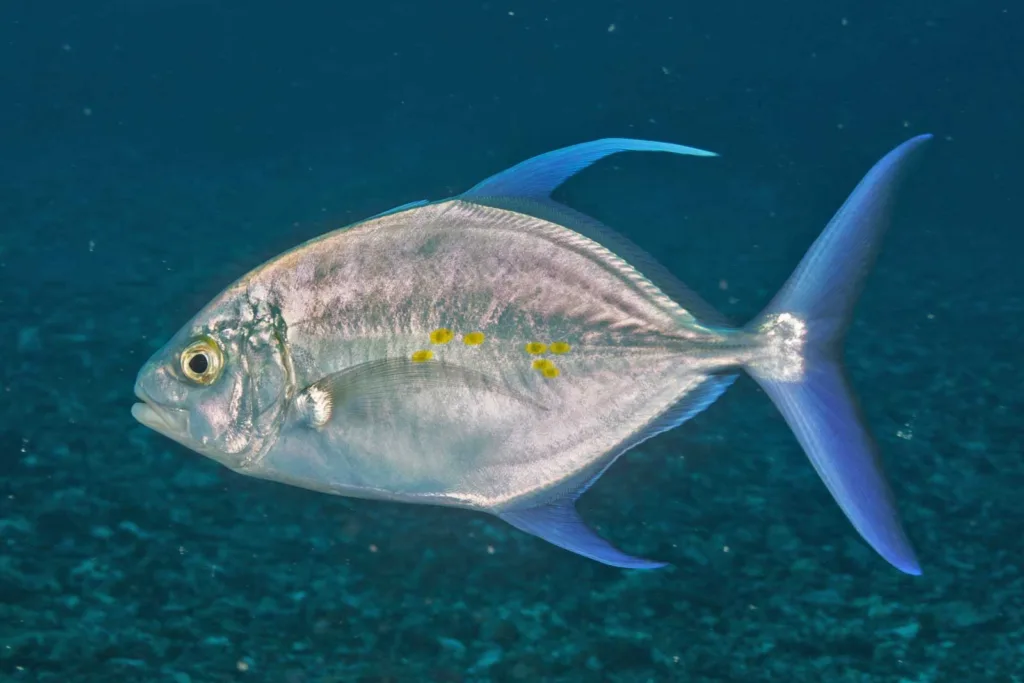
In colour, the Island Trevally is restrained and functional. Its body is a sleek silver-grey, often tinged with olive-green above, blending easily with reef shadows. Most distinctively, small yellow to golden spots are scattered across its sides, typically appearing in a row near the lateral line.
A fine white margin often edges the anal fin, adding a subtle accent to an otherwise subdued palette. This camouflage allows the fish to move inconspicuously through mixed habitats, from sunlit lagoons to the dimmer reef slopes where the light begins to fail.
A home shaped by oceanic reefs
The Island Trevally inhabits lagoons and seaward reefs, often descending to depths exceeding 50 meters. Unlike many coastal trevallies, it shows a strong preference for oceanic islands and is notably scarce near continental coastlines.
It may be encountered alone, in pairs, or moving in loose schools. Its diet is versatile, consisting of sand-dwelling crustaceans, worms, and small fishes. This links the species closely to both the reef-associated seabed communities and the surrounding water column.
A near-constant companion of island reefs
With a distribution spanning the Indo-Pacific and Eastern Pacific, the Island Trevally is one of the most consistently encountered species around remote island chains. In the Maldives, its presence is so reliable that it becomes part of the background rhythm of reef life—seen regularly, yet rarely examined closely.
It is a fish defined not by spectacle, but by persistence. Wherever Maldivian reefs meet the deep ocean, the Island Trevally is likely nearby, moving steadily through its blue domain.
Species Snapshot
- Scientific Name: Carangoides orthogrammus
- English Name: Island trevally
- Local Name: Thumba handhi
- Family: Carangidae
- Maximum Size: 75 cm (commonly 40 cm)
- Habitat: Lagoons and seaward reefs, often deeper than 50 m
- Diet: Crustaceans, worms, and small fishes
- Distribution: Indo-Pacific and Eastern Pacific (Oceanic islands)
References
- M.R.S. (1997). Fishes of the Maldives. Marine Research Section, Ministry of Fisheries and Agriculture, Republic of Maldives.
- Froese, R. and D. Pauly. Editors. (2024). FishBase. Carangoides orthogrammus. www.fishbase.org.
- Smith-Vaniz, W.F. (1999). Carangidae. In FAO species identification guide for fishery purposes. The living marine resources of the Western Central Pacific.