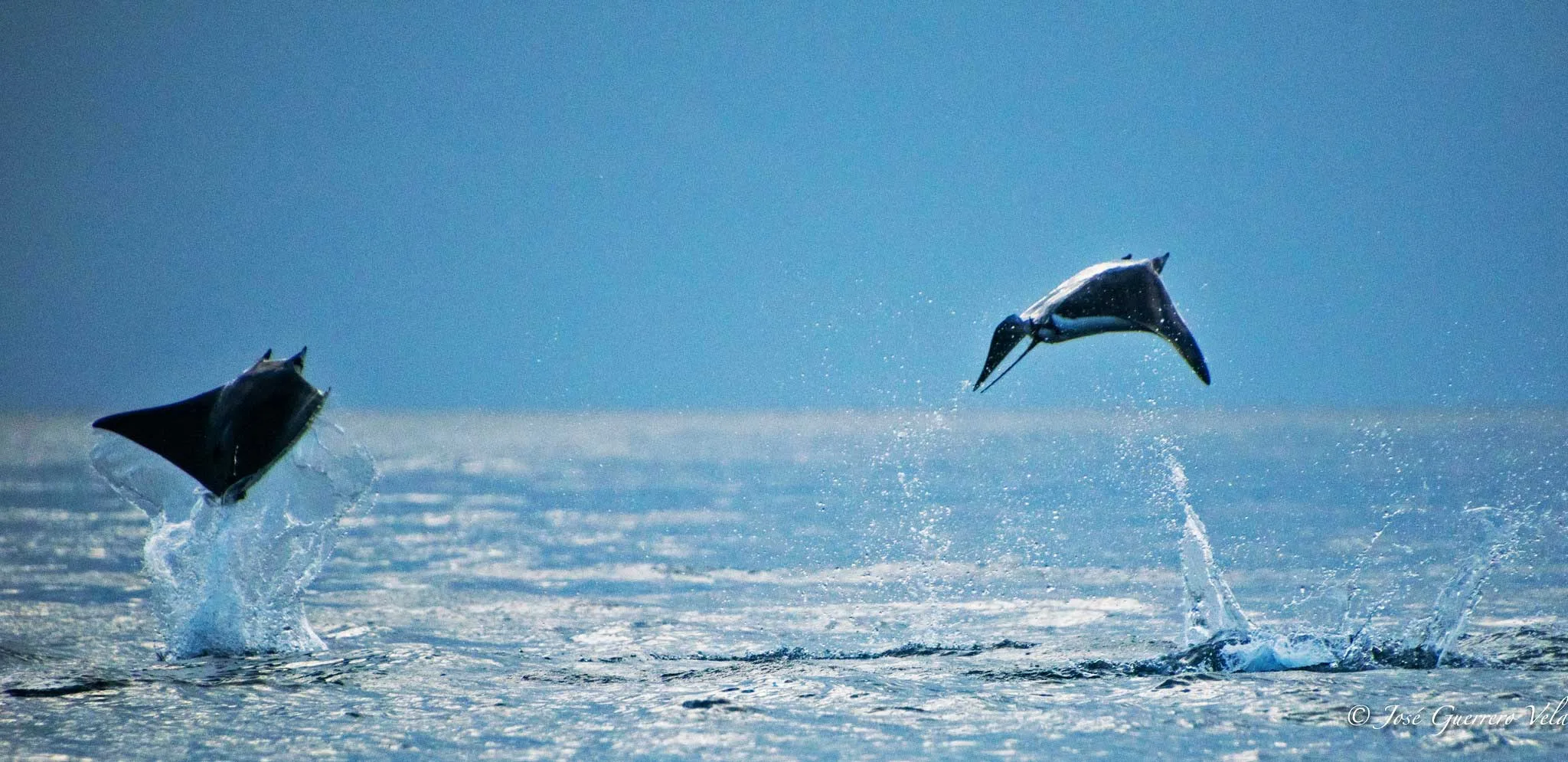
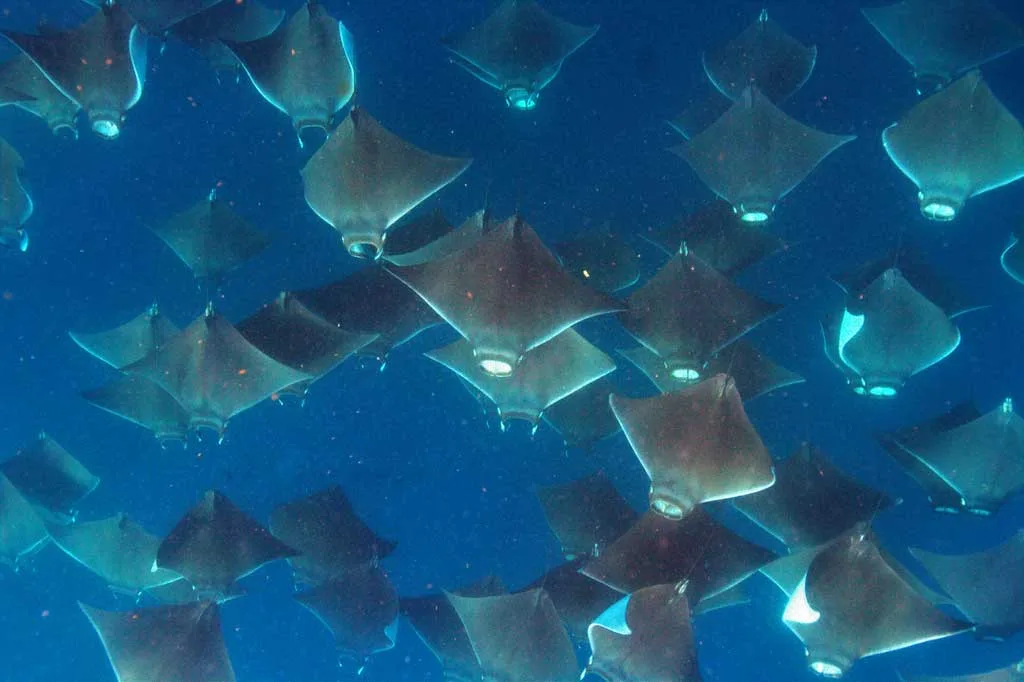
Between the moon and the tide, the ocean around the Maldivian atolls appears to forget its own rules. Without warning, the surface fractures as dark, winged shapes erupt into the air—twisting, flipping, and crashing back in thunderous succession. For a few breathless moments, the sea itself seems to fly. This is a gathering of Mobula rays, often called devil rays, performing one of the most spectacular and least understood behaviors in the marine world.
Mobula rays are frequently mistaken for manta rays, and the confusion is understandable. Both belong to the same family, Mobulidae, and together they are known as mobulid rays. Long thought to be separate lineages, genetic research has revealed that mantas and devil rays are even more closely related than once believed, now sharing a single genus: Mobula. Today, scientists recognize roughly ten living mobulid species—three manta rays and the remainder devil rays—each adapted to a life built around plankton, motion, and vast oceanic spaces.
To the untrained eye, mantas and mobulas appear nearly identical. Both have broad, wing-like fins and distinctive cephalic lobes that unfurl like ribbons to guide plankton into their mouths. Both are gentle filter feeders, intelligent and entirely harmless to humans. Yet their lives unfold in markedly different ways. Manta rays are the giants of the group, some spanning more than six meters from wingtip to wingtip. They tend to move slowly, often alone or in small groups, lingering at cleaning stations and sometimes approaching divers with apparent curiosity. Mobula rays are smaller but far more restless. They travel in large schools, roam open waters, and rarely linger long enough to be closely observed.
What truly sets devil rays apart, however, is their habit of leaving the ocean altogether. Mobula rays are famous for breaching—accelerating at high speed and launching themselves meters into the air before crashing back into the sea with astonishing force. Scientists have debated the purpose of this behavior for decades. The explosive impact may send low-frequency sound waves across long distances underwater, allowing individuals to communicate within sprawling schools. It may help dislodge parasites or unwanted hitchhikers. It may also serve as a display, a demonstration of strength and vitality during courtship. No single explanation fully accounts for the behavior, and it is likely that breaching serves several functions at once.
In the Maldives, these airborne displays are closely tied to the rhythm of the monsoon. During the Southwest Monsoon, nutrient-rich currents sweep plankton toward the eastern sides of the atolls. Devil rays follow the food, assembling in extraordinary numbers. Hundreds may gather at once, forming long, flowing chains that move through the water like living currents. Witnessed from above, a “Mobula fever” transforms a calm lagoon into a churning, kinetic landscape of wings and spray.
Despite their dramatic presence, Mobula rays remain among the ocean’s most elusive inhabitants. Unlike manta rays, which often tolerate human observers, devil rays are shy and quick to disappear. Their constant need to swim—an adaptation known as ram ventilation, which allows them to breathe only while moving—leaves little room for rest or lingering encounters. As a result, much of their life history remains poorly understood.
What is known raises concern. Like mantas, Mobula rays grow slowly and reproduce at an exceptionally low rate, typically giving birth to a single pup after a long gestation. This makes their populations highly vulnerable to fishing pressure, accidental bycatch, and the shifting distribution of plankton driven by climate change. As warming seas alter ancient food pathways, the routes these rays have followed for generations may be quietly rewritten.
In the Maldives, where marine conservation is a national priority, Mobula rays are protected as symbols of an ocean still governed by ancient forces. To see them leap is to witness raw, untamed energy—a fleeting moment when the boundary between sea and sky dissolves. Even in an age of satellites and sensors, the ocean keeps its secrets well. Sometimes, it reveals them only in flight.
References
- Manta Trust (Maldives Manta Conservation Programme): Essential data on Mobulid species identification and sighting trends in the Maldives. mantatrust.org
- IUCN Red List of Threatened Species: Current conservation status and biological vulnerability assessments for Mobula tarapacana and Mobula thurstoni. iucnredlist.org
- Save Our Seas Foundation: Marine biology research on the movement and ecology of filter-feeding rays in the Indian Ocean. saveourseas.com
- Stevens, G. M. W. (2016): Field Guide to the Manta & Devil Rays of the World.