
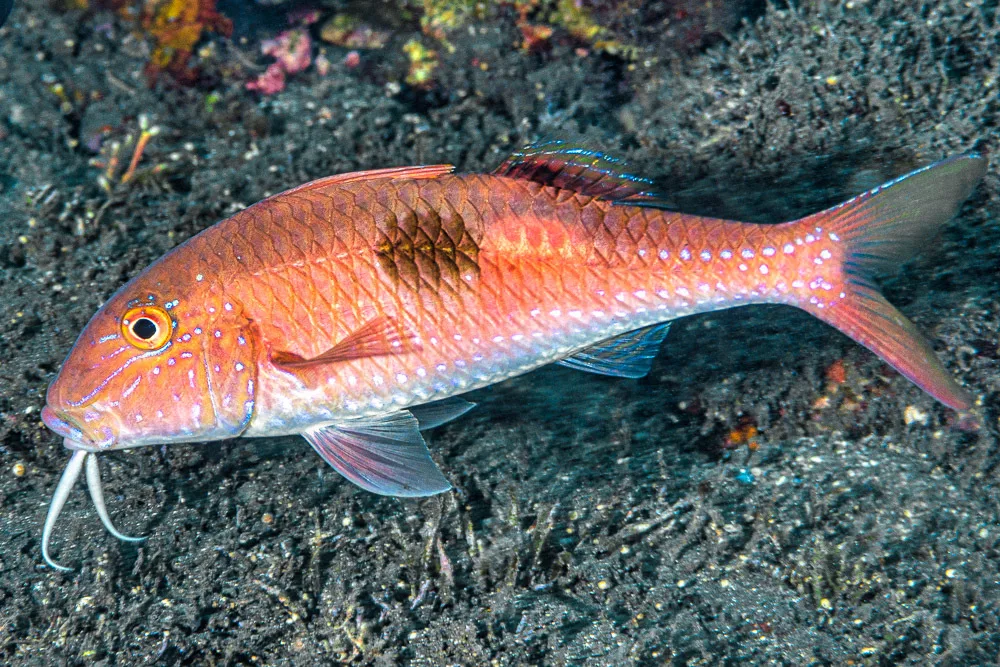
Along the warm coral slopes of the Maldives, where light fractures into shifting patterns of gold and pink, a small but unmistakable reef dweller moves quietly across the sand. At first glance, it blends easily into its surroundings—until the eye catches a single, dark mark on its flank. This is the side-spot goatfish, a modest fish with a signature spot that sets it apart in the crowded theater of the reef.
Known locally as Lah kalhuoh’, the side-spot goatfish belongs to the goatfish family (Mullidae), a group instantly recognizable by the pair of sensitive barbels that hang from the chin. These whisker-like organs are not ornamental. They are finely tuned tools, sweeping the seabed as the fish searches for hidden prey beneath the sand.
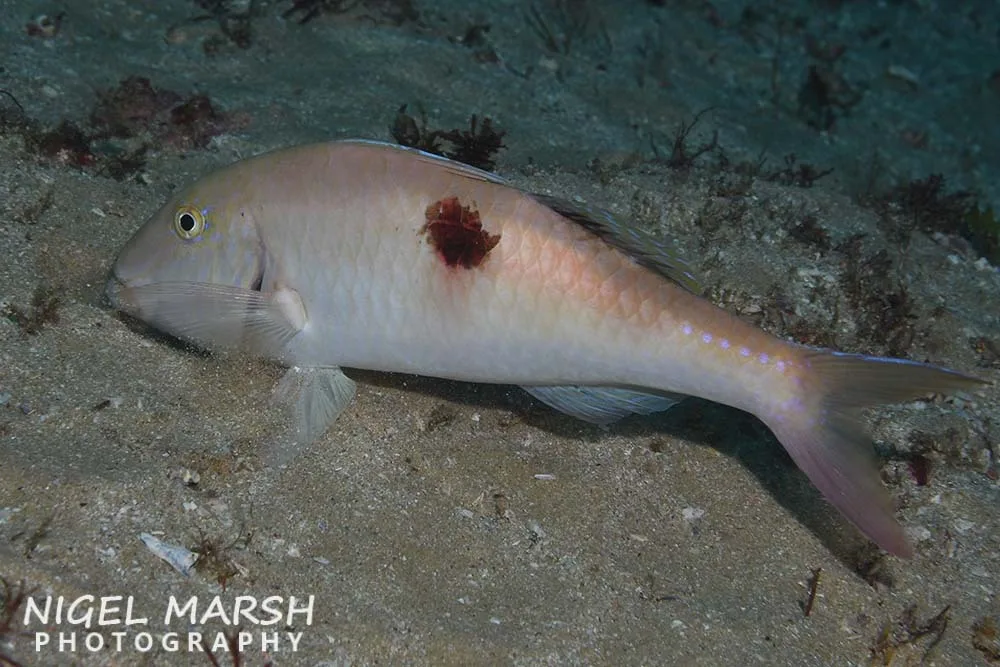
Reaching a maximum length of about 30 centimeters, the side-spot goatfish has a moderately elongate body built for constant movement along the reef floor. Its coloration—ranging from pale yellowish-brown to light red—fades softly into white or pale pink along the belly, a gradient that mirrors the sandy habitats it frequents. The defining feature is impossible to miss: a large, round black spot positioned on the lateral line beneath the gap between the dorsal fins, often edged by a paler halo.
Structurally, the fish is a precise example of reef specialization. The first dorsal fin bears eight spines, followed by a second dorsal fin with one spine and eight rays. The anal fin carries one spine and six rays, while the pectoral fins extend with sixteen rays, allowing for fine maneuvering just above the substrate. Its barbels reach back toward the rear margin of the preopercle, perfectly placed for probing crevices and sand pockets.
Life for the side-spot goatfish revolves around the reef’s hidden layers. It feeds primarily on benthic invertebrates, organisms concealed beneath sand and rubble. With deliberate movements, the fish fans the seabed, uncovering small crustaceans and worms that would otherwise remain invisible. In doing so, it plays a subtle ecological role—stirring sediments, aerating the substrate, and contributing to the reef’s dynamic balance.
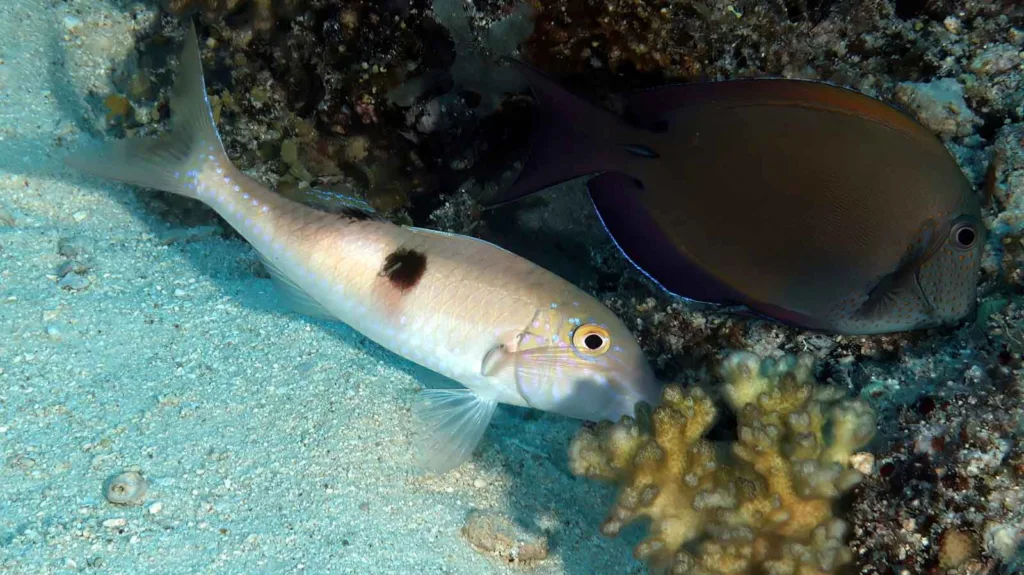
Though widely distributed across the Indo-West Pacific, this species is considered fairly common in the Maldives, where reef systems provide ideal feeding grounds. During the breeding season, behavior shifts in ways that are rarely noticed by casual observers. Males engage in courtship displays, rapidly wriggling their barbels—a delicate, almost rhythmic motion that signals readiness and intent, echoing similar behaviors seen across other goatfish species.