Moving in quiet schools across the shallow reefs of the Maldives, the goldlined rabbitfish is a study in subtle beauty and ecological importance. Known locally as Thammas, this reef-dwelling herbivore may not command the attention of large predators or charismatic megafauna, yet its role in maintaining reef balance is indispensable.
The goldlined rabbitfish belongs to the family Siganidae, a group of reef-associated fishes recognized for their grazing habits and deep, laterally compressed bodies. Adults commonly reach about 25 centimeters in length, though some individuals grow as large as 43 centimeters. The body is oval and compact, with a gently convex head profile and minute scales that give the fish a smooth, almost satin-like appearance in the water. Its dorsal fin is armed with 13 spines and 10 soft rays, mirrored below by an anal fin with 7 spines and 9 rays, while the slightly forked tail provides steady propulsion over reef flats.
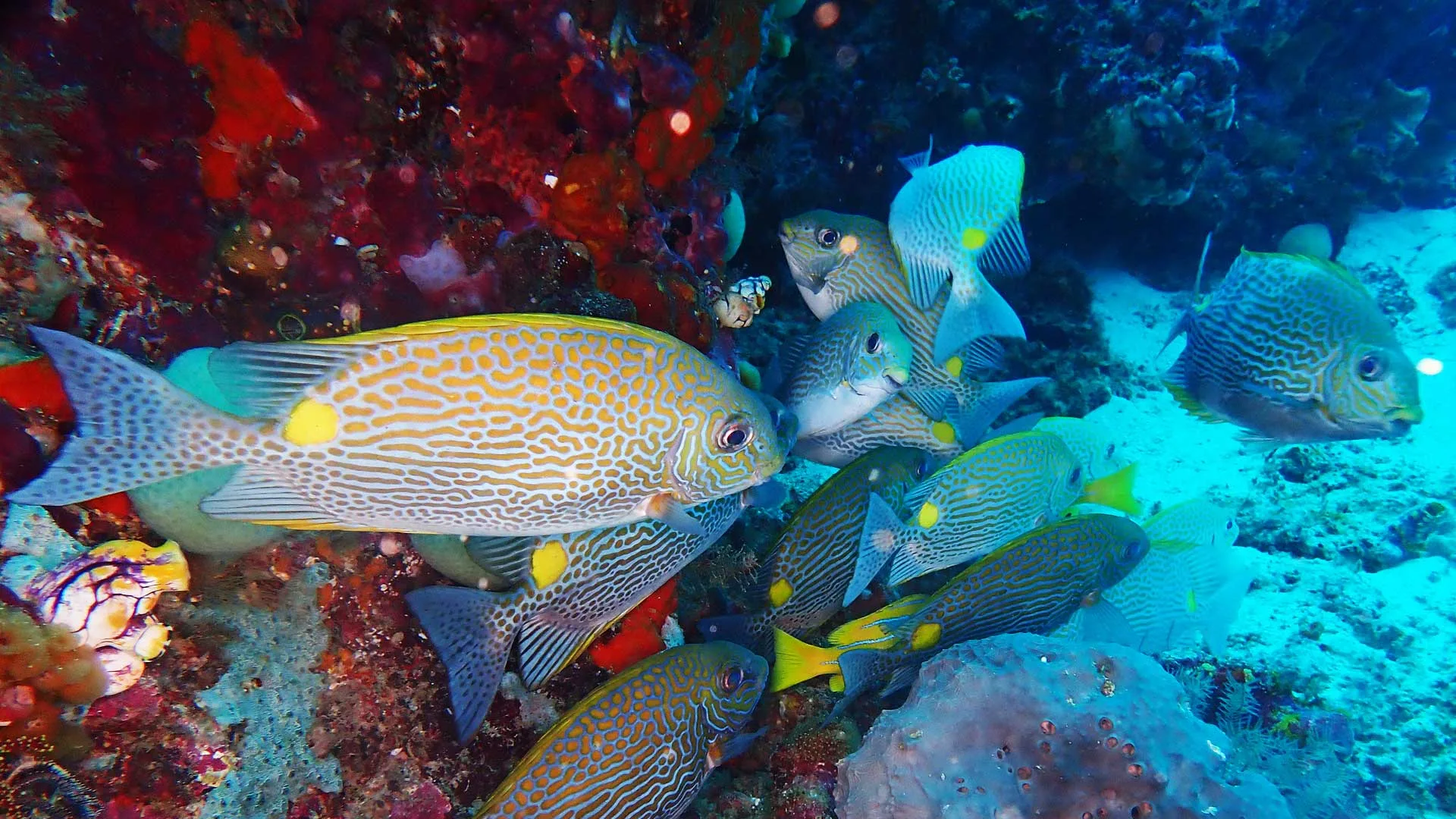
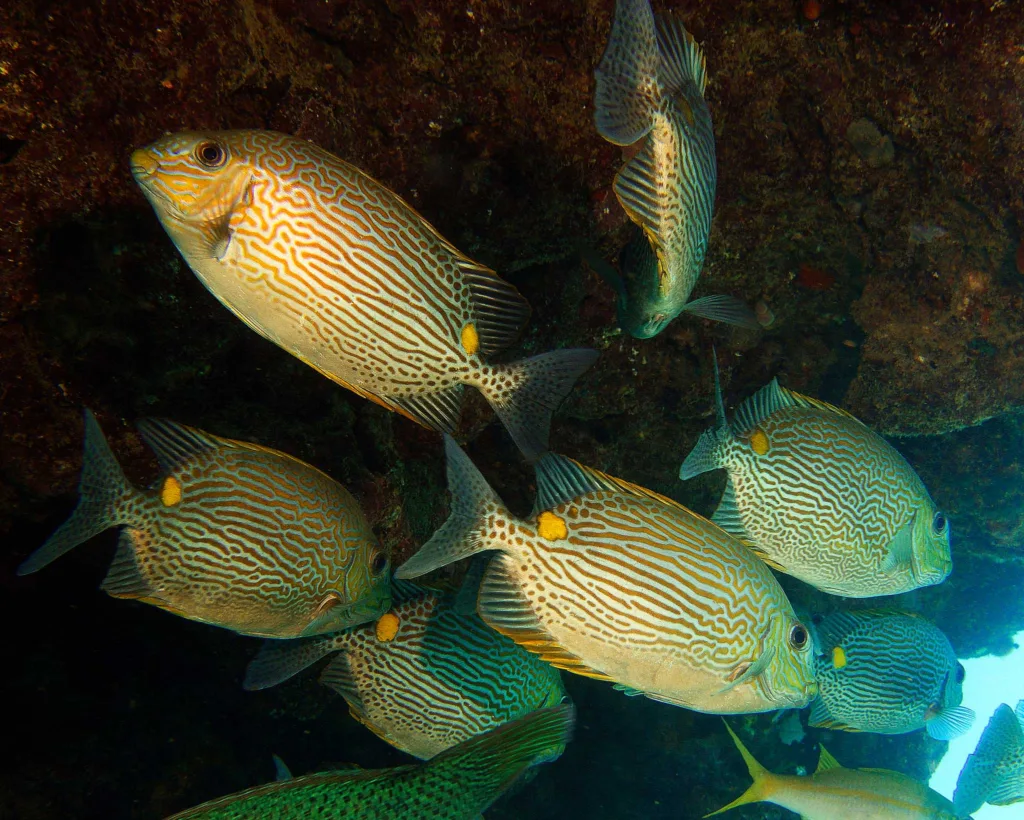
Its coloration is understated but distinctive. The upper body carries a bluish sheen that fades into silver along the belly. Across the sides run fine horizontal golden lines, which fragment into spots toward the dorsal and anal regions and near the base of the tail. A single, prominent golden blotch beneath the soft dorsal fin serves as a key identifying feature, catching the light as the fish turns.
Goldlined rabbitfish are social animals, most often encountered in schools along shallow coastal reefs. Adults and sub-adults frequent reef flats, where they graze methodically across hard substrates. Juveniles, more vulnerable to predators, shelter in mangrove-lined shallows, where food is plentiful and cover abundant. Feeding is constant and deliberate: the fish scrape algae from coral surfaces and browse on seaweeds and seagrasses, helping to prevent algal overgrowth that can smother living reefs.
The species ranges widely from the Maldives to the western Pacific, but within the Maldives it shows a curious pattern of abundance. It is particularly common in the southern atolls, while being notably scarce in the waters around Malé, suggesting localized environmental or habitat preferences that remain poorly understood.
Closely related to another rabbitfish species distinguished by an all-over pattern of yellow spots, the goldlined rabbitfish can be reliably identified by its striped-and-spotted golden markings. Such subtle differences underscore the diversity hidden within reef fish communities—diversity that often goes unnoticed beneath the surface.
Quietly grazing, rarely hurried, and almost always in company, the goldlined rabbitfish exemplifies the understated rhythm of reef life. Its presence is a reminder that coral ecosystems depend not only on dramatic predators and vibrant corals, but also on diligent grazers whose daily work keeps the reef alive.
Source
M.R.S. (1997). Fishes of the Maldives. Marine Research Section, Ministry of Fisheries and Agriculture, Republic of Maldives. 408 pp. ISBN 99915-62-12-5.
Feature photo: gege84500 / iNaturalist (CC BY-NC)