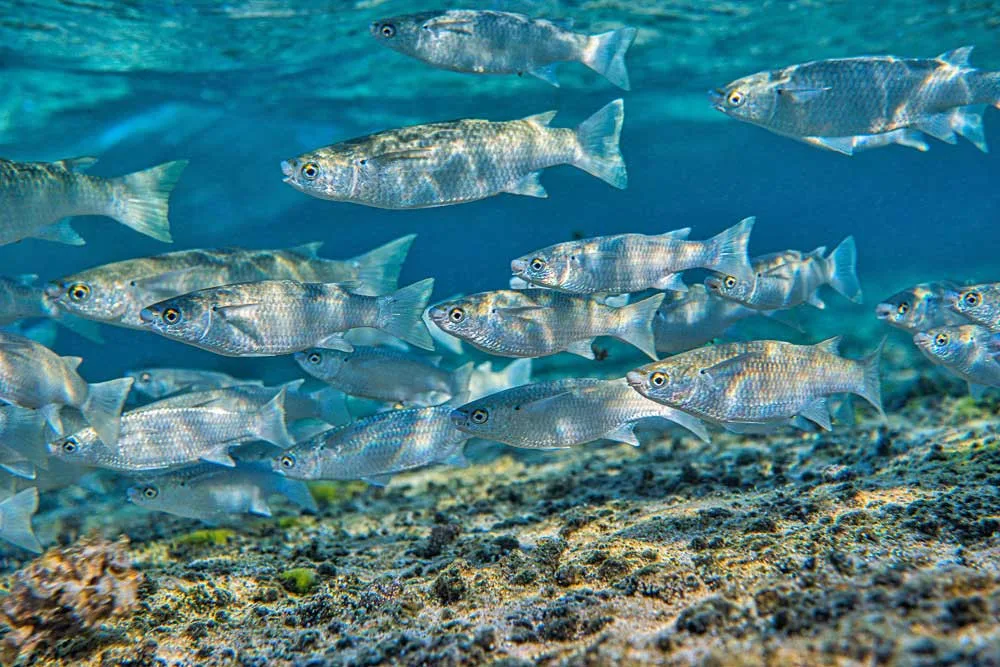
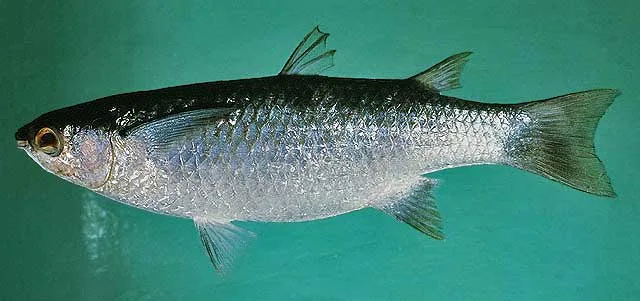
In the shimmering, sun-drenched shallows where the Maldivian atolls meet the open sea, a silver flash often signals the presence of the coast’s most vigilant residents. The mullets are a global family of over 70 species across 15 genera, mastering the “in-between” zones of sand flats, estuaries, and bustling harbors. In the Maldives, three recorded species serve as the primary link between the microscopic world of the sand and the larger predators of the reef.
While common, they are rarely easy to approach. These are famously wary travelers, frequently seen in tight, synchronized schools cruising the surface, ready to vanish at the slightest ripple of danger.
The Deep Patrolling Warty-lip
Among the species found in the archipelago, the Warty-lip Mullet (Crenimugil crenilabis) is the one most likely to catch a diver’s eye. Growing to a robust 40 cm, these fish are the deep-divers of their family, patrolling reef slopes down to depths of 20 meters.
Their feeding process is a marvel of biological engineering. They dip down to the seafloor, scooping up mouthfuls of the upper sand or mud layer. Within their specialized systems, they filter out a microscopic feast of algae and tiny invertebrates. On these same reefs, you might spot their cousin, the Bluespot Mullet (Moolgarda seheli). Though similar in appearance, a keen observer will notice its more deeply forked tail and its preference for brackish, silty environments.
The Harbor Specialist Finger-lip
While the Warty-lip patrols the reefs, the Finger-lip Mullet (Oedalechilus labiosus) is the “street-smart” resident of the Maldives’ man-made frontiers. Reaching about 25 cm, these fish are commonly found in small, disciplined groups navigating the shadows of jetties and protected bays.
Characterized by a uniquely blunt snout compared to other Maldivian species, the Finger-lip Mullet is a surface specialist. They are often seen darting amongst the pilings and rocks of harbors, a testament to the family’s incredible ability to adapt to silty and high-traffic conditions.
Species at a Glance
- Family Mugilidae
- A large global family with roughly 70 species and 15 genera.
- Warty-lip Mullet (Crenimugil crenilabis)
- The most observed species by divers, reaching 40 cm in length.
- Known for schooling along reef slopes and filtering the upper sand layers.
- Finger-lip Mullet (Oedalechilus labiosus)
- A smaller specialist (25 cm) with a blunt pointed snout.
- Prefers protected bays, harbors, and silty surface waters.
- Bluespot Mullet (Moolgarda seheli)
- Very similar to the Warty-lip but distinguished by a deeper forked tail.
- Primarily found in estuarine environments.
References
- Primary Source
- Kuiter, R.H. & Godfrey, T.J. (2014). Fishes of the Maldives: Indian Ocean. 3rd Edition. Atoll Editions.
- Additional Research
- Froese, R. & Pauly, D. (Eds.). (2026). FishBase. World Wide Web electronic publication. (Used for verifying global species counts and family taxonomy).