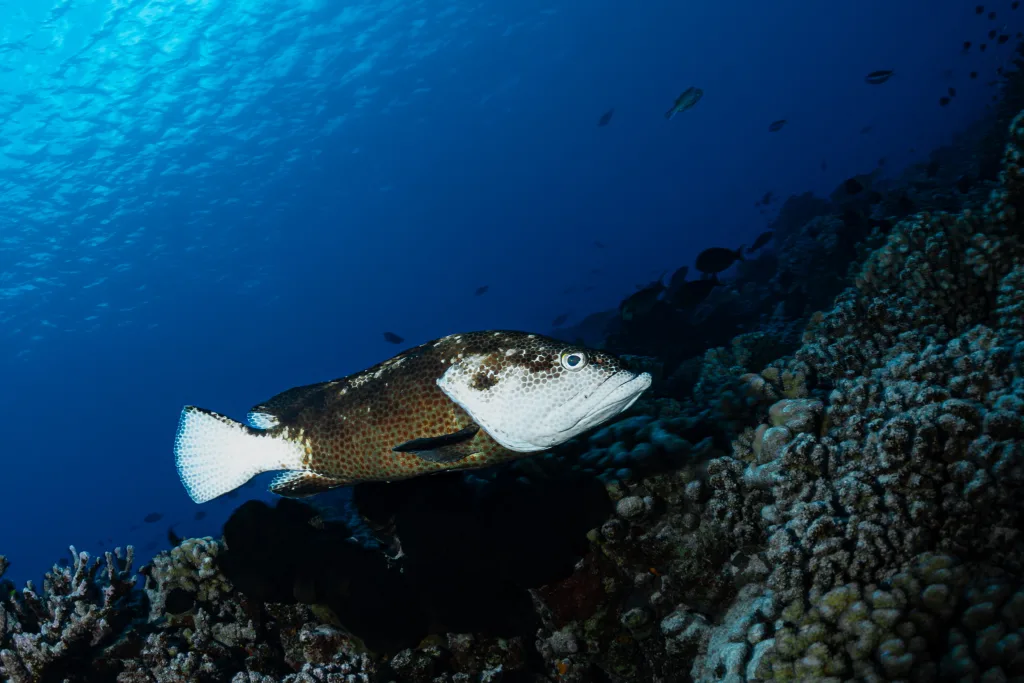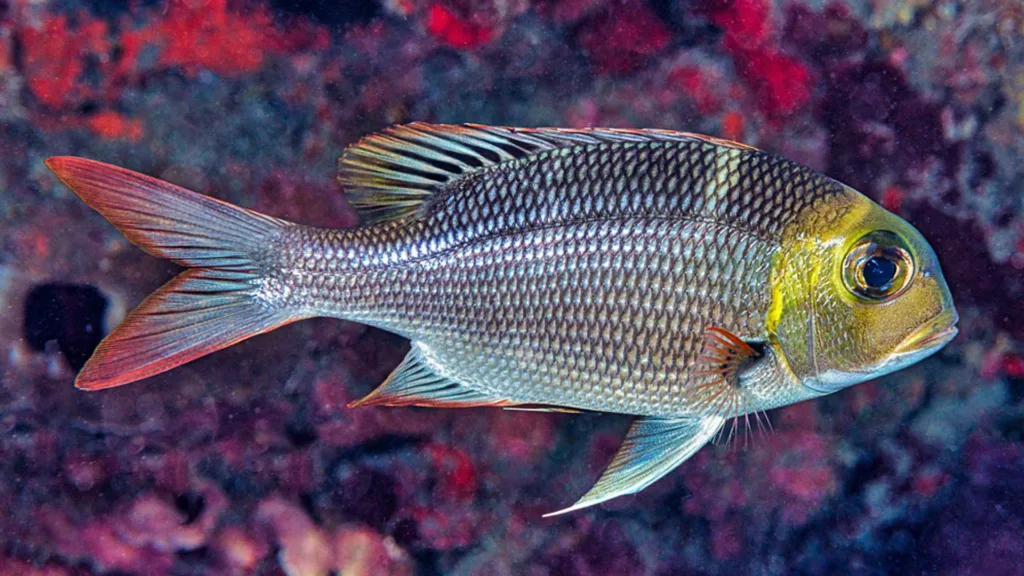
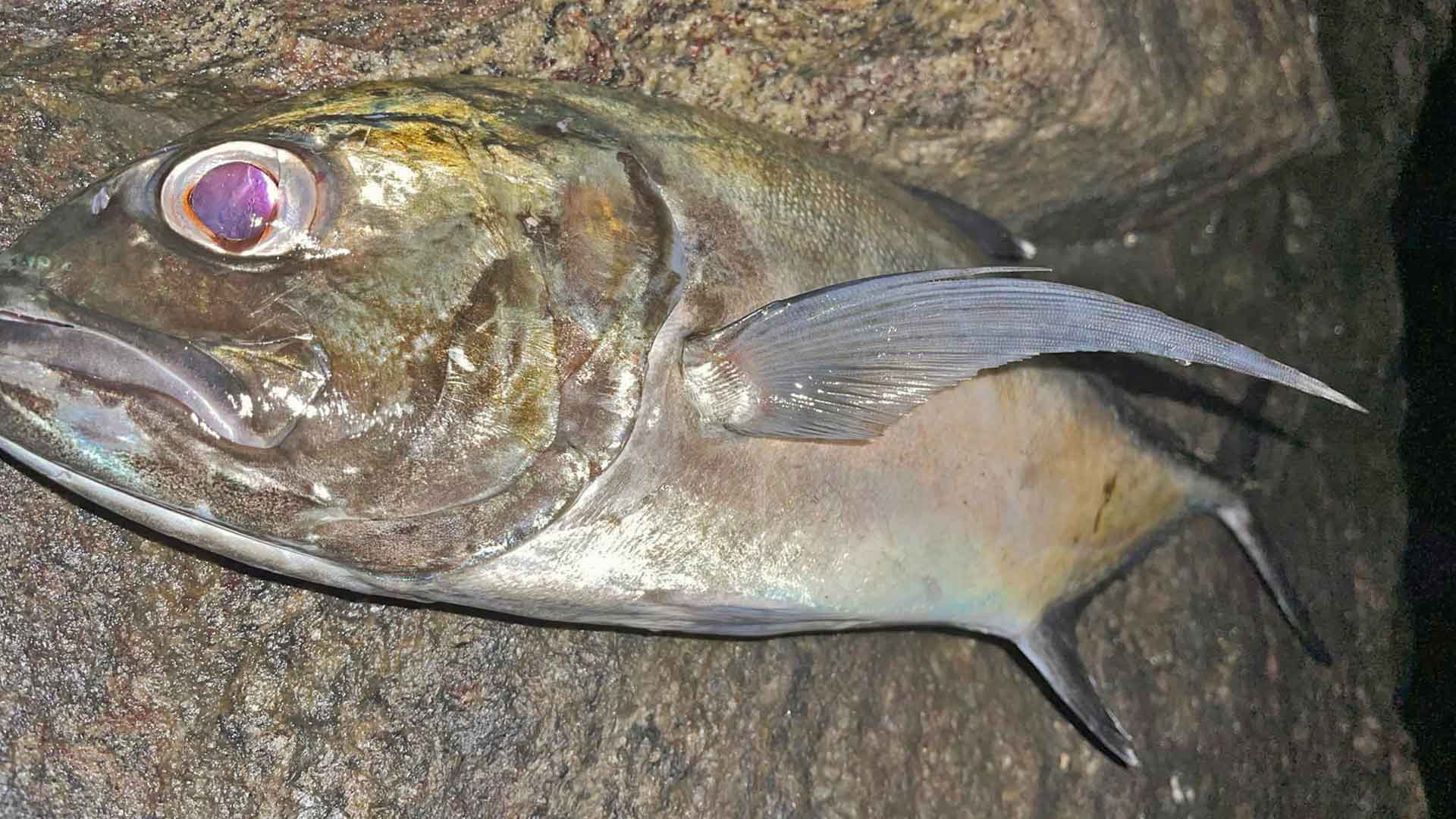
The bigeye trevally is instantly recognizable. Its eye is oversized and luminous, adapted for life in low light. A pointed snout and gently curved head give the fish a streamlined, almost alert expression, as if it is always watching. In the warm waters of the Maldives, bigeye trevallies inhabit rocky shorelines, reef drop-offs, and steep underwater ledges—zones where light fades quickly and predators thrive.
Although they occur both inshore and offshore, bigeye trevallies are primarily coastal fish. Juveniles remain close to shore, while adults move between shallow reef edges and deeper water. During the day, they are often seen in large, tightly synchronized schools that glide slowly through the water. At night, those schools dissolve. The fish split into smaller hunting groups, patrolling the darkened reef with purpose.
In the marine ecosystem, bigeye trevallies play an important role as mid-level predators, helping regulate populations of smaller reef fish and invertebrates. They can grow to nearly three feet in length and are famously aggressive feeders, striking a wide variety of lures. Their large eyes give them a decisive advantage in twilight and darkness—an adaptation that makes them especially active after sunset.
I have caught many bigeye trevallies along the southern edge of Malé, where reef structures drop abruptly into deeper water. For years, my preferred method involved luminous metal jigs weighing between 60 and 100 grams. These jigs imitate wounded baitfish, flashing as they fall. But curiosity led me to experiment.
I asked my friend Naseeh—known locally as @gaxidbeoulve—to help design something new. Together, we developed a hybrid lure: a metal jig dressed with small fluorescent-green squid skirts that glow in the dark. Fitted with assist hooks, the skirts add movement and silhouette, creating a lure that remains visible even in near-total darkness.
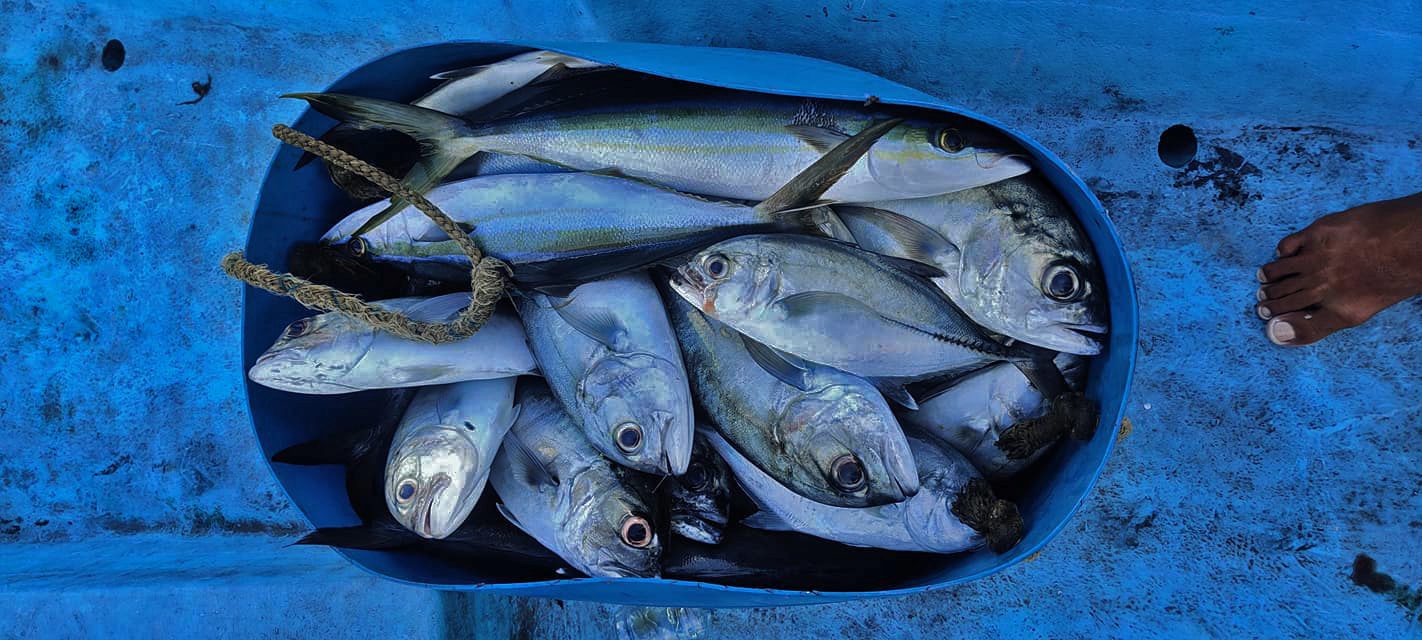
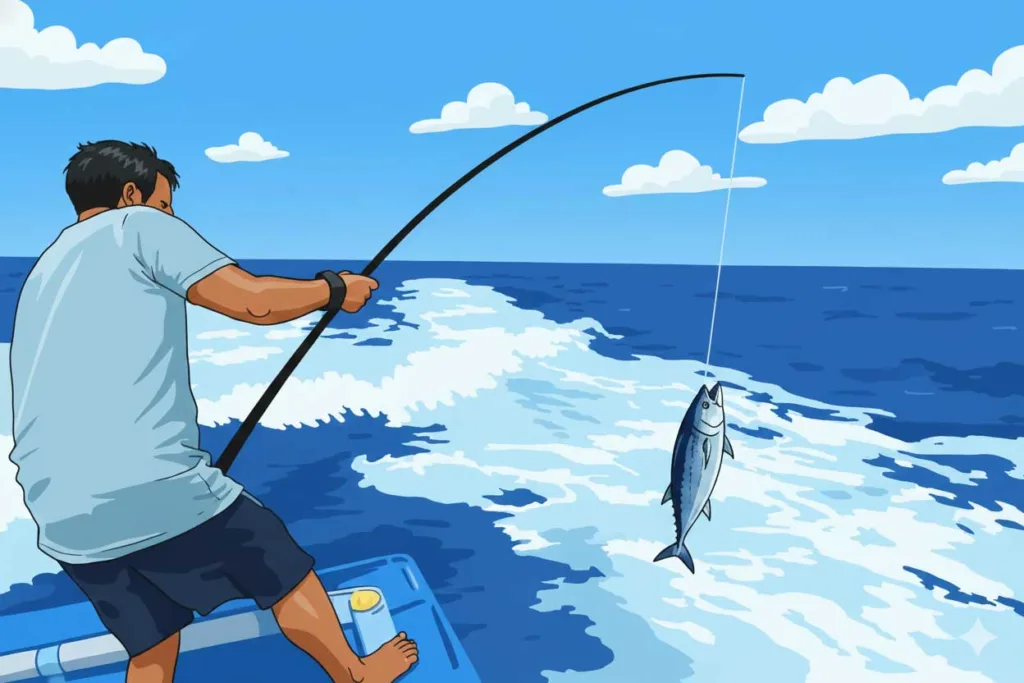
The technique is deliberate. After casting, I allow the lure to sink to the bottom, then retrieve it with quick horizontal flicks of the rod, punctuated by brief pauses. Sometimes the strike comes deep; at other times, the fish intercept the lure at surprisingly shallow depths. When a bigeye trevally commits, the response is immediate—the drag screams, and the fish surges with power.
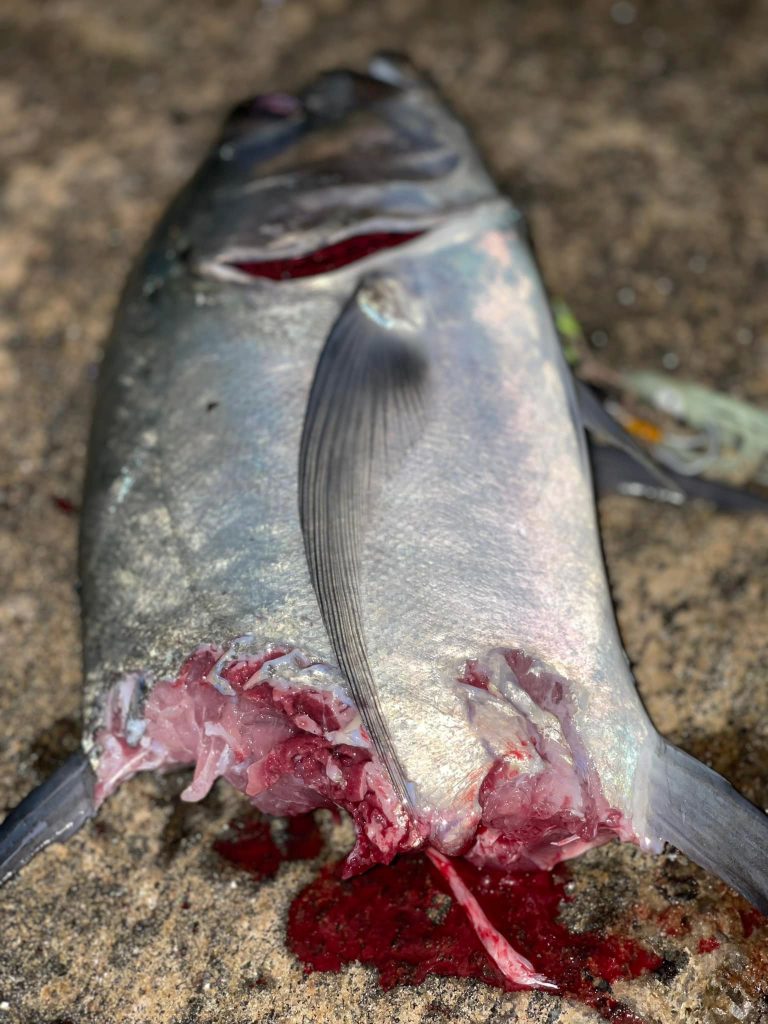
Bigeye trevallies are among the hardest-fighting fish for their size. More than once, I have lost trophy fish to sharks drawn in by the struggle. Such losses are common in Maldivian waters, where predators patrol constantly.
Through trial and repetition, we found this lure combination to be highly effective. We typically use 5000- to 8000-size reels, spooled with braided line ranging from size 2.0 to 3.5, or monofilament between 30 and 60 pounds. Most bigeye trevallies are caught at night, when their senses are at their sharpest.

They can also be caught using traditional handline fishing—a method that remains widespread across the Maldives. Using cut bait, the line is allowed to drift or sink naturally. No rod, no reel. Just line, patience, and timing. Traditionally, no weight is used, as bigeye trevallies often strike close to the surface.
I sometimes break this rule. When the current is strong, I quietly attach a sinker to help the bait reach depth faster. My friend Niyaz disapproves—he insists the weight is unnecessary, and he is usually right. Still, in fast-moving water, the sinker allows me to cover more ground and encounter more fish.
Few schooling species are as captivating as the bigeye trevally. By day, their coordinated movements form living patterns, shifting and reforming as if guided by a single mind. By night, they become solitary hunters, swift and efficient. Though they cruise slowly in groups, their speed is formidable when they strike.
To watch them move—whether in daylight harmony or nocturnal pursuit—is to witness a fish perfectly adapted to the edge between light and dark, reef and open sea.