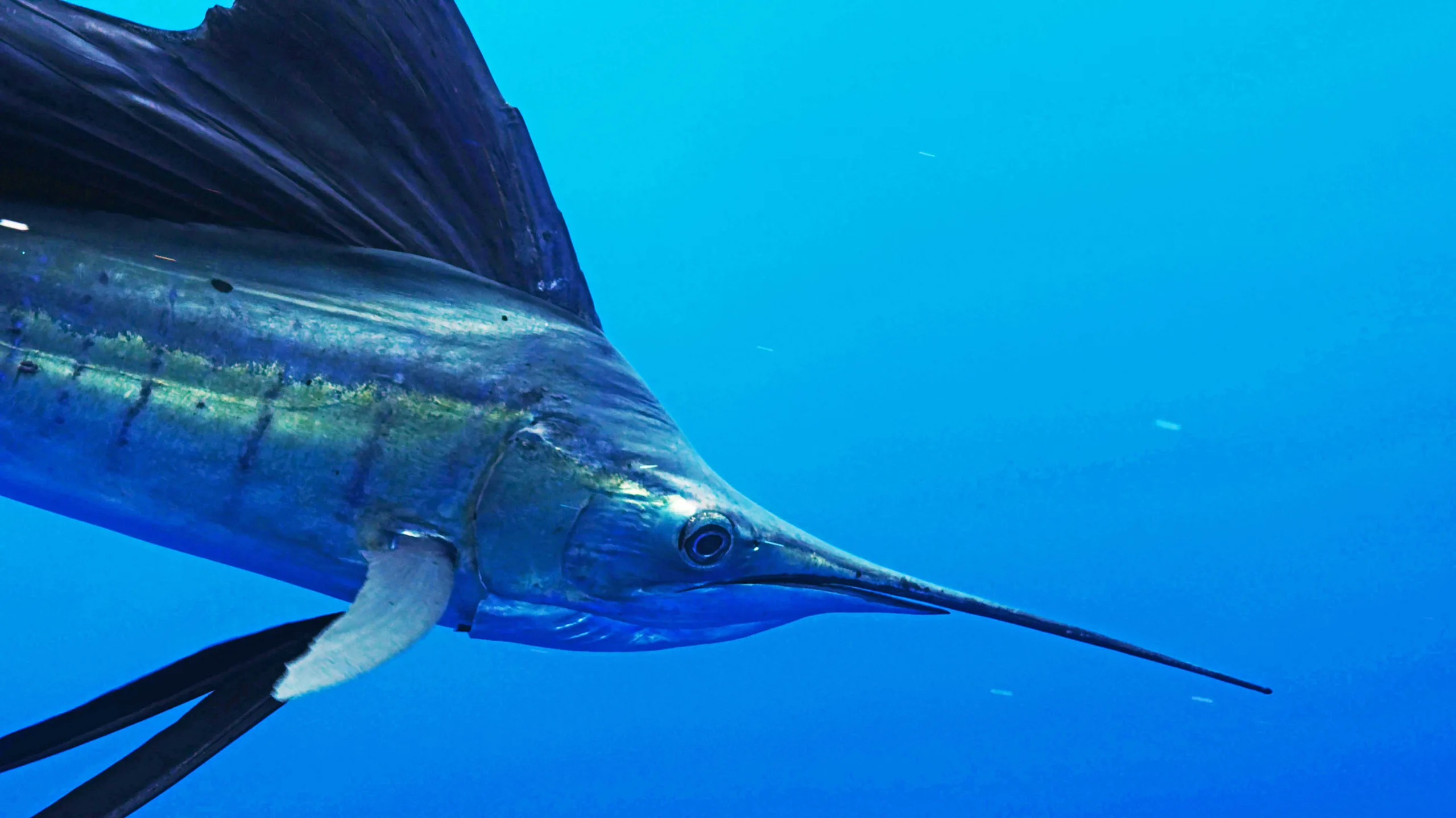
WHERE THE CRYSTALLINE turquoise of the Maldivian lagoons meets the abrupt, bottomless indigo of the Indian Ocean, a boundary exists. It is a vertical frontier—a place where nutrient-rich currents collide with ancient coral walls. In this high-velocity shadow-land, one of the ocean’s most formidable apex predators reigns supreme: the Black Marlin (Makaira indica), known locally as Kalhu mas hibaru.
Massive, muscular, and built for explosive daylight combat, this titan was once a ghost in Maldivian records. For centuries, the nation’s maritime culture revolved almost exclusively around the pole-and-line harvest of tuna. The marlin moved through these waters as a rare shadow—an incidental encounter in scientific surveys or a powerful “by-catch” that occasionally entangled itself in nets meant for lesser prey.
However, the dawn of the 21st century brought a seismic shift to these island waters. Following the 2010 nationwide ban on shark fishing, a new generation of fishers turned their sights toward the “Edge of the Atoll”. What was once a rare visitor has become the center of a burgeoning island-based fishery, a prized target for international big-game anglers, and a symbol of a changing blue economy.
From its history as an elusive wanderer to its current status as a backbone of coastal livelihoods, this is the story of the Maldives’ most uncompromising ocean giant.
At the outer edge of a Maldivian atoll, the sea drops away without warning. Turquoise shallows give way to deep indigo, currents tighten, and life from the open ocean brushes close to coral walls. It is here—along these invisible borders—that the black marlin appears.
Massive, fast, and uncompromisingly strong, the black marlin is among the most powerful fish on Earth. In the Maldives, it has long been present, yet for most of history it passed almost unnoticed—an ocean giant moving through island waters without leaving much trace behind.
A rare shadow in early surveys
When Maldivian offshore waters were first systematically explored in the late 1980s, black marlin were not a focus. The surveys were designed to understand tuna and shark resources, pushing farther offshore than traditional pole-and-line fishing allowed. What they found reshaped scientific understanding of the Maldivian EEZ.
Billfish appeared regularly, but sparingly. Swordfish dominated these encounters, while sailfish and black marlin formed only a small fraction. Black marlin made up just a few percent of all billfish caught, appearing incidentally in drifting gillnets and shallow longlines set at night. They were present, but uncommon—proof of passage rather than abundance.
At the time, black marlin were by-catch, not a target. They entered nets meant for tuna and hooks set for sharks, offering the first quiet confirmation that these powerful predators moved through Maldivian waters decades before anyone fished for them intentionally.
Built for daylight and strength
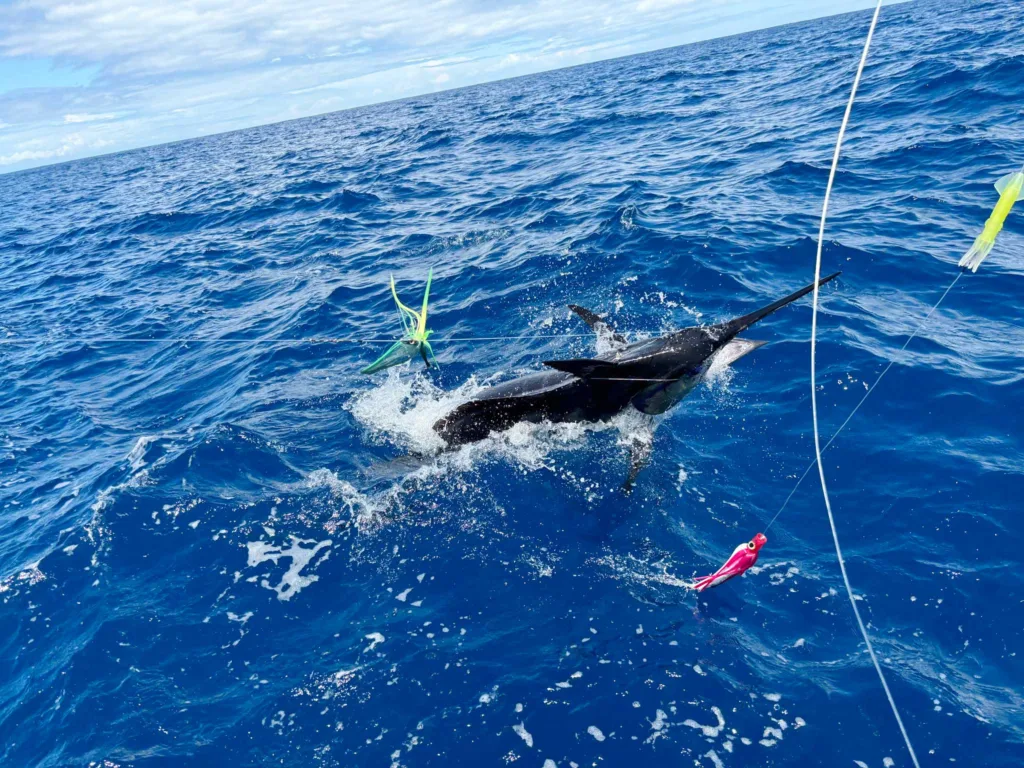
Unlike swordfish, which roam deep and rise under cover of darkness, black marlin are largely daylight hunters. Thick-bodied and muscular, with rigid pectoral fins that never fold flat, they are built less for stealth than for explosive force. Their strikes are sudden, violent, and unmistakable.
In the Indian Ocean, black marlin patrol current lines, reef drop-offs, and the outer edges of atolls—exactly where Maldivian lagoons fall away into the open sea. These margins concentrate baitfish, drawing predators close enough to islands that humans sometimes intersect their paths.
A fishery emerges
For centuries, Maldivian fishing revolved almost entirely around tuna. Billfish were caught occasionally but rarely pursued. That balance shifted in the early 21st century.
When shark fishing was banned nationwide in 2010, many fishers who had depended on sharks turned instead to billfish. Black marlin—known locally as Kalhu mas hibaru—became part of a growing, island-based fishery operating along atoll edges.
Unlike the incidental catches of the 1980s, this new fishery was deliberate.
Small boats, typically 20 to 40 feet long, began working the reef margins by day. Fishers deployed trolling lines and drift lines, using artificial lures often tipped with baitfish. When a marlin struck, the line was released with a float attached, allowing the fish to exhaust itself before the final struggle.
What followed was often spectacular. Black marlin are famous for blistering runs and aerial leaps, launching their massive bodies clear of the water in an effort to throw the hook. Even once landed, they demand respect—powerful enough to injure crews if mishandled.
From rarity to routine
By the 2010s, black marlin had become a recognized part of Maldivian billfish catches. They entered local markets, supplied tourist resorts, and were sometimes salted and dried for export. Recreational big-game fishing added another dimension, with visiting anglers drawn by the chance to encounter one of the ocean’s ultimate adversaries.
Yet precise numbers remain elusive. Billfish landings are scattered across islands, resorts, and markets, and much of the catch is consumed locally. What is clear is the contrast: a species that appeared only rarely in scientific nets during the 1980s is now firmly embedded in coastal livelihoods.
Lessons from the past
The early surveys offer an important reminder. When black marlin first appeared in Maldivian records, they were few, incidental, and largely untouched by fishing pressure. Today, they are actively targeted.
That transition carries risk. Billfish are wide-ranging and slow to mature, and history elsewhere has shown how quickly fishing pressure can outpace understanding. In the Maldives, black marlin fisheries remain small-scale, limited by boat size, weather, and skill. For now, restraint is built into the system.
But the ocean is changing, and so are human demands.
Giants at the edge
Black marlin do not linger. They arrive suddenly, strike with force, and vanish back into blue water. To most people in the Maldives, they remain unseen—moving beyond the reef, where lagoon blues fade into ocean black.
Their story is one of passage and change. Once a rare shadow in scientific surveys, the black marlin has become a symbol of how Maldivian fisheries evolve—quietly, pragmatically, and always at the edge between tradition and the deep sea.
References / Sources
Based on:
- Anderson, R. C. & Waheed, A. (1990). Exploratory Fishing for Large Pelagic Species in the Maldives. FAO / Bay of Bengal Programme, Ministry of Fisheries and Agriculture, Republic of Maldives.
- Jauharee, A. R. (2015). The Maldives Billfish Fishery – An Update. Marine Research Centre, Ministry of Fisheries and Agriculture, Republic of Maldives.
- Feature photo: Oleksandr Sushko/Unsplash