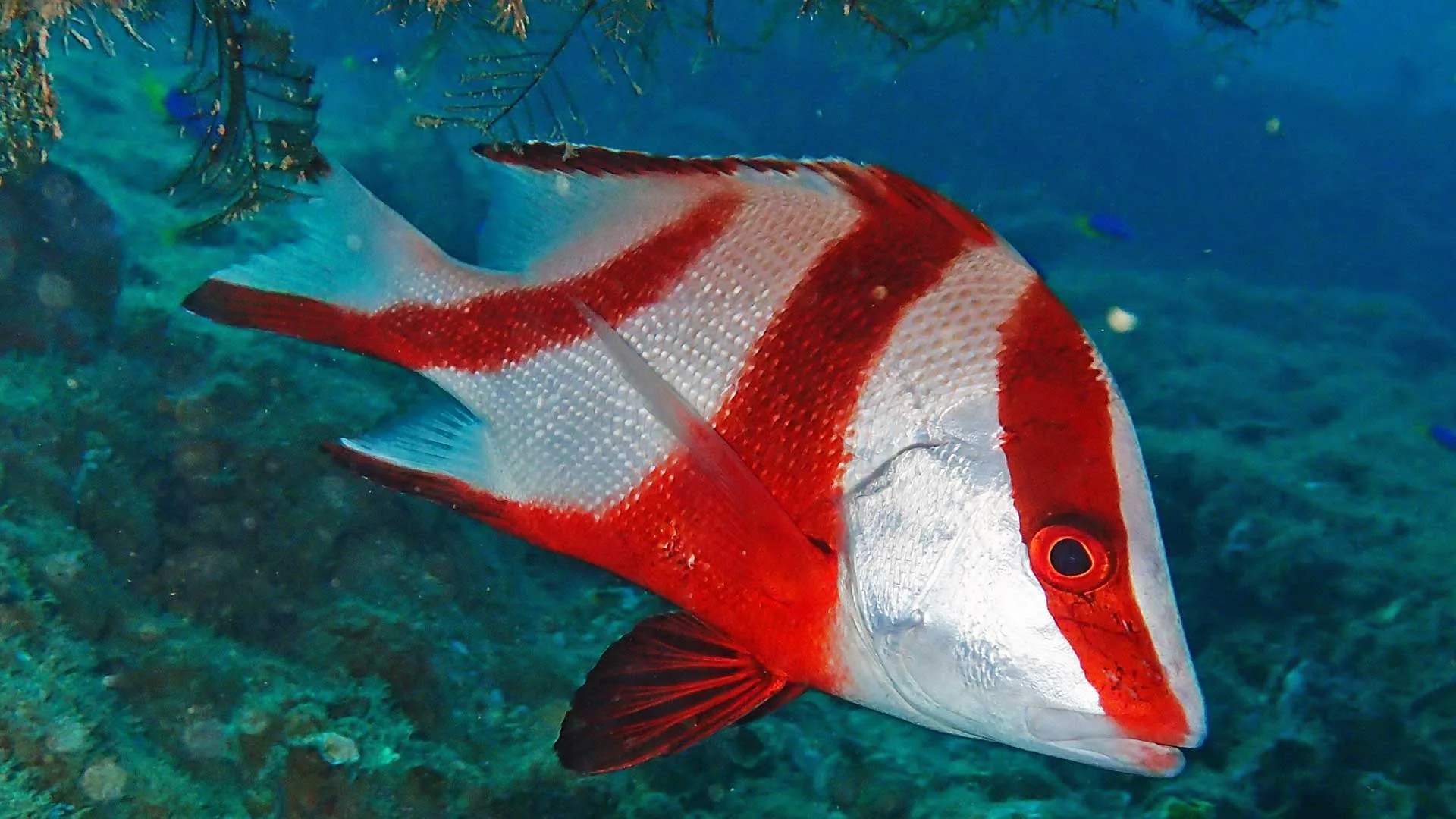
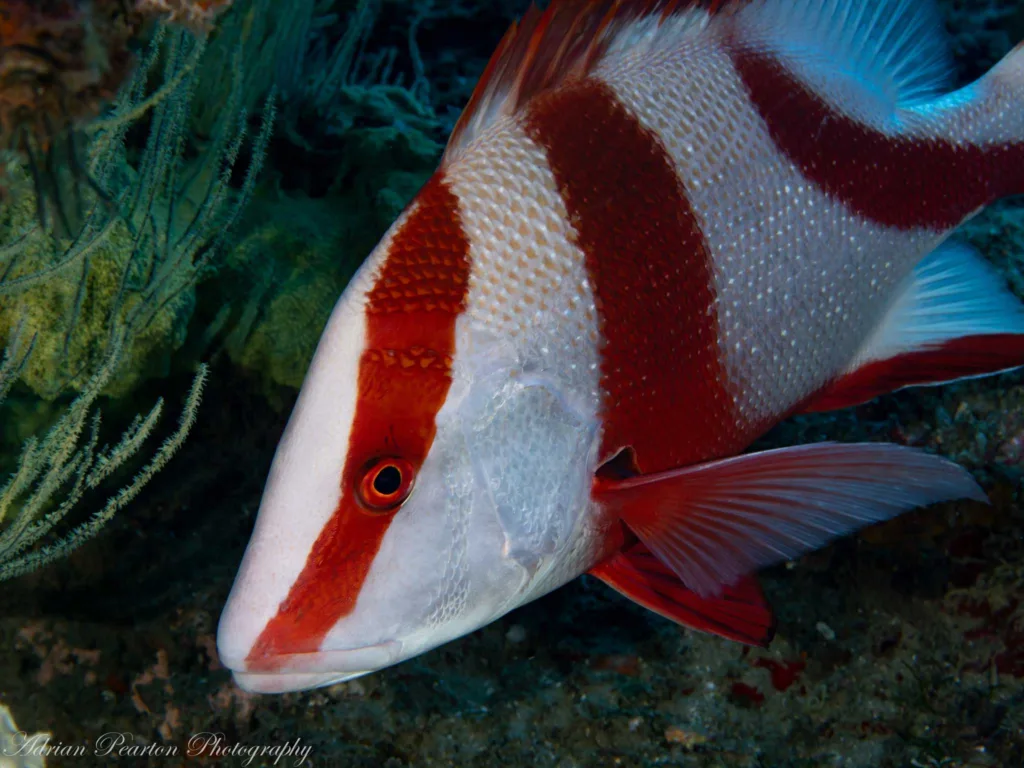
Across the coral ramparts and shadowed drop-offs of the Indo–West Pacific, few reef predators command the same quiet authority as the Emperor red snapper (Lutjanus sebae). Known to Maldivian fishers as Maaginimas, this deep-bodied giant is a creature of symmetry and strength—a fish whose vivid colors and imposing size hint at a life spent along the very edges of the reef world. In the Maldives, however, it remains an elusive presence, rarely encountered and long remembered.
To encounter an Emperor red snapper in the wild is to witness precision shaped by pressure and depth. Its body is exceptionally deep and laterally compressed, an architecture suited for stability and control along reef slopes. While many reef fishes are measured in tens of centimeters, the Maaginimas is built on a different scale. Adults commonly reach around 60 centimeters, and in exceptional cases grow to nearly one meter, placing them among the largest members of the snapper family.
Its anatomy sets it apart even among its formidable relatives. The dorsal fin carries 11 spines and 15–16 soft rays, while the anal fin bears three spines and ten rays. The pectoral fins, supported by 17 rays, allow for deliberate maneuvering close to structure. Body depth measures 2.1–2.4 times within the standard length, ending in a slightly forked tail designed for steady propulsion rather than sudden speed.
The Emperor red snapper’s appearance is a visual record of its life history. Fully grown adults are uniformly red, their coloration deepening with age and depth. Juveniles, by contrast, are strikingly patterned, marked by three bold dark bands. One band passes across the eye, another cuts vertically through the center of the body, and a third sweeps from the dorsal fin toward the lower tail. These bands fade as the fish matures, disappearing entirely as adults retreat into deeper water.
That movement into depth defines the species’ relationship with humans. Adults prefer deep water and are rarely seen by divers, inhabiting reef slopes and drop-offs well below the casual limits of recreational diving. Juveniles occupy very different spaces, often sheltering among long-spined sea urchins, where their banded pattern provides camouflage and protection. Sub-adults are most often found in small groups, tucked into caves at the base of drop-offs or hovering near isolated reef outcrops surrounded by deep sand flats—a transitional stage between the safety of shallow refuges and the solitude of adulthood.
Throughout these stages, the Maaginimas remains a capable predator. It feeds on small fishes, benthic crustaceans, and cephalopods such as squid and octopus, helping regulate populations along reef margins where ecological balance is easily disrupted. Its wide depth range—from roughly 10 meters to more than 100 meters—allows it to exploit habitats that few other reef predators can use so effectively.
Although the Emperor red snapper is widely distributed across the Indo-Pacific, it is considered rare in the Maldives, with relatively few confirmed records. This scarcity, combined with its preference for deeper reefs, has earned it a reputation as a ghost of the Maldivian underwater landscape. For those fortunate enough to encounter one, the experience is unmistakable: a large, crimson figure emerging from blue water, embodying the quiet power of the deep reef.
Sources
M.R.S. (1997). Fishes of the Maldives. Marine Research Section, Ministry of Fisheries and Agriculture, Republic of Maldives. 408 pp. ISBN 99915-62-12-5.
Kuiter, R. H. Fishes of the Maldives and the Indian Ocean.