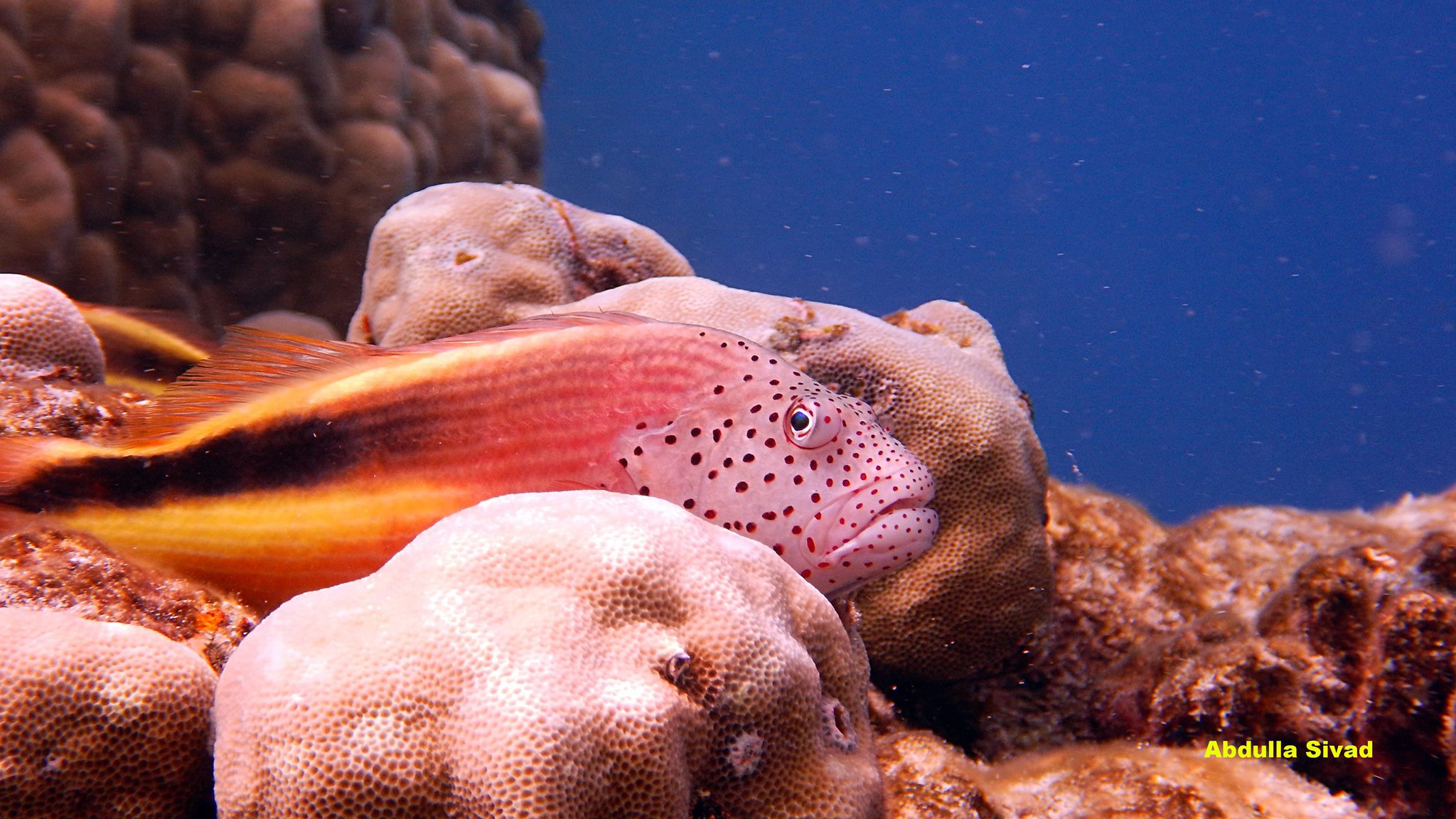
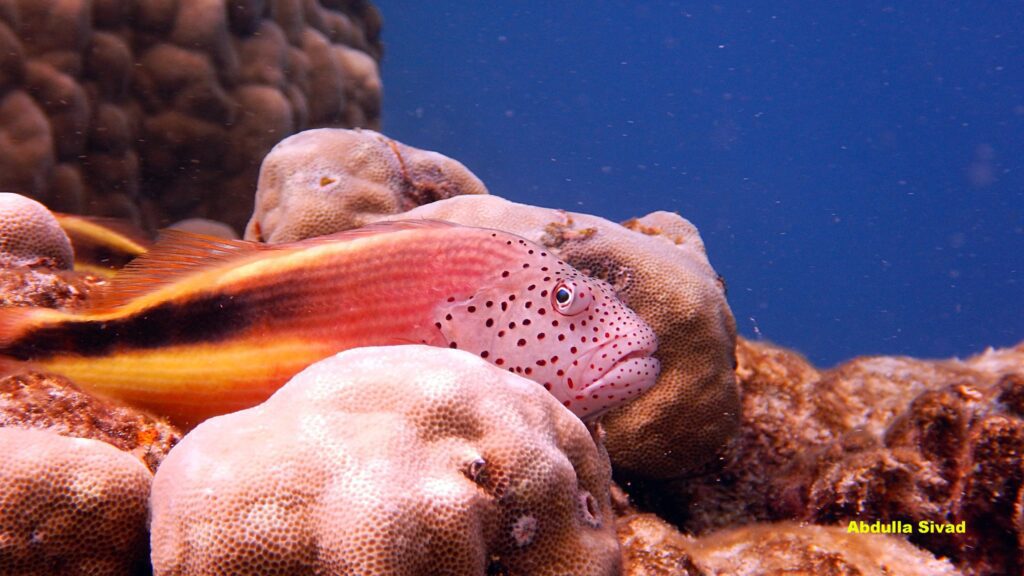
Perched motionless atop corals, watching the reef below with unwavering focus, hawkfishes are among the most distinctive hunters in tropical seas. Their stillness is deceptive. In a split second, they can launch into action, swooping down to seize unsuspecting prey before returning to their lookout posts. This unique strategy, combined with bold behavior and striking forms, has earned hawkfishes a special place among reef predators.
Hawkfishes belong to the family Cirrhitidae, which comprises nine genera and 35 species. The group is found primarily in the Indo-Pacific region, with only three species occurring in the Atlantic Ocean. The Maldives alone is home to six genera and eight species, making it an important region for hawkfish diversity.
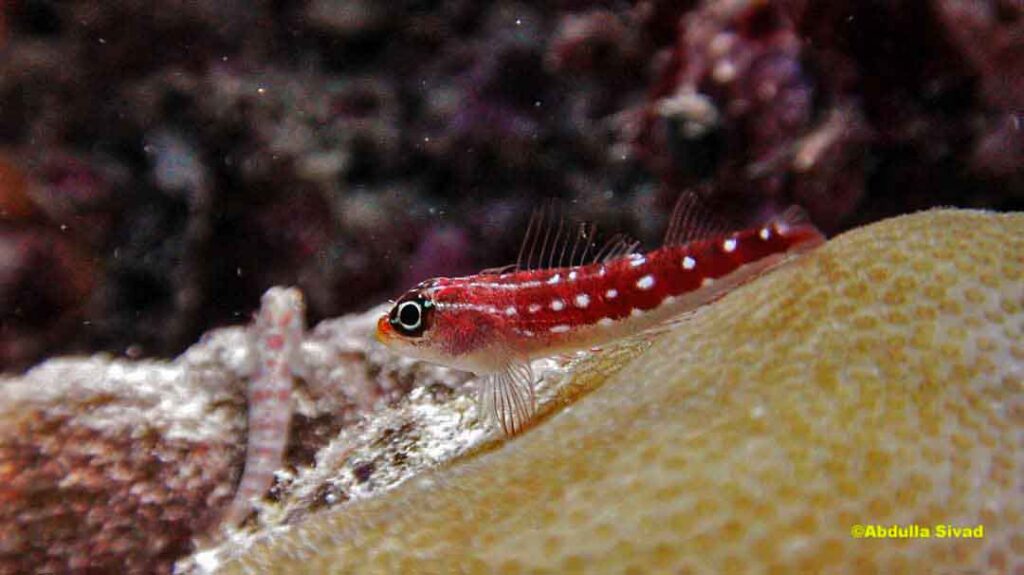
Physically, hawkfishes vary widely in shape. Some species are laterally compressed with high bodies, while others are stocky or elongated. One of their most recognizable features is the presence of small filamentous tufts at the tips of each spine in the dorsal fin—often the easiest way to identify them in the wild. As carnivores, hawkfishes perch on corals to watch for small prey such as prawns and juvenile fish.
Different species occupy a range of reef habitats, including black corals, reef crests, surge zones, and deep current channels. Depending on the species, hawkfishes may live in small groups or defend territories aggressively.
Ring-Eye Hawkfish (Paracirrhites arcatus)
Also known as the Horseshoe Hawkfish, Paracirrhites arcatus is typically found living alone or in pairs among small coral heads on the upper, exposed slopes of reefs. This species is easily recognized by three orange streaks running down its sides and a distinctive oval structure protruding from behind the eye.
The body coloration ranges from light green to bright red, and individuals can grow up to 14 cm in length. The ring-eye hawkfish is widely distributed across the Indo-Pacific.
Foster’s Hawkfish (Paracirrhites forsteri)
Foster’s hawkfish, also known as the freckled hawkfish, is a larger species that can reach 20 cm in length. It is a common and widespread species in the Maldives and displays a remarkable range of coloration. The numerous dark spots on the head make it particularly easy to identify.
This species typically inhabits areas close to the reef surface at depths of up to 20 meters, though it is capable of descending deeper. Like many hawkfishes, Paracirrhites forsteri is widespread throughout the Indo-Pacific region.
Masters of the Ambush
Across ecosystems, insects, birds, and animals employ a wide range of hunting strategies shaped by factors such as size, strength, and environmental interactions. These relationships between predator and prey—and between large and small species—fall within the scope of physical law (Endler 1986).
Hawkfishes are named for their distinctive hunting technique. They remain perched high on the reef, scanning the surroundings before suddenly diving downward to ambush prey. This strategy is highly effective, increasing their chances of capture while reducing exposure to predators. Their confidence in the face of danger is reinforced by their ability to swoop quickly and maneuver skillfully through coral structures or anemones.
Still, watchful, and swift, hawkfishes embody the balance of patience and precision that defines life on the reef.
Reference: