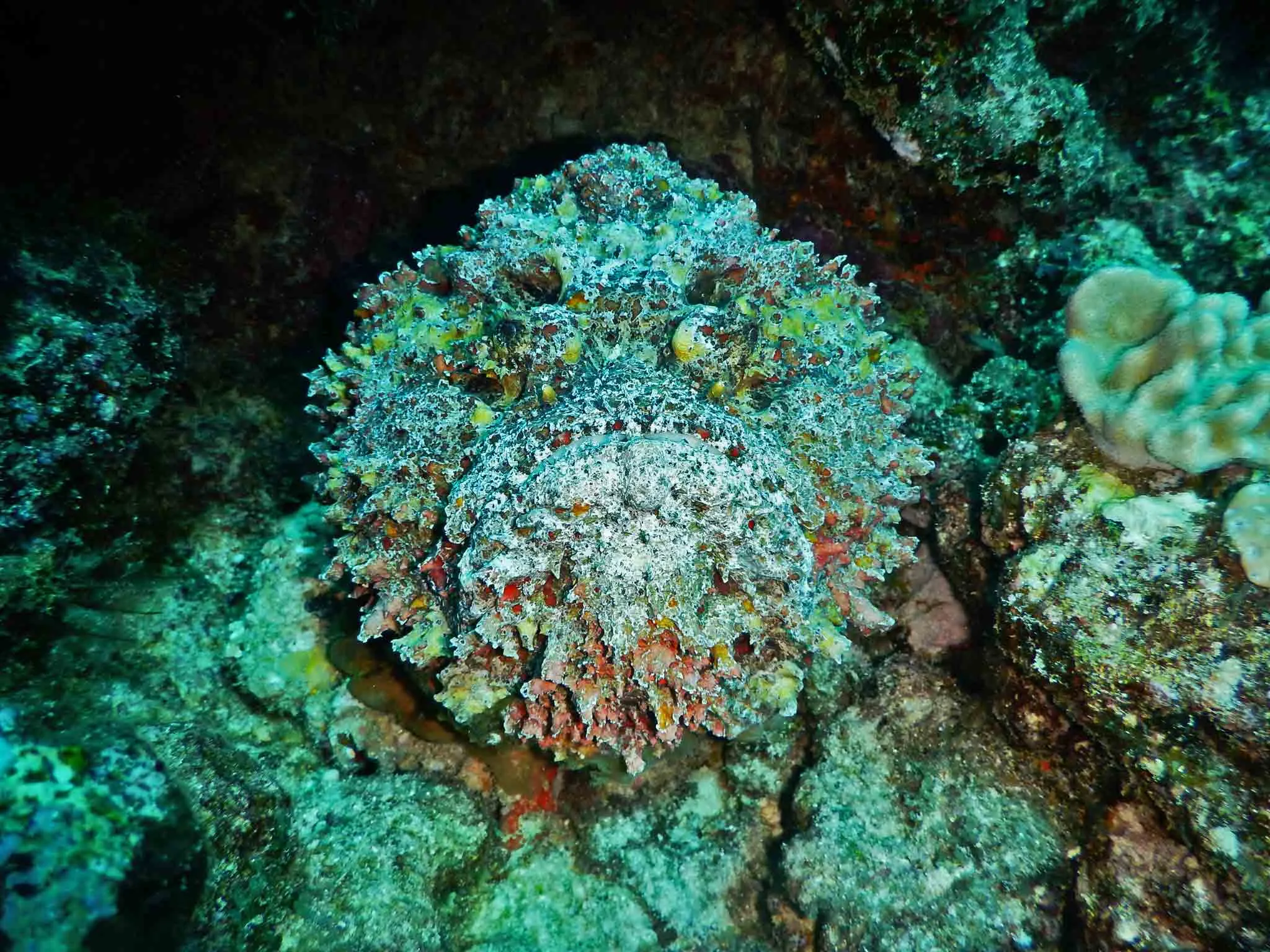
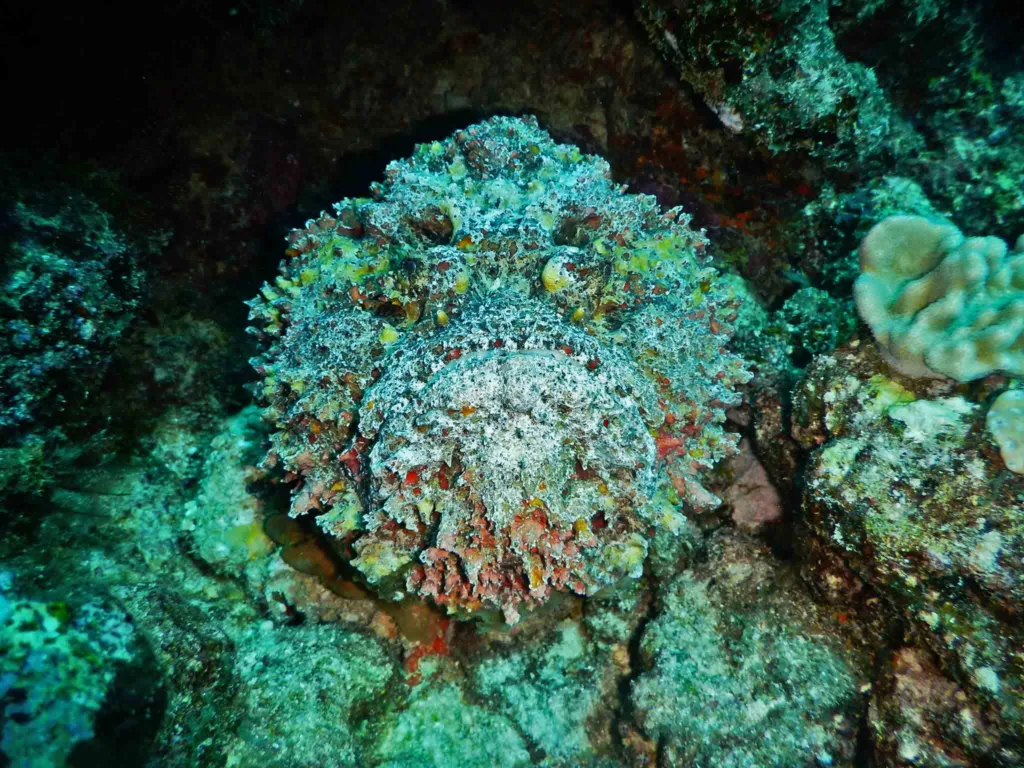
In the shimmering, sun-drenched shallows of the Maldivian lagoons, where the water is as clear as air, lies a predator that has perfected the art of non-existence. It does not swim with the grace of a ray or the speed of a tuna. Instead, it waits. To the Maldivian people, it is the Gaa’viha’mas—literally “Stone Fish”—a creature that has traded beauty for a lethal, jagged geometry.
The Master of the Macabre
The Stonefish (Synanceia verrucosa) is the undisputed heavyweight champion of camouflage. Its skin is not covered in scales, but in a thick, warty mucus that actively traps sand, silt, and even small fragments of algae. Over time, the fish becomes a living extension of the reef’s debris.
It can remain motionless for days, half-buried in the rubble of a reef flat or tucked against a coral “bommie.” Its mouth, a wide, upward-turned cavern, is indistinguishable from a natural crevice until the very moment it strikes.
The 0.015-Second Strike
While the Gaa mas appears sedentary, it possesses the fastest strike in the marine world. It is a “sit-and-wait” ambush predator that relies on a high-pressure vacuum. When an unsuspecting goby or shrimp swims within range, the Stonefish expands its massive jaws in just 15 milliseconds. The resulting suction is so powerful that the prey is inhaled before the surrounding water even ripples. By the time a human eye can blink, the meal is over, and the “stone” has returned to its slumber.
The Crown of Thorns
The true terror of the Stonefish lies along its dorsal ridge. Hidden beneath its mottled skin are 13 stout, needle-sharp spines, each connected to twin venom glands at the base. These spines are not used for hunting; they are purely defensive.
If a predator—or an unwary beachgoer—steps on the fish, the pressure causes the skin to retract, driving the spines upward like hypodermic needles. The venom is a potent neurotoxin that causes excruciating pain, tissue necrosis, and, in extreme cases, respiratory paralysis. In the Maldives, ancient wisdom advises never to walk barefoot on the reef flats, for the Gaa mas does not flee; it stands its ground, confident in its invisible armor.
A Necessary Evil
Despite its fearsome reputation, the Stonefish is a vital component of the atoll’s ecosystem. By culling smaller, weaker fish, it maintains the health of the reef’s lower food chain. It is a grim but essential sentinel, a reminder that in the paradise of the Maldives, survival often depends on staying perfectly, dangerously still.
Safety Note: The best defense against a Gaa viha mas is a good pair of thick-soled reef shoes and a ‘shuffling’ walk. By sliding your feet across the sand rather than lifting them, you alert buried creatures to your presence, giving the ‘Invisible Terror’ a chance to settle deeper into the sand rather than deploying its spines. In the water, look for a ‘rock’ that appears to have a grumpy, downward-turned mouth—and give it a very wide berth.