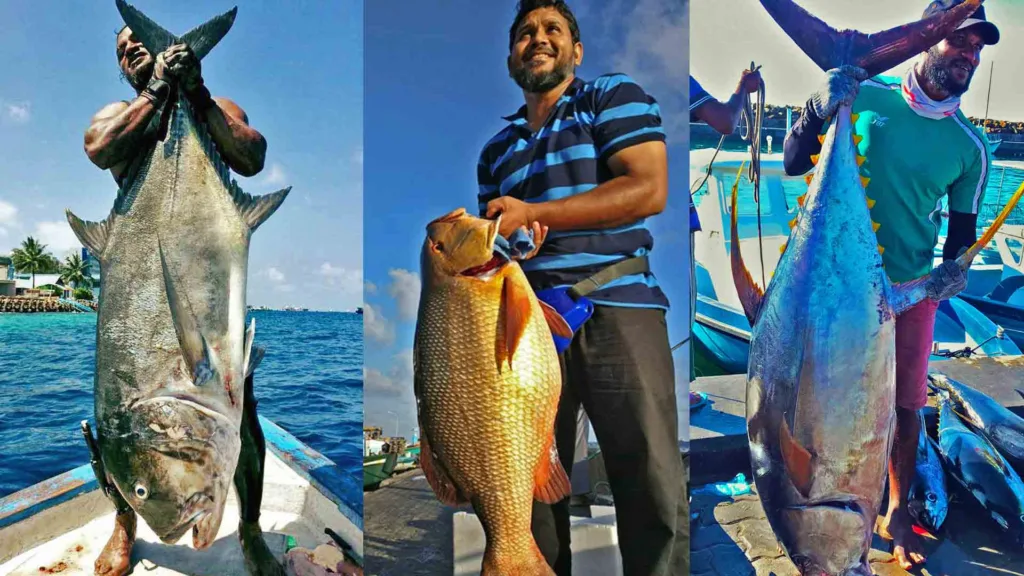


The giant trevally—known in Fuvahmulah as maamudu—is one of the ocean’s most formidable predators. Built like a living engine, the GT moves through the water with raw, muscular power. It hunts with explosive speed, navigates raging currents effortlessly, and fears almost nothing except sharks and humans. Islanders respect it deeply, knowing that a single encounter with this creature can become a battle between strength and instinct.
One quiet afternoon in the late 1970s, this respect was tested in a way few could imagine. The story that unfolded that day has since become part of Fuvahmulah’s modern folklore.
It was a clear, brilliant day, with a sky so blue it seemed endless. Coconut palms along the edge of Ambul Beach in Hoadhadu ward shimmered in the sunlight. A 58-year-old fisherman, seasoned by decades of working the sea, made his way down the beach to try his luck with medun, a traditional handline fishing method.
He carried a bucket, a coil of nanu line (fishing line), and the quiet confidence of someone who knew the rhythms of the sea by heart. Medun required strength and patience: a heavy, 300-pound monofilament line reinforced with a thin rope, cast into deep water and held firmly from shore.
Around 2:30 p.m., he deployed his line into a deep passage carved through the island’s front reef. The tide was rising, and he knew predators often used this channel to move closer to the island. Once the line was set, he settled comfortably on the warm sand, gripping it lightly in his hand and watching the horizon.
The ocean glimmered beneath the afternoon sun, and the sky looked endless above the water. For a long time, nothing stirred. The fishing line remained still. Not a single nudge or vibration travelled through it.
But the fisherman was patient. He had done this countless times before. High tide was approaching, and he believed something would eventually rise from the depths.
Then, at 5:30 p.m., everything changed in an instant.
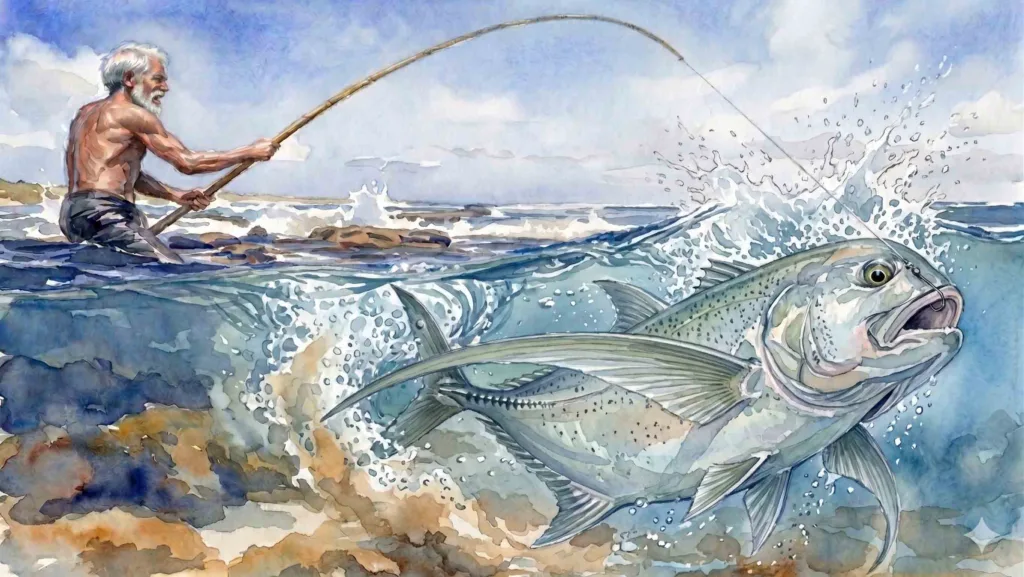
The fishing line in his hand snapped tight with explosive force, jerking him forward so violently that he lost his balance. Before he could react, the line twisted into a knot around his right arm. A giant trevally had struck the bait with incredible power and immediately bolted towards the open sea.
The fisherman was dragged down the beach, sand scraping against his body as the GT pulled him rapidly towards the water. Within seconds, he was yanked into the passageway and plunged into the sea.
He kicked upwards, gasping as saltwater hit his face, but the fish surged again, dragging him beneath the surface. His world became a rush of blue and bubbles as he struggled to break free from the knot.
The GT drove deeper and deeper, dragging the helpless fisherman along. He resurfaced for moments at a time, only to be forced under again as the creature made another run. He fought desperately with both hands, trying to free himself, but his trapped arm prevented him from gaining full control.
His lungs burned, his muscles screamed, and the sea battered him relentlessly. Still, he clung to the fishing line, driven by instinct and the will to survive.
The giant trevally hauled him hundreds of metres offshore. Each run felt as though it could be his last.
After several violent plunges, the GT began to tire. Its powerful movements slowed, but the fisherman was just as exhausted. His strength was draining quickly, and he felt his grip beginning to slip. He kicked to stay afloat, fighting to keep his head above the waves, but exhaustion was overwhelming him.
His hope began to fade.
Just then, through the blur of sunlight and seawater, help appeared.
A dhoani returning from a fishing trip noticed an unusual shape drifting on the surface. As the crew approached, they realised it was a man—barely holding on, still tied to a fishing line disappearing into the depths.
They hauled him aboard immediately and freed his arm from the line. Though exhausted, battered and shaken, the fisherman was alive. Against all odds, he had survived a confrontation with one of the ocean’s most powerful predators.
When the fishermen brought him aboard and took the fishing line from his hand, they realised that the monster fish was still securely hooked. It was a massive GT, roughly four feet in length. The fish was caught, and the fisherman lived to tell the tale—a rare outcome in such an encounter.
The crew rushed him back to Fuvahmulah, where word of the ordeal spread quickly across the island. People spoke in awe of his survival and with renewed respect for the giant trevally.
In the days that followed, the story became part of the island’s shared memory. It was retold not just as a tale of danger, but as a reminder of the sea’s dual nature—beautiful yet unforgiving, generous yet merciless.
It is also a testament to the resilience of a fisherman who, even when dragged into the open ocean by a monster, refused to surrender.
Today, the fisherman’s survival is remembered as one of Fuvahmulah’s most extraordinary stories—a dramatic encounter between man and nature, courage and instinct, and the familiar shores of home and the wild, unpredictable deep.