The Stealthy Life of the Bluefin Trevally
Across the sprawling coral cathedrals of the Maldivian atolls, most inhabitants rely on camouflage or caution to survive. But the Bluefin Trevally (Caranx melampygus)—known to locals as Fani handhi—takes a different approach. It is a creature of high-voltage color and sudden, violent speed, a sentinel that patrols the reef edge with the confidence of a seasoned apex predator.
A Masterpiece of Aquatic Engineering
To see a Bluefin Trevally in the wild is to witness a masterpiece of evolutionary design. Its body is a streamlined blade, optimized for the high-pressure environment of the open Indian Ocean. While many of its cousins in the jack family appear in muted silvers and greys, the Bluefin is an outlier.
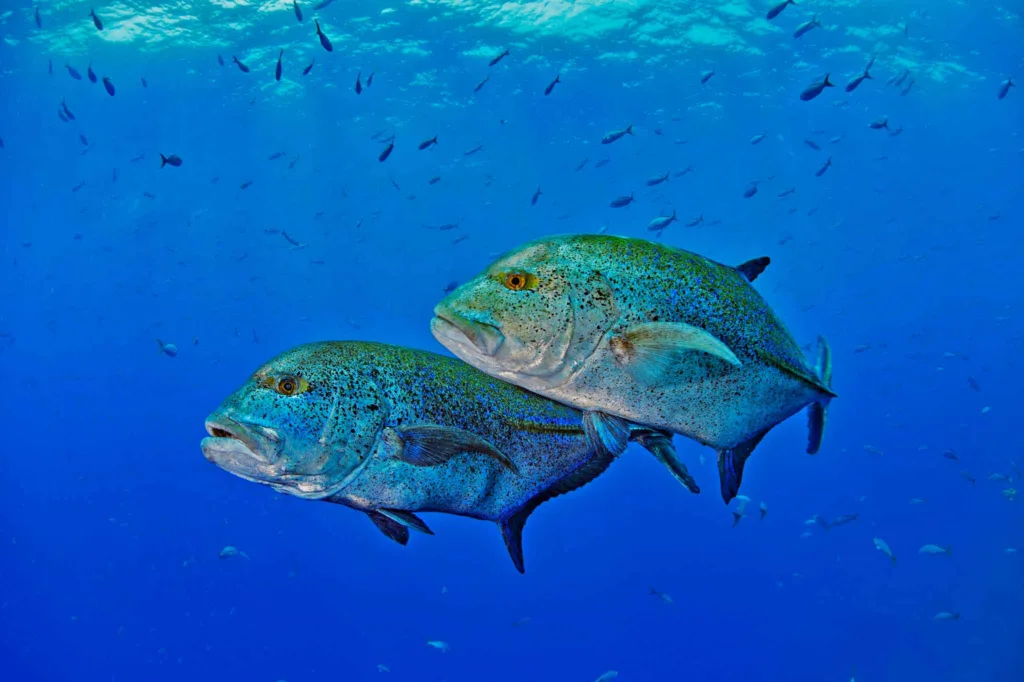
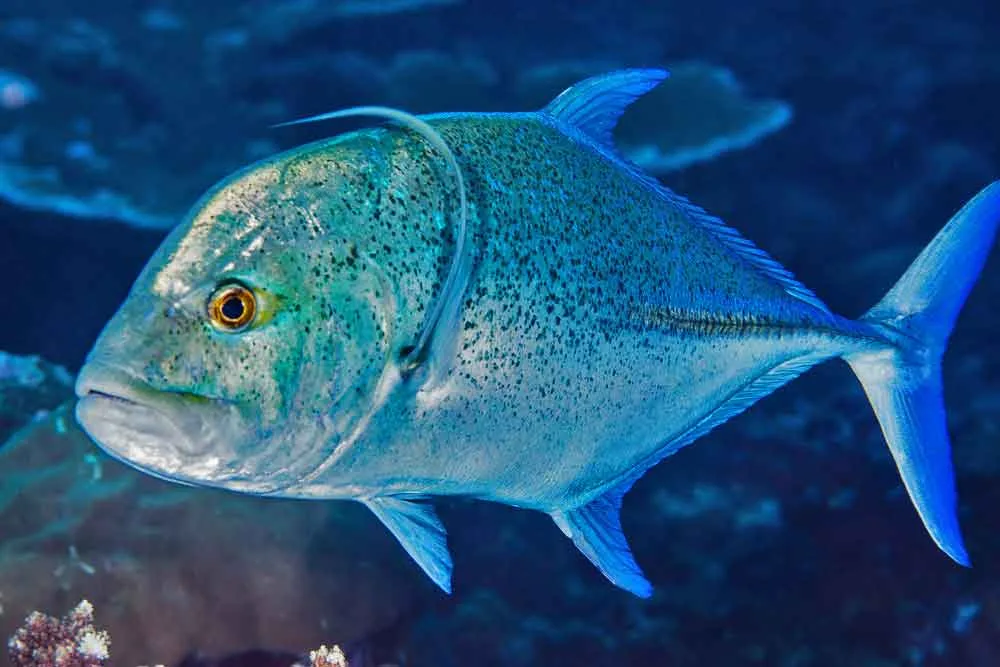
Its upper flanks are washed in vibrant, iridescent greenish-blue, peppered with a constellation of irregular black spots that emerge as the fish matures—a biological signature as unique as a fingerprint.
But it is the fins that give the fish its name. Tinged with a neon, electric sapphire, they glow with a brilliance that seems almost artificial against the sun-drenched turquoise of the reef. This beauty, however, is a warning: it is the uniform of a specialized hunter.
The Art of the Ambush
While scientific records from the Marine Research Section classify the Bluefin as a “reef-associated” species found at depths of 3 to 40 meters, local Maldivian knowledge offers a deeper insight into its character.
As noted by angler and island expert Yasir Salih of Maldives My Islands, the Bluefin is a “stealth attacker.” It does not simply wander; it strategizes. Using the steep drop-offs of the atolls as tactical staging grounds, it waits for the precise moment of vulnerability. A master of the flank, it launches sudden, explosive charges from the reef’s shadows—scattering baitfish before they sense even a ripple in the water.
The Angler’s Ghost
For those on shore, the Fani handhi is a legendary adversary. To hook one is to enter a high-stakes duel. Salih’s accounts describe the fish’s predatory instinct as “excitement so real,” triggered by the rhythmic dance of a lure.
It is a fish that demands respect. Even on light tackle, its first run is a brutal test of gear and resolve—marked by violent head-shakes and a desperate, powerful drive toward the protective maze of coral.
A Biological Coming of Age
The life of a Bluefin Trevally is one of transformation. In their youth, they are the “yellow-fins” of the shallows—juveniles bearing pale, dusky fins and bright yellow pectorals, lacking the starry black spots of adulthood.
Marine Species
Bluefin Trevally
| Scientific Name | Fani handhi Caranx melampygus |
| ID Marker | Electric blue fins; greenish-blue upper flanks peppered with irregular black spots in adults. |
| Habitat | Reef-associated; utilizes steep atoll drop-offs and seaward reefs from 3m to 40m depth. |
| Biology | High-speed “stealth attacker.” Juveniles (Yellow-fins) mature into blue offshore hunters. |
Only as they venture into deeper, more perilous offshore waters do they “turn blue,” assuming the electric mantle of maturity.
Whether hunting in the chaotic, oxygen-rich surf of Fuvahmulah or gliding silently past a group of divers, the Bluefin Trevally remains the most iconic jack of the Maldives—a shimmering, sapphire testament to the wild, restless spirit of the reef.
References & Source Data
- Maldives Records: M.R.S. (1997). Fishes of the Maldives. Marine Research Section, Ministry of Fisheries and Agriculture.
- Global Databases: FishBase; IUCN Red List (Status: Least Concern)