As daylight fades on a Maldivian reef, the reef’s daytime residents retreat into crevices and coral branches. From the sandy margins near coral heads, a different presence emerges—calm, deliberate, and watchful. Known locally as Dhongu, the Humpnose Big-Eye Bream (Monotaxis grandoculis) is a nocturnal specialist, perfectly adapted to life after dark in the waters of the Maldives.
Often overlooked by divers and rarely targeted by fishers, this large-eyed reef fish plays a subtle but important role in maintaining the balance of reef ecosystems.
Built for Low Light
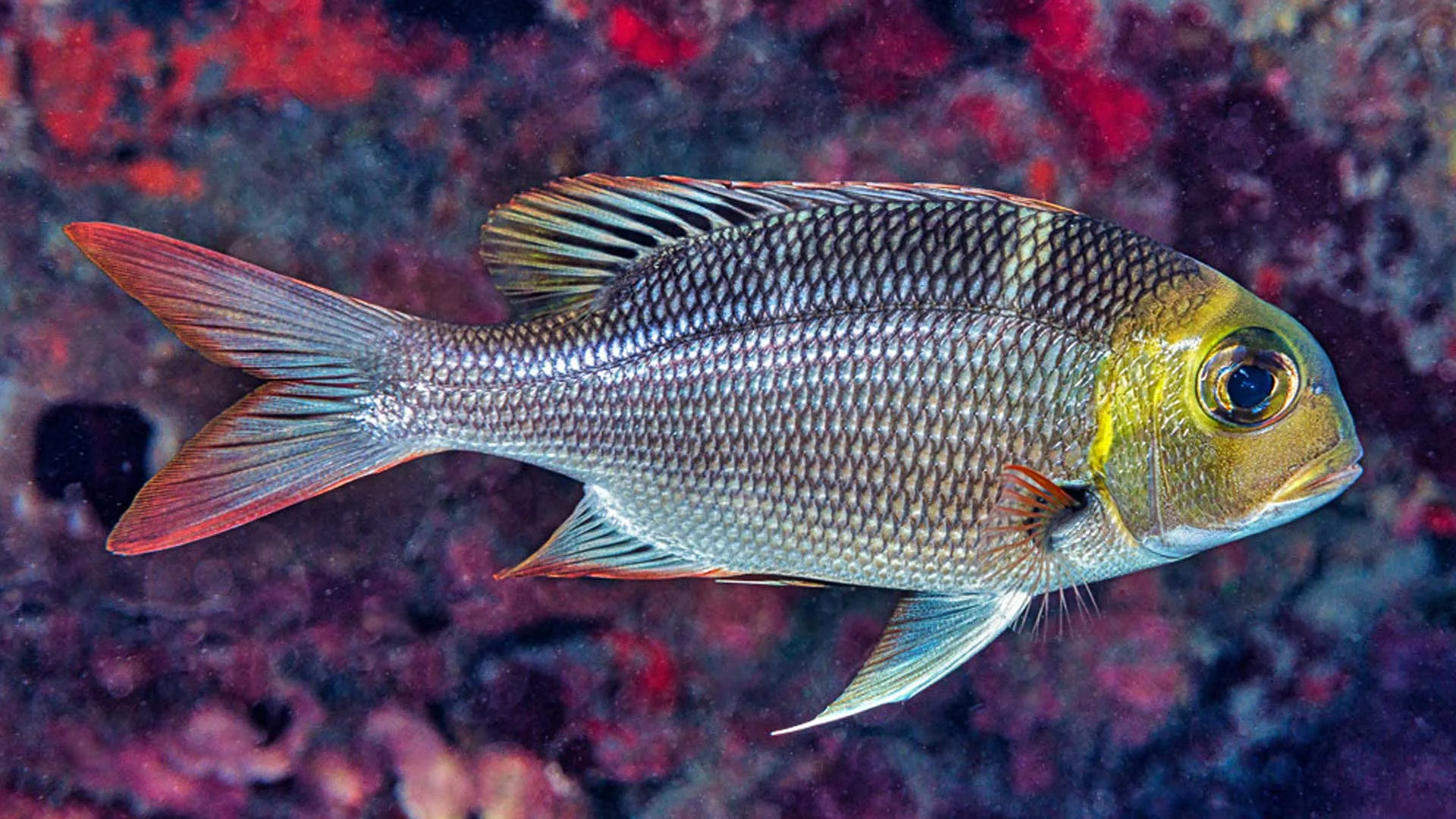
The Humpnose Big-Eye Bream belongs to the family Lethrinidae, a group that includes emperors and big-eye breams. Adults commonly reach about 40 centimeters in length, with the largest individuals growing up to 60 centimeters.
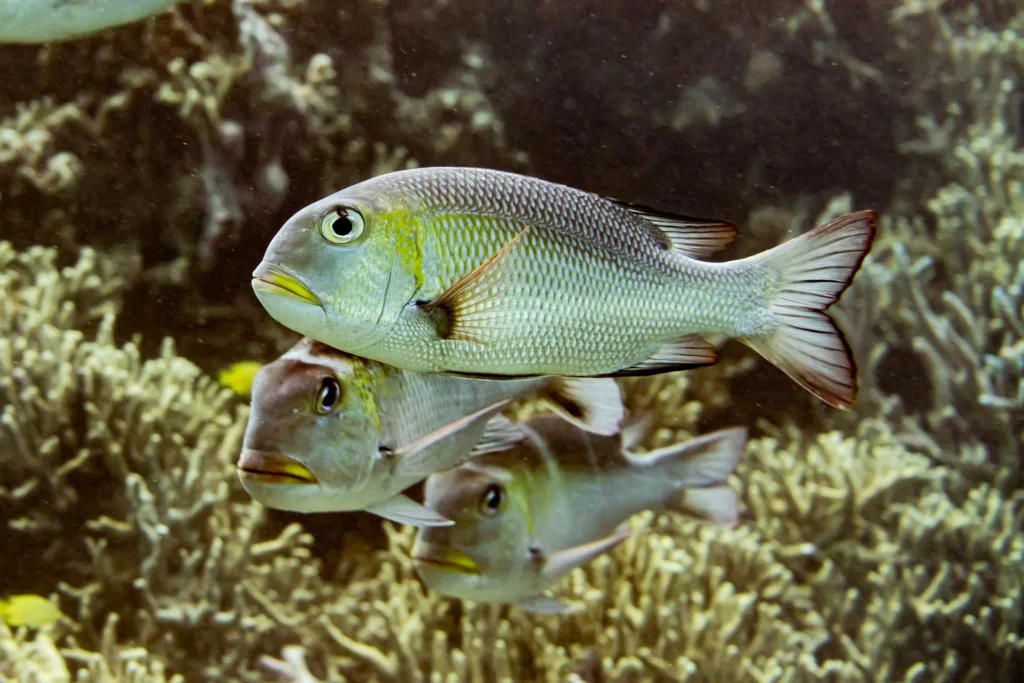
Its most distinctive features are immediately apparent: large, forward-facing eyes adapted for dim conditions and a strongly convex head profile that gives the species its common name. The body is oblong and robust, with cheeks covered in multiple rows of scales and pectoral fins partially scaled at their base.
The fins follow a classic lethrinid pattern—a dorsal fin with ten spines and ten soft rays, an anal fin with three spines and nine rays, and pectoral fins with fourteen rays. Along the jaws, powerful molar-like teeth are set to one side, designed not for tearing flesh, but for crushing hard shells.
Subtle Colours, Changing with Age
Adult Humpnose Big-Eye Breams are typically bluish-grey above, fading to paler tones below. The centers of their scales often reflect light with a silvery sheen, while scattered brownish scales may appear along the sides. In life, individuals can look surprisingly different—some dark and brownish, others pale and almost metallic—depending on habitat and lighting.
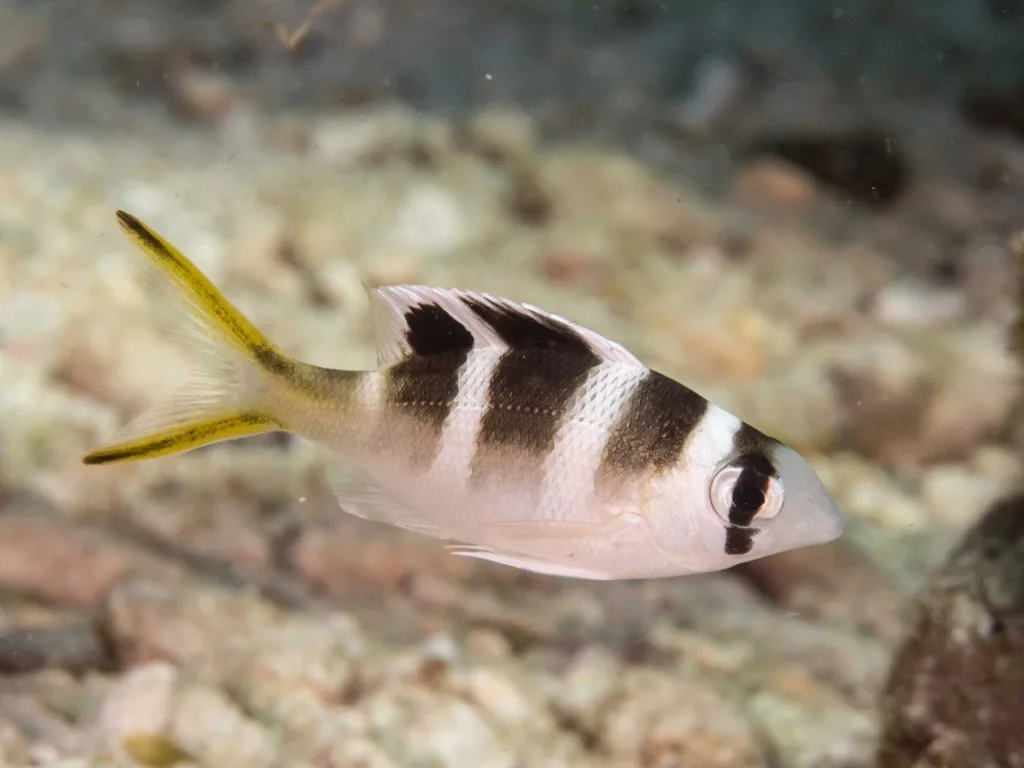
Juveniles are far more striking. Young fish are pale white, marked with three dark saddle-like bands across the back. These bold patterns fade as the fish matures, disappearing entirely in adults.
A Nocturnal Forager
During daylight hours, Dhongu are usually seen resting near coral reefs, sandy slopes, and rubble patches, from shallow waters around 3 meters down to depths of 60 meters. As night falls, they become active hunters.
Their diet is dominated by hard-bodied invertebrates. Using their crushing teeth, they feed heavily on molluscs, crabs, hermit crabs, sea urchins, and other benthic organisms such as brittle stars and polychaete worms. This feeding strategy allows them to exploit food sources that many reef fish cannot access.
Most individuals are solitary, moving slowly across the seafloor under cover of darkness. Larger adults, however, are sometimes observed forming small aggregations, particularly in productive feeding areas.
Wide-Ranging, Yet Unassuming
The Humpnose Big-Eye Bream is widely distributed across the Indo-West Pacific, from the Red Sea and East Africa through the Indian Ocean and into the Pacific. Despite this broad range, it remains relatively uncommon in Maldivian fisheries and is not normally caught by local fishermen, likely due to its nocturnal habits and preference for reef-associated prey rather than baited hooks.
Interestingly, two distinct colour forms of Monotaxis grandoculis have been recorded across its range. This variation has led scientists to speculate that more than one closely related species may be involved—an example of how even familiar reef fish can still hold unanswered taxonomic questions.
A Quiet Role on the Reef
Marine Species
Humpnose Big-eye Bream
| Scientific Name | Dhongu Monotaxis grandoculis |
| ID Marker | Large forward-facing eyes and a strongly convex (humped) head profile. Scales on cheeks and pectoral fin bases. |
| Habitat | Coral reefs, sandy slopes, and rubble patches; found from 3m to depths of 60m. |
| Biology | Nocturnal specialist with powerful molar-like teeth used to crush molluscs, crabs, and sea urchins. |
Though rarely the focus of attention, the Dhongu plays an important ecological role. By preying on invertebrates that graze, burrow, or bore into reef structures, it helps regulate populations that could otherwise damage corals and the surrounding substrate.
For divers who linger near reefs at dusk—or explore sandy patches with a torch after dark—the Humpnose Big-Eye Bream offers a glimpse into the reef’s nocturnal rhythm: a reminder that the reef never truly sleeps, and that much of its life unfolds beyond the reach of sunlight.
Sources & References
- Marine Research Section (M.R.S.) (1997). Fishes of the Maldives. Ministry of Fisheries and Agriculture, Republic of Maldives. 408 pp. ISBN 99915-62-12-5.
- FishBase — Monotaxis grandoculis species summary and biological data.
- Australian Museum — Big-eye seabream (Monotaxis grandoculis) species profile.
- World Register of Marine Species (WoRMS) — Taxonomic status of Monotaxis grandoculis.
- Fearure image: Francois Libert / iNaturalist (CC BY-NC)