A reef fish shaped by order and balance
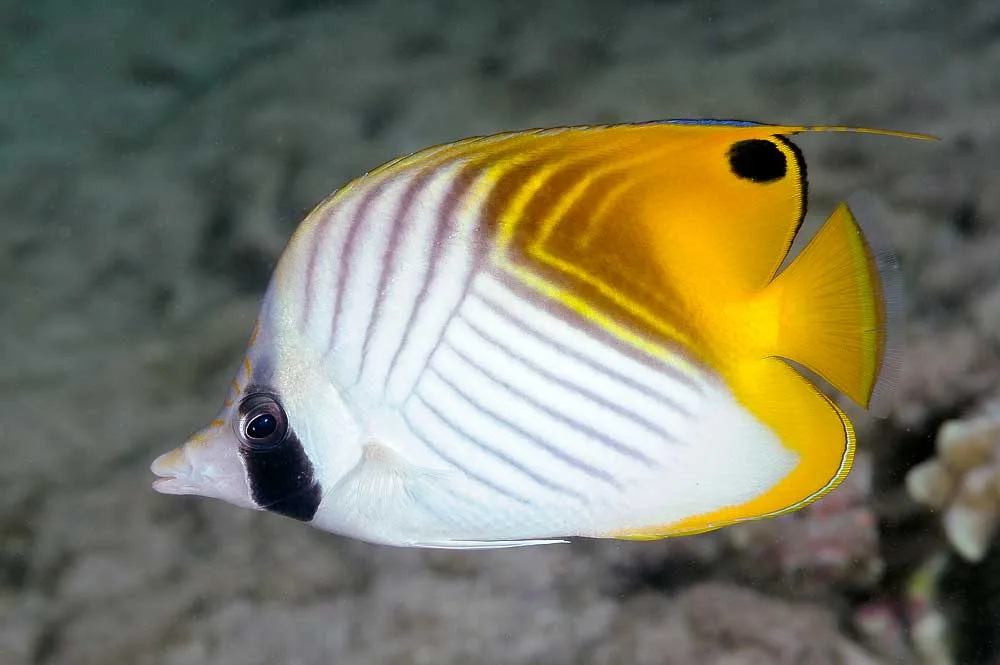
In the clear shallows of the Maldives, where coral branches twist into living labyrinths and sunlight fractures into dancing ribbons, the threadfin butterflyfish moves with unhurried purpose. Known locally as Naruvaa bibee, it is a species so familiar that divers may pass it by—yet so finely detailed that a closer look reveals a masterpiece of natural design.
Rarely growing beyond 20 centimeters, the threadfin butterflyfish carries itself like a living motif of the reef. Its body is pale white, gently washed with yellow toward the tail, crossed by precise grey diagonal lines that meet at sharp angles. A bold black band masks the eye, while a striking black spot on the dorsal fin misdirects would-be predators. In adults, a delicate filament trails from the dorsal fin, fluttering softly in the current like a loose thread—giving the species its name.
Even amid the visual complexity of a coral reef, this fish stands out as a moment of calm structure and symmetry.
A body shaped for life among coral
The form of the threadfin butterflyfish tells the story of its habitat. Its laterally compressed body allows it to slip effortlessly between coral branches, while strong dorsal and anal fins provide stability in shifting currents and wave-driven surges.
With 13 dorsal spines, 23–25 soft rays, and carefully controlled pectoral fins, the species is finely tuned for maneuvering through one of the ocean’s most intricate environments. The elongated filament extending from the dorsal fin of adults adds elegance, but may also serve as a visual signal during social interactions. On the reef, such features are rarely without purpose.
A home shaped by shallow reefs and open slopes
In the Maldives, the threadfin butterflyfish is most commonly encountered on shallow, protected reefs, where coral cover is dense and feeding opportunities are plentiful. It is equally comfortable along outer reef slopes, descending to depths of 30 meters, where currents bring a constant supply of nutrients and life.
Its feeding habits reflect a close dependence on healthy reef systems. By consuming algae, polychaete worms, and coral polyps, the species occupies a delicate position within the reef food web—neither strictly specialized nor entirely opportunistic, but closely tied to living coral environments.
A partnership shaped by synchrony and trust
Unlike schooling reef fish, the threadfin butterflyfish is most often observed in pairs, swimming side by side with striking coordination. These partnerships are believed to be long-lasting and may persist across breeding seasons.
In Maldivian waters, pairs are sometimes seen in the company of other butterflyfish species, moving calmly through shared reef spaces. Their synchronized behavior reflects a quieter rhythm of reef life—one defined not by speed or competition, but by cooperation and stability.
A common fish shaped by coral reefs
The threadfin butterflyfish is among the most frequently recorded butterflyfishes in the Maldives, yet its abundance does not lessen its significance. Instead, it serves as a constant presence in an ocean increasingly shaped by change.
On reefs built slowly over centuries, this familiar fish continues to glide through coral corridors, trailing its filament like a signature. In doing so, it reminds us that even the most common species can embody refinement, resilience, and the quiet wonder of the natural world.
Species snapshot
- English name: Threadfin butterflyfish
- Local name: Naruvaa bibee
- Family: Chaetodontidae
- Maximum size: 20 cm
- Habitat: Shallow reefs to 30 m
- Diet: Algae, polychaete worms, coral polyps
- Distribution: Indo-Pacific
Reference
M.R.S. (1997). Fishes of the Maldives. Marine Research Section, Ministry of Fisheries and Agriculture, Republic of Maldives. 408 pp.