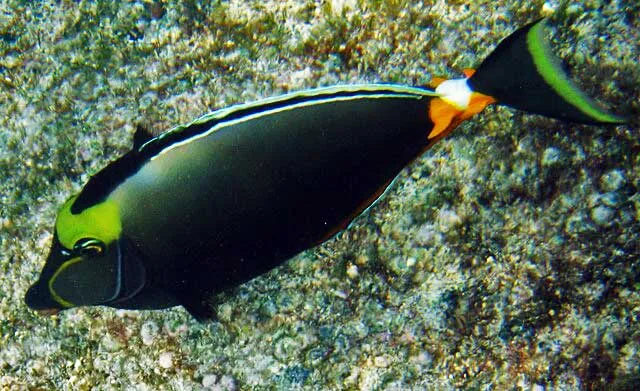
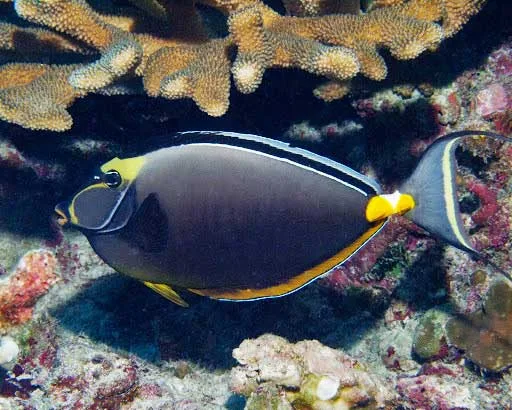
In the neon-lit chaos of a Maldivian coral reef, where every inhabitant competes for attention, the Orange Spine Unicornfish (Naso lituratus) is the undisputed aristocrat. Known locally as the Ran geri, this fish doesn’t just inhabit the reef; it patrols it with an air of tailored elegance. With a charcoal-grey coat, a vivid orange “lipstick” smear at the mouth, and a bold yellow mask, it looks less like a wild animal and more like a high-fashion statement of the deep.
A Weapon Sheathed in Silk
Don’t let the sophisticated palette fool you. The “unicorn” in its name is a bit of a misnomer for this specific species; unlike many of its cousins, Naso lituratus foregoes the namesake horn for a smooth, streamlined profile designed to slice through the powerful Indian Ocean currents.
But beauty in the coral city often carries a hidden edge. On the slender base of its tail lie two pairs of bright orange “scalpels”—razor-sharp, movable keels that can be erected with startling speed. These defensive blades, characteristic of all surgeonfishes, serve as a vivid warning to predators: in this world, elegance is always paired with armor.
The Reef’s Silent Gardener
Beyond its striking appearance, the Ran geri serves a critical civic duty. As a dedicated herbivore, it is a tireless gardener. Its refined palate focuses on benthic algae—the soft, filamentous growth that, if left unchecked, would quickly smother the slow-growing corals and choke the vitality out of the reef.
From the sun-drenched reef flats to the outer slopes plunging 30 meters into the blue, these fish are the line of defense. Usually found in pairs, they graze with a rhythmic focus, ensuring the intricate coral structures have the space and light they need to thrive. They are the silent architects of the very landscapes that make the Maldives a global wonder.
A Life in the Current
The life of a unicornfish is a journey of tides. Their sturdy, laterally compressed bodies—reaching lengths of 45 centimeters—are built for the rush of the open sea. While their microscopic larvae drift across the vast ocean, the adults find their home in the clear, high-energy environments of the atolls.
As they mature, their coloration deepens, and the orange of their caudal spines becomes more vivid—a badge of survival in one of the most competitive ecosystems on Earth. They remain a vivid reminder that the health of the Maldives is held in a delicate balance, maintained by the constant, hungry presence of its most beautiful residents.
Species at a Glance
- Local Name: Ran geri
- The Look: Smart grey-and-orange coloration with a yellow snout-band.
- The Gear: 6 dorsal spines and two pairs of “scalpels” at the tail.
- The Mission: Protecting coral by grazing on invasive algae.
Sources & Further Reading
Allen, G.R., Steene, R., Humann, P. & DeLoach, N. (2015). Reef Fish Identification: Tropical Pacific. New World Publications. (A global standard for identifying surgeonfishes and their behaviors).
Froese, R. & Pauly, D. (Eds.). (2025). FishBase: Naso lituratus species account. World Wide Web electronic publication. www.fishbase.org. (The primary source for technical data, including fin ray counts and distribution).
Kuiter, R.H. & Godfrey, T.J. (2014). Fishes of the Maldives: Indian Ocean. 3rd Edition. Atoll Editions. (The definitive modern photo guide for Maldivian marine life).
M.R.S. (1997). Fishes of the Maldives. Marine Research Section, Ministry of Fisheries and Agriculture, Republic of Maldives. 408 pp. ISBN 99915-62-12-5. (The foundational regional catalog published by the Maldivian government).
McIlwain, J., Choat, J.H., Abesamis, R., et al. (2012). Naso lituratus: The IUCN Red List of Threatened Species. (Source for current conservation status and global population trends).
Randall, J.E. (2001). Surgeonfishes of Hawai’i and the World. Mutual Publishing and Bishop Museum Press. (Comprehensive scientific background on the Acanthuridae family and the Naso genus).