Creatures of Omen and Myth
Since ancient times, humans have viewed fish primarily as a source of food. Yet some species—particularly those that appeared eerie, oversized, or unfamiliar—were regarded with fear and suspicion. Eels and other “strange” fish, especially those with unusual shapes, extreme sizes, sharp or irregular teeth, or striking colors, were often seen as bad omens or ominous signs. Sharks, eels, whales, stonefish, and other formidable marine creatures frequently fell into this category.
The Many Eels of the Maldives
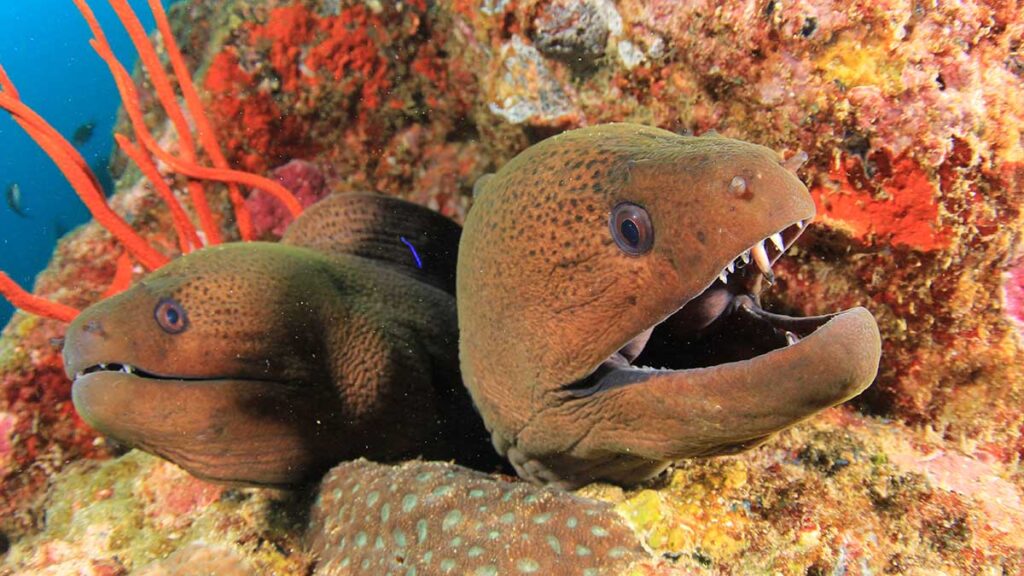
Among marine life, eels have long carried an aura of mystery. They may appear frightening at first glance, but they are also among the most fascinating creatures of the sea. Of all the marine species I have encountered, eels—especially moray eels—stand out. Around 40 species of moray eels have been recorded in the Maldives. These include moray eels, spaghetti eels, honeycomb moray eels, ribbon eels, and white-mouth moray eels, all commonly seen in Maldivian waters.
A Predator with a Hidden Gentle Side
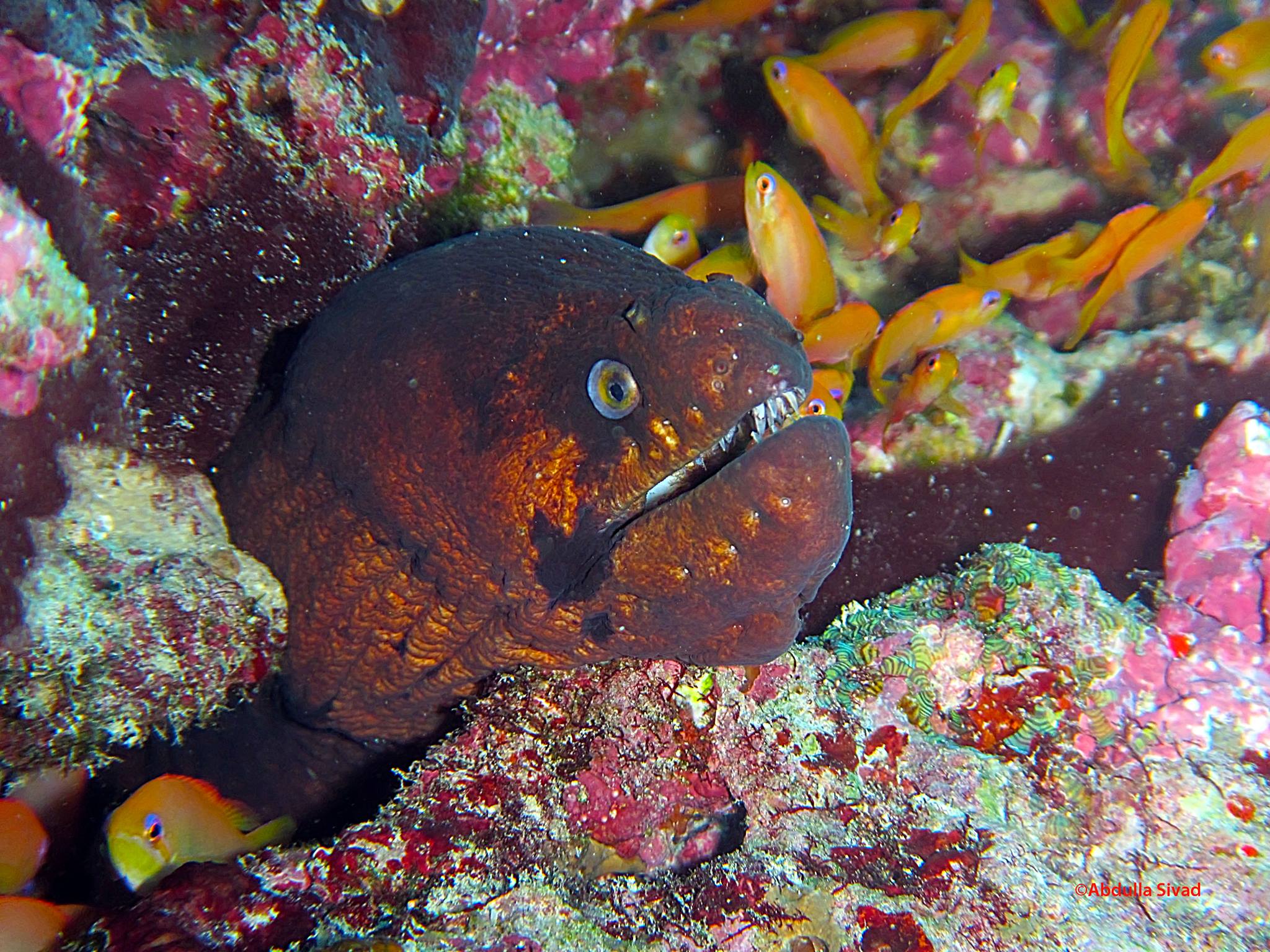
With mouths full of razor-sharp teeth and disproportionately large heads, moray eels are among the most striking predators on the reef. These carnivores can grow to weigh as much as 30 kilograms. Using their powerful, muscular bodies, they overpower prey and tear flesh from fish, squid, cuttlefish, and octopus. Their blunt teeth are well suited for crushing crustaceans.
Despite their fearsome appearance, moray eels also participate in one of the reef’s most remarkable partnerships. Wrasse and shrimp approach them freely, entering their mouths and gill cavities to remove parasites and food particles. These cleaners—often described as holding a “free visa”—move unharmed through a predator’s most dangerous territory.
Humans, Eels, and Ancient Practices
Human fascination with eels stretches far back in history. The Romans deliberately selected eels and kept them in ponds to ensure a constant supply of fresh fish (Hill, 2023). This reflects a broader cultural pattern in which animals perceived as ominous—such as crows, eagles, and owls—were both feared and tamed.
In the Maldives, herons were kept at households to guard against intruders. Certain fish were also kept in freshwater wells or ponds. Silvery fish (bang) and barred flagtail (kattafulhi) were favored because they could survive in both saltwater and freshwater environments.
A Spearfisher and His Unlikely Companion
My father—known as Saliheybey—was a skilled spearfisher. His close friend Hussainbeybe once recounted a story from their days spearfishing in the herahafarogano, the reef-front area of Fuvahmulah. During one dive, my father encountered a giant moray eel living deep within a cave.
Instead of avoiding it, he began feeding the eel with small fish he caught. Over time, the eel became remarkably tame. When Saliheybey approached the crevices, the eel would emerge from its shelter and wait. Small fish were pinned to the tip of the iron spear and gently extended toward the eel, which seized the offering without hesitation. Fed daily, the eel became a familiar presence—almost a companion beneath the reef.
Misunderstood Guardians of the Reef
When a moray eel opens its mouth, it may appear threatening, but this behavior is simply how it breathes. Slender and toothy, these elusive, snake-like creatures captivate divers and snorkelers alike. Found throughout the Maldives, moray eels are an integral part of reef ecosystems.
Shy by nature yet endlessly compelling, moray eels have occupied a space between fear and fascination for centuries—misunderstood predators that quietly hold their place in the balance of the sea.